

How to Grow Peppers in Containers: One Plant, One Pot, the Right Size
One pepper, one pot, one sunny spot. That is the whole plan, and the pot size is the decision that matters most. A pepper in a pot that is too small does not just grow slowly. It dries out by dinner, drops its flowers in heat, and never builds the plant that carries fruit.
This guide is for a pepper grown outside, on a patio, balcony, or sunny doorstep. It is also a December guide, not a planting guide. Peppers are a spring crop. You plan the pot and the variety now, start seeds indoors 8 to 10 weeks before your last frost, and move the plant out only after frost danger has passed and nights stay mild. Nothing in this guide asks you to plant a pepper in November.
If you grow peppers inside under lights, that is a different guide. Our guide to growing peppers indoors covers heat, light hours, hand pollination, and carrying a plant through winter. This one covers real sun, wind, rain, and a transplant that goes outside for the season.
Pick the Pot by the Variety, Not by the Shelf
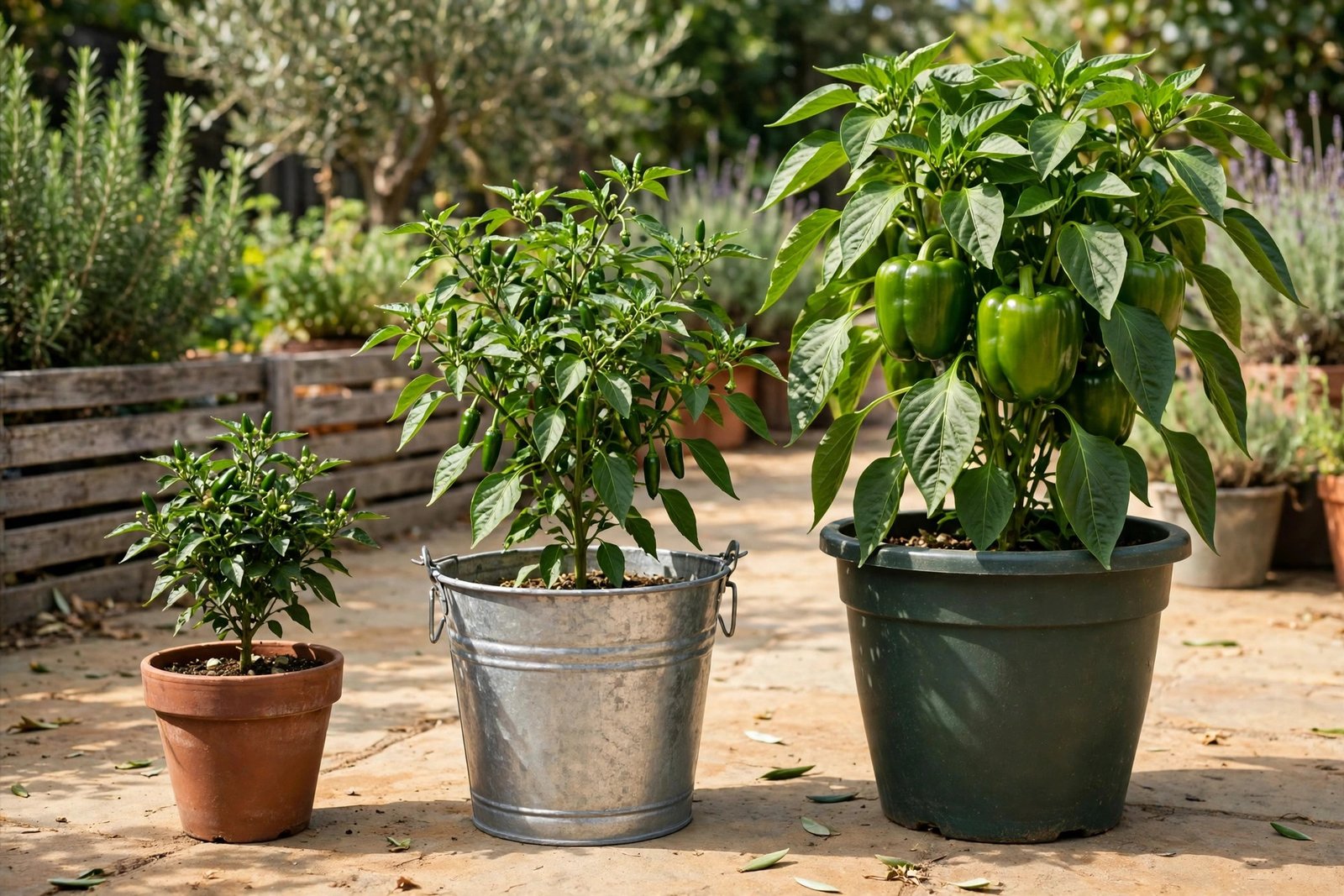
Most guides give one pot size for every pepper. That is the mistake this guide fixes. A compact ornamental and a full-size bell are different plants with different root systems, and they do not want the same pot. The table below is the plan. Read it before you buy anything.
| Variety group | Pot size | Depth | Plants per pot | Why this size |
|---|---|---|---|---|
| Compact ornamental or small hot (NuMex Twilight, Chilly Chili, Medusa) | 3 to 5 gallons, prefer 5 | At least 12 inches | 1 | Small root zone, but a 3-gallon pot dries fast in heat |
| Mini sweet and mild (mini bell, Gypsy, Mariachi, Sweet Banana) | 5 gallons | At least 12 inches | 1 | Stocky plants that fill the pot and fruit steadily |
| Everyday hot (Early Jalapeno, serrano, cayenne, Thai, shishito) | 5 gallons | At least 12 inches | 1 | Upright plants with a heavy pod load need the full buffer |
| Full-size bell and large sweet | 5 to 7 gallons, 7 to 10 in hot or windy spots | At least 12 inches | 1 | Big canopy and heavy fruit need the extra volume |
| Poblano and large roasting | 5 to 10 gallons | At least 12 inches | 1 | Large canopy, long season, high fruit load |
| Vigorous long-season hot (habanero, Scotch bonnet) | 7 to 10 gallons | At least 12 inches | 1 | Long season and a big plant need the buffer most |
The floor is 5 gallons for most peppers. The University of Wisconsin Extension container vegetable guide puts larger vegetables like peppers at a 5-gallon minimum with 12 to 18 inches of depth, and Maryland Extension and Colorado State University Extension agree on the 5-gallon floor. Alabama Cooperative Extension lists one plant per 5- to 7-gallon container. A 3-gallon pot only suits a compact or ornamental type, and it dries fast enough that you will check it daily in summer.
One plant per pot is the rule in the 3- to 10-gallon range. Two plants in one 5-gallon pot do not give twice the harvest. They share the same water, food, and root room, and you end up with two thin plants instead of one strong one. A wide trough can hold more than one plant, but only if each plant still gets its full volume and 12 to 18 inches of spacing.
Check the pot itself before you buy it. It needs open drainage holes, and it needs to be at least 12 inches deep. A wide base beats a tall narrow pot, because a fruit-heavy plant in a narrow pot leans in wind. Do not put stones or gravel in the bottom to help drainage. Wisconsin Extension and Maryland Extension both say a layer at the bottom impedes drainage instead of improving it. Fill the pot with mix from top to bottom, and use a porous potting mix rather than garden soil. Our soil mix guide for vegetables in pots covers the recipe, so this guide does not repeat it.
One more number to know: Colorado State lists 2 to 5 gallons for peppers in an older table. The current container guides agree on the 5-gallon floor, and the smaller figure is a minimum that only works with a compact variety and constant attention. Buy the 5-gallon pot first and size up from there.
Pick a Variety by What You Cook
Choose the pepper you actually want to eat, then match the pot to the plant. A compact variety in a 5-gallon pot will outproduce a full-size bell squeezed into a small one. The plant label tells you what you need: mature height, days to maturity, and words like compact, patio, dwarf, or container.

Mild and sweet
Gypsy stays under 24 inches and sets fruit through summer. Mariachi was bred for containers and tops out around 18 inches, with fruit that ripens from pale yellow to orange red. Mini bell types like Snackabelle stay stocky and reach about 18 inches. Sweet Banana grows 14 to 20 inches. Fushimi is a compact Japanese heirloom with thin-walled pods for stir-frying. All of these sit comfortably in a 5-gallon pot.
Everyday hot
Early Jalapeno is the reliable cooking pepper, and the plant stays under 2 feet in a pot. Serrano grows 18 to 24 inches and runs more compact than jalapeno. Cayenne types like Cayennetta and Red Ember grow 14 to 18 inches on upright plants, so stake them early or they topple under a heavy pod load. Shishito is compact and prolific, with thin-walled pods that roast in minutes, and about one pod in ten runs noticeably hotter than the rest. Thai chiles stay under 20 inches in small upright plants that tolerate patio heat well.
Small hot and prolific
Habanero plants stay compact, usually under 30 inches, but they need a long warm season and a 7-gallon pot to do their best work. Scotch bonnet behaves the same way. These are the peppers to choose when you want heat and volume from one pot, and they are the ones that punish a small pot fastest.
Ornamental, and still edible
NuMex Twilight tops out at 18 inches and does well in a 3-gallon pot, with pods that ripen through purple, yellow, and orange to red on the same plant. Chilly Chili is a no-heat ornamental on a 10- to 12-inch bush, safe for a family patio. Medusa stays 8 to 12 inches with upright pods that shift from ivory to red. The pods are edible, but most growers plant these for the display first.
Eggplant is the closest outdoor sibling to a container pepper. If you want a second heat-loving pot crop, our guide to growing eggplant in containers covers the same outdoor setup with a taller plant and heavier staking.
Sun and Spot: Six to Eight Hours, Then Manage the Heat
Peppers need real sun. The University of Maryland Extension container vegetable guide puts warm-season crops at 6 to 8 hours of direct sun, and Alabama Cooperative Extension and Illinois Extension agree. A south- or west-facing patio or balcony usually provides it. Watch the space through a sunny day rather than guessing from the direction it faces, because a railing or a wall can steal hours you thought you had.
One difference to know. Most extension guides say 6 to 8 hours, while Colorado State University Extension sets 8 hours as the bar for fruiting vegetables. Treat 6 hours as the floor and 8 as the target for heavy fruiting. A plant with only 6 hours will grow, but it will flower less and ripen fruit more slowly.
Full sun does not mean ignoring heat. Oregon State notes that peppers can suffer sunscald in intense late-afternoon sun, so morning sun with relief in the late afternoon protects the fruit. A dark pot makes it worse. Dark plastic holds excess heat around the roots, so a light-colored pot, a fabric pot, or a sleeve that shades the pot itself is the safer pick on a hot patio. On paving, raise the pot slightly off the surface so reflected heat does not bake the roots.
Wind is the other outdoor factor. A tall pepper in a light plastic pot can dry out and tip before the soil feels dry. Put the pot against a stable wall with airflow, use a wide heavy base, and add support before the branches carry fruit. If your space gets only a few hours of direct sun, a pepper is the wrong crop for it. The light tiers in our indoor vegetable growing guide will help you pick a crop that matches the light you actually have.
Transplant Timing: Start Inside, Move Out When Nights Stay Warm
Peppers grow slowly from seed, so start indoors 8 to 10 weeks before your last frost. That is the window our guide to starting seeds indoors uses for peppers, and it owns the frost-date method and the full timing chart, so this guide does not rebuild either one. Alabama Cooperative Extension lists 6 to 8 weeks before planting time, which fits a warm climate with a long season. The 8- to 10-week start is the safer pick where the season is short.

Harden the plant off for about a week before it moves out for good. Give it a little more outdoor sun and wind each day, and bring it back in if nights turn cold or the plant wilts hard. Move it into its final pot only after frost danger has passed and nights stay mild. Minnesota Extension puts the line at nighttime lows above 50 degrees F, and says to protect plants when nights fall below 55 degrees F.
Set the transplant at the same soil level it had in its nursery pot. Do not bury the stem deeply the way you would a tomato. Water the root ball before you move it, disturb the roots as little as you can, firm the mix gently, and water until a little drains from the holes. Keep the new transplant out of extreme wind for a few days, and put the stake in now rather than pushing one through a crowded root ball later.
Water and Feed in a Pot
A pot dries faster than a garden bed, and a pepper pot dries faster than most pots. Check the mix before you water. Push a finger about 2 inches down. If the top layer feels dry, water deeply until a little runs from the drainage holes. If it feels moist, wait. A fixed every-other-day schedule cannot account for rain, pot size, pot material, plant size, and weather, so the finger test is the schedule.
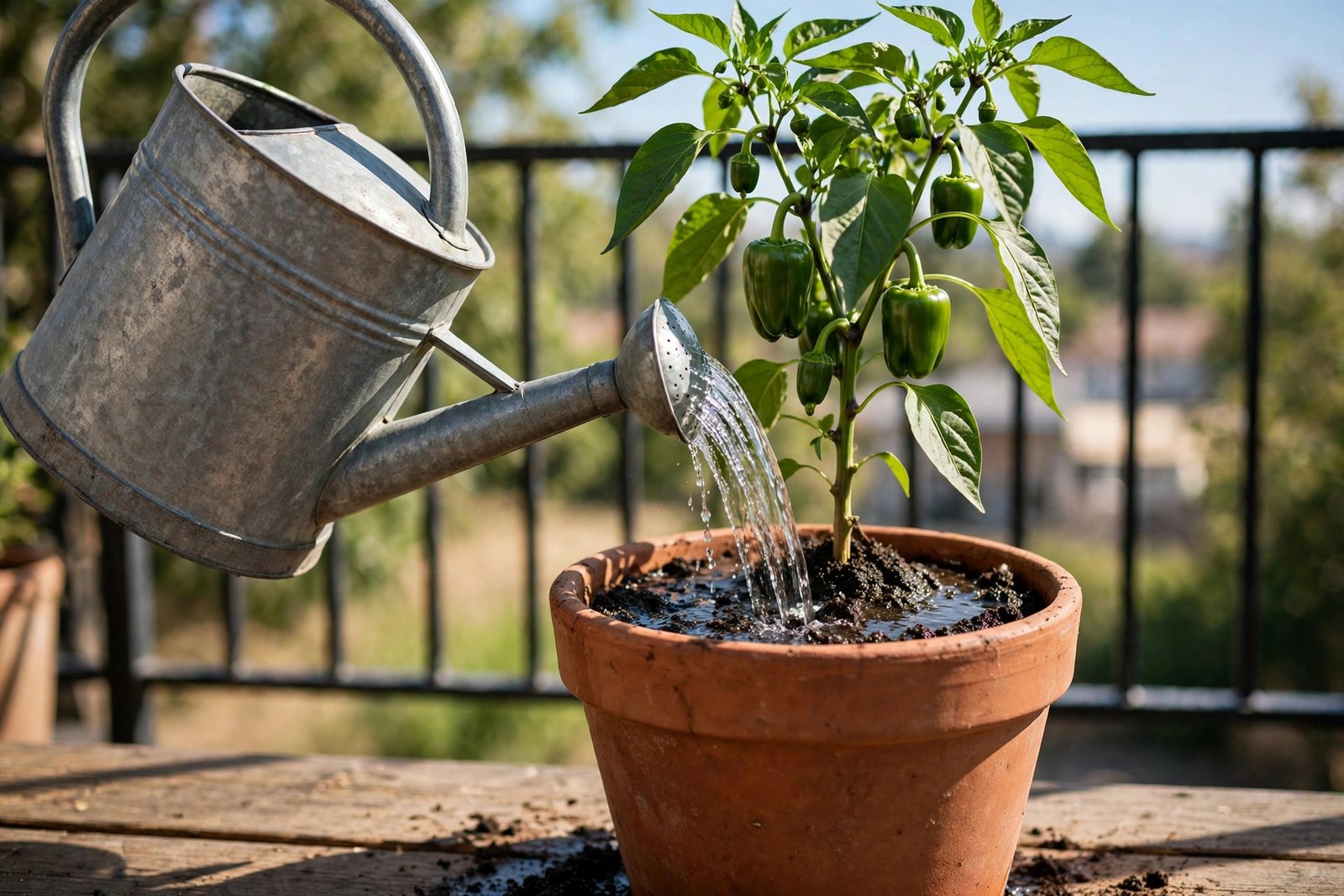
Expect to check daily once the plant is big and carrying fruit. Wisconsin Extension notes that fruiting vegetables in containers may need daily watering as heat and plant size increase, and Colorado State points out that even plastic pots can need daily or twice-daily attention in extreme conditions. North Carolina A&T puts peppers at about 1 inch of water a week, but a container loses moisture far faster than the ground, so treat that figure as a floor and let the finger test decide. Water at the base, not over the leaves, and empty the saucer after watering so the roots never sit in drained water.
Feeding works the same way: steady and by the label, not by the calendar. Most bagged mixes carry a starter fertilizer charge that lasts about two weeks. After that, North Carolina A&T recommends weekly feeding with a balanced water-soluble fertilizer, a 1-1-1 ratio such as 20-20-20, until flowering begins. Once flowers appear, switch to a lower-nitrogen, higher-potassium blend to support fruit instead of leaves. Our fertilizer guide for container vegetables covers the full routine, so this guide does not re-teach rates. Follow the product label, and do not fix a weak plant by adding more fertilizer until you have checked light, roots, and moisture first.
Support and Harvest
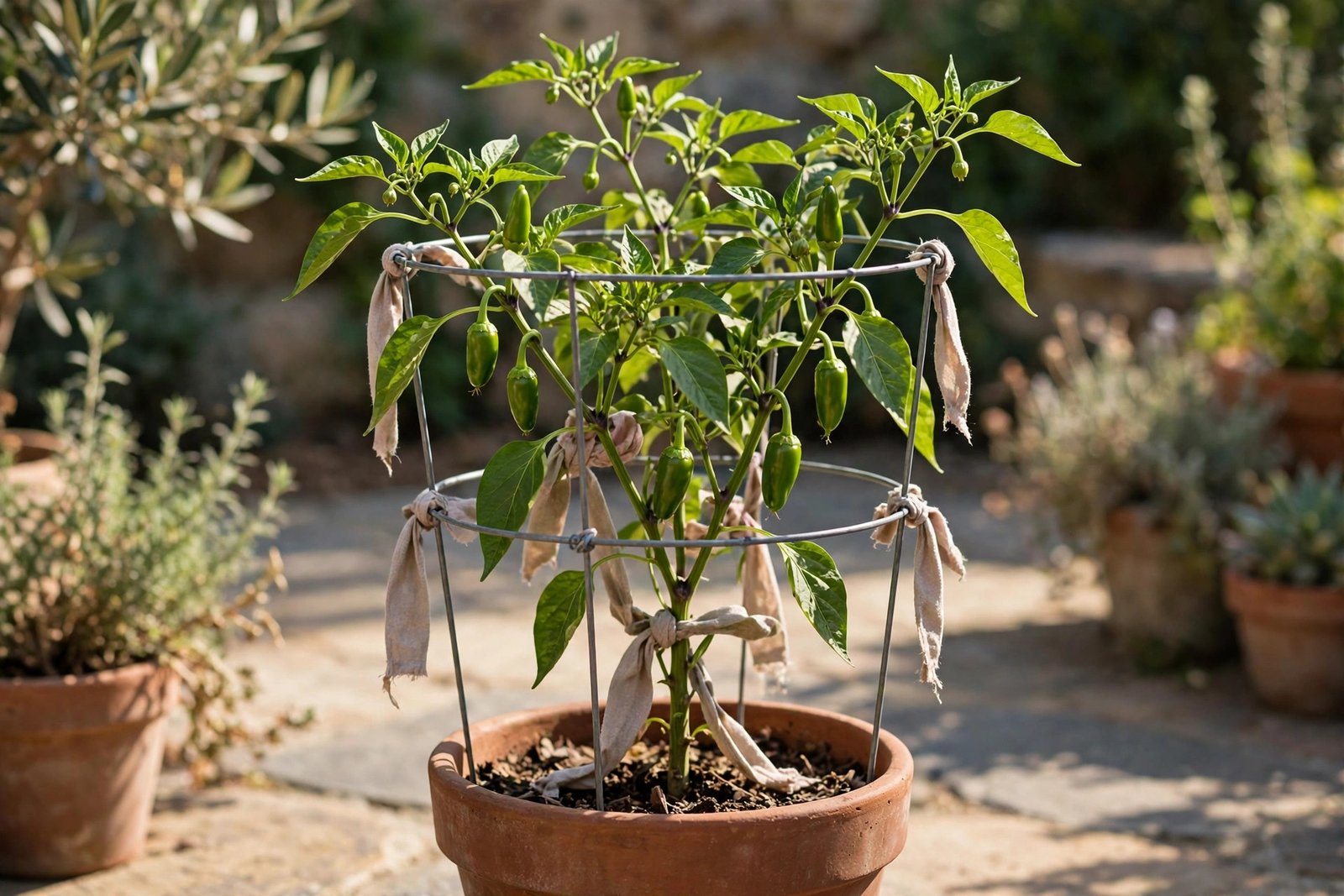
A compact pepper in a sheltered spot may stand on its own. Most peppers do better with a short stake or a compact cage installed early, while the plant is small. Tall plants, brittle branches, wind, and heavy fruit are the reasons. Tie stems loosely with soft material and leave room for the stem to thicken. A rigid tie cinched around a growing stem will cut into it.
Harvest with clean scissors or pruners, and cut the stem. Do not pull or twist, because mature pepper branches are brittle and a pulled fruit can break the branch with it. Sweet peppers are ready at full size. Let them reach full color for the best flavor, or pick them green if you do not want to wait. Hot peppers can be picked green or left to ripen, and riper fruit is usually spicier. Oregon State notes that peppers take at least 45 to 55 days to produce harvestable fruit after pollination, and 15 to 20 days longer where nights run cool, so a flower you see in June is a pepper you eat in August. Wear gloves when you handle very hot chiles, and wash your hands and tools after.

What Goes Wrong Outdoors
Flowers drop without setting fruit. Heat is the usual cause. Maryland Extension reports that pepper flowers and small fruit can drop when nights fall below 60 degrees F or above 75 degrees F, or when daytime temperatures pass 95 degrees F. Illinois Extension cites a study that found flower set suffers above 91 degrees F. Cold nights, dry roots, saturation, and low light can do the same. Stabilize the moisture, wait for suitable temperatures, and let the next flush of flowers tell you whether the plant recovered.
The nitrogen question, answered honestly. The usual advice blames extra nitrogen when a healthy plant grows leaves and no fruit. Illinois Extension notes that university research does not back that as the cause of missing fruit, and points to heat and pollination instead. If your plant is leafy and fruitless, check temperatures and airflow first, and do not cut the feed before you know the plant is actually overfed.
Blossom-end rot. A dark sunken patch at the blossom end of the fruit comes from uneven watering and disrupted calcium delivery. Restore consistent moisture first, and do not add calcium blindly to every affected pot. The fix is steadier water, not a supplement.
The pot dries out in wind. A small pot on an exposed balcony can dry in a day. Size up if the variety and the season allow, water in two passes a few minutes apart so the mix can re-wet, and add a thin mulch layer on the surface. Daily surface splashing is not a fix. A larger pot is.
Sunscald. Pale or bleached patches on the fruit follow intense exposure or a loss of leaf cover. Keep healthy foliage on the plant, and give the pot temporary late-afternoon relief during a heat wave. The fruit is not necessarily diseased.
Poor fruit set on a sheltered balcony. Outdoor peppers usually pollinate without hand work, because wind and insects move the pollen. A sheltered balcony may have too little air movement, so gently tap the cage or shake the plant once flowers are open if fruit set is poor and the plant otherwise looks healthy. Planting flowers that attract pollinators near the patio helps too, and Illinois Extension notes that bee-pollinated plants set larger and more abundant fruit.
Frequently Asked Questions
What size pot does a pepper plant need?
Five gallons is the practical minimum for one pepper plant, and the pot should be at least 12 inches deep. A compact or ornamental type can manage in 3 to 5 gallons, but a 3-gallon pot dries fast and needs daily checks in summer. A full-size bell, a poblano, or a vigorous long-season hot pepper does better in 7 to 10 gallons.
Can I put two pepper plants in one pot?
No, not in a 5-gallon pot. One plant per pot is the rule in the 3- to 10-gallon range, because two plants share the same water, food, and root room and both end up weaker. A wide trough can hold more than one plant, but only if each plant still gets its full volume and 12 to 18 inches of spacing.
Can I grow full-size bell peppers in a container?
Yes, but they are the hardest peppers to grow in a pot. Give a full-size bell 7 to 10 gallons in a hot or windy spot, pick a compact bell variety, and stake it early. A small-fruited or mini bell is the easier pick if your season is short or your balcony is windy.
I already grow peppers indoors. Is this the same guide?
No. The indoor guide covers growing a pepper under lights, hand pollination, and carrying a plant through winter. This guide covers a pepper outside on a patio or balcony, with real sun, wind, and rain, and a transplant that goes out after frost danger has passed. Read the one that matches where your plant actually lives.
Sources and Further Reading
University of Wisconsin-Madison Division of Extension, Growing Vegetables in Containers
University of Maryland Extension, Growing Vegetables in Containers and Salad Tables
Colorado State University Extension, Container Gardens
North Carolina A&T State University Cooperative Extension, Growing Fruiting Vegetables in Containers: Tomato, Pepper and Eggplant
Oregon State University Extension Service, Grow Your Own Peppers (EC-1227)
Alabama Cooperative Extension System, Grow More Peppers (Sweet and Hot)
University of Illinois Extension, The Garden Scoop: Pepper Production Problems
Yardless Harvest, Growing Peppers in Pots: Size, Soil and Support
GrowDwell, Growing Peppers in Containers: From Pot to Harvest
LeafyPixels, Growing Peppers in Pots: 15 Steps for More Fruit
GardenWatering, 7 Steps to Grow More Peppers in Containers
Edible Grove, Growing Peppers in Containers
KnowThePepper, Best Peppers for Containers: 10 Strong Picks for Cooking
Gardenia, Best Peppers for Small Spaces and Containers
2 Comments