
How to Start Seeds Indoors

Every indoor seed starting schedule hangs on one date: the last frost date for your town. Find that date, count back the number of weeks your crop needs indoors, and you have your sowing day. Everything else in this guide is technique. The date is the plan.
Below is the whole method in the order the season runs it: one anchor date, one summary chart for the crops most home gardeners start, and six steps from clean cells to a hardened off transplant. Where the two best sources disagree on timing, both figures are printed side by side. Nothing has been averaged into a tidier number than the sources gave. This is how to start seeds indoors when the goal is transplants that are ready the week the weather is.
Start With One Date: Your Last Frost
Your last frost date is the average date of the final spring frost where you live. It is a local figure, worked out for your county or ZIP code, and it is not your USDA hardiness zone. The zone describes how cold winters get. The frost date describes when spring frosts end. Two towns in one zone can sit weeks apart, and seed starting runs on the second figure.
Two reliable places give you the date. The Old Farmer’s Almanac runs a frost date calculator by ZIP code, built from the nearest official weather station, and your local Cooperative Extension office publishes the same figure for your county. Once you hold the date, the seed packet takes over: most packets print their own instruction in the same language, along the lines of start indoors 8 to 10 weeks before the last frost.
Treat the date as an anchor, not a promise. The Almanac builds its dates on a 30 percent probability threshold, so a frost still lands after the listed date in about three springs out of ten. Seeds ignore the calendar anyway: as the Almanac puts it, they sprout based on soil temperature, not the date on the wall. A cold spring is a fair reason to hold tender crops back a week, whatever the chart says.
The Summary Chart: Weeks Before the Last Frost
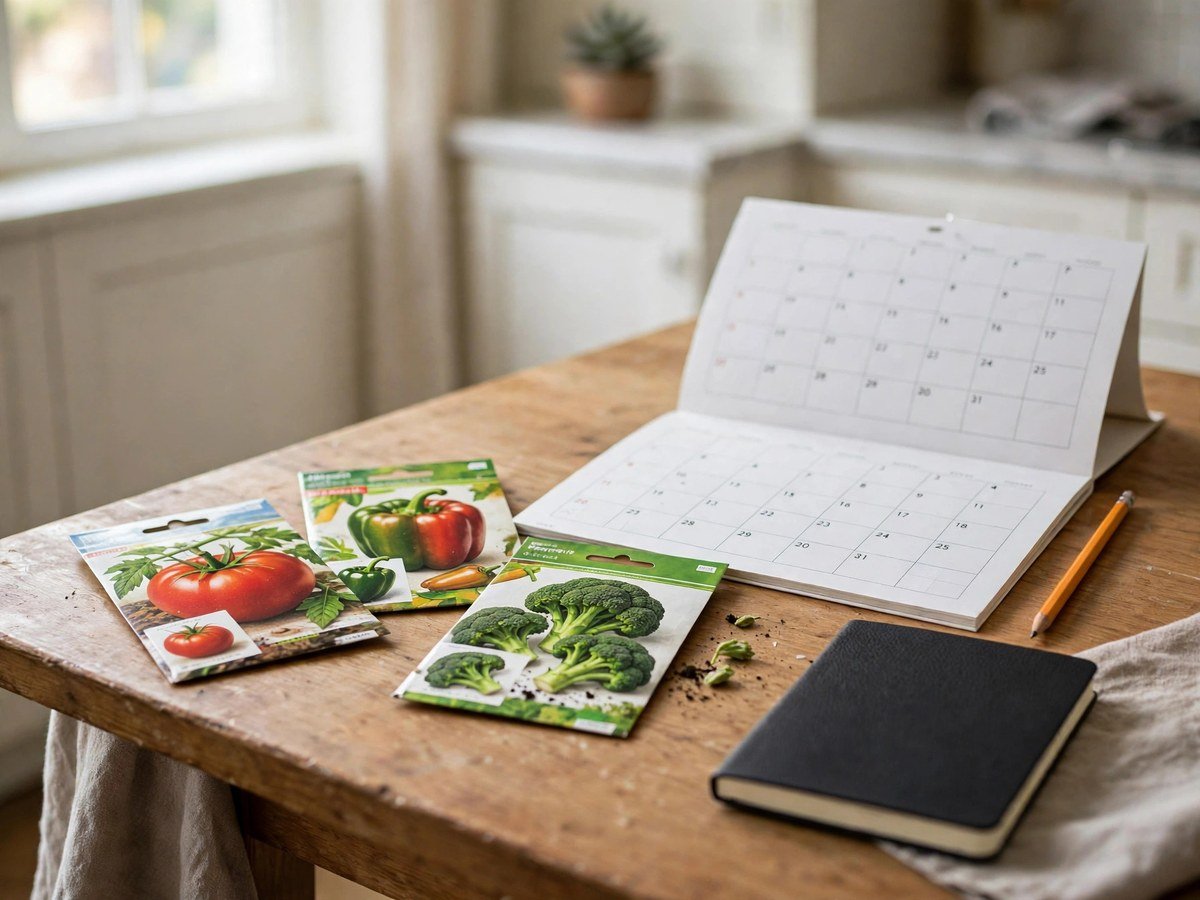
The chart below is a summary, built for planning a spring of indoor sowing at a glance. The anchor column is the University of Maryland Extension’s chart, the most recent extension version, updated in August 2026. The second column is the Old Farmer’s Almanac range for the same crop, printed wherever it differs. The two sources were not blended. Where they agree, the cell says so. One condition sits behind every row: Maryland puts the germination temperature for most vegetable seeds at a mix temperature of 65 to 75°F, so warm mix is assumed. Cold mix stretches every figure in the chart.
| Crop | Start indoors, weeks before last frost (Maryland Extension) | The Almanac’s range |
|---|---|---|
| Peppers | 8 to 10 | 8 |
| Eggplant | 8 to 10 | 8 to 10 (the same) |
| Onions | 8 to 10 | Listed as direct sow only* |
| Tomatoes | 5 to 6 | 6 to 8 |
| Broccoli | 4 to 6 | 4 to 6 (the same) |
| Cabbage | 4 to 6 | 4 to 6 (the same) |
| Cauliflower | 4 to 6 | 4 to 6 (the same) |
| Cucumbers | 3 to 5 | 3 to 4 |
| Squash | 3 to 5 | Direct sow only* |
| Melons | 3 to 5 | Direct sow only* |
| Lettuce and other leafy greens | 2 to 4 | Lettuce 4 to 5 |
| Spinach | Skip the tray. Sow it in its final pot | Direct sow only |
* The Almanac’s chart lists onions, squash and melons as direct sow crops and gives them no indoor weeks. Maryland starts all three indoors. Both routes grow the crop; the indoor start buys growing time where the season is short, and the cucurbit family asks for gentle handling at transplanting because its roots dislike disturbance.
Peppers and eggplant carry the longest indoor run, so they are the first sowings of the year. Eggplant then grows on happily in a pot, as our guide to growing eggplant in containers shows. Lettuce sits at the fast end; our guide to growing lettuce indoors takes that quick crop through to the cut.
Basil is missing from the chart, and the gap is honest. Neither anchor source lists it, so no figure has been borrowed from a third chart to fill the row. Basil belongs with the warm season crops started inside, and the Almanac counts it among the crops planned around frost dates. Let the packet set its weeks, counted back from the same date, and give the tray your warmest spot.
The working rule: one date, counted back honestly, beats a perfect guess. If the two columns disagree for your crop, the gap is a week or two of transplant size, not a right answer and a wrong one. Sow on time from either column; the plants will never know the difference.
The Six Steps
With the dates set, the work itself is six steps, always in the same order.
Step 1: Count back and write it down
Take each crop’s weeks from the chart, count back from your frost date, and write the sowing date on the packet or the calendar. Memory is not a system, and six crops at four dates will defeat it by March. Sow the slow crops first: peppers, eggplant and onions go in weeks before the fast cucumbers and squash, and the trays stagger themselves once the dates are down.
Step 2: Clean containers and fresh seed mix
Almost any clean container works if it drains and is at least 2 inches deep: cell trays, small pots, washed food containers. Reused trays need a wash first. A 10 percent bleach solution is the standard sanitation step for a second season, because the fungi behind damping off survive on dirty plastic. Fill the cells with soilless seed starting mix, never garden soil, and moisten it before sowing until it feels like a wrung out sponge. Dry mix, peat based mix above all, shrinks from water and is hard to wet once seed is in it.
Step 3: Sow at the depth the seed asks for
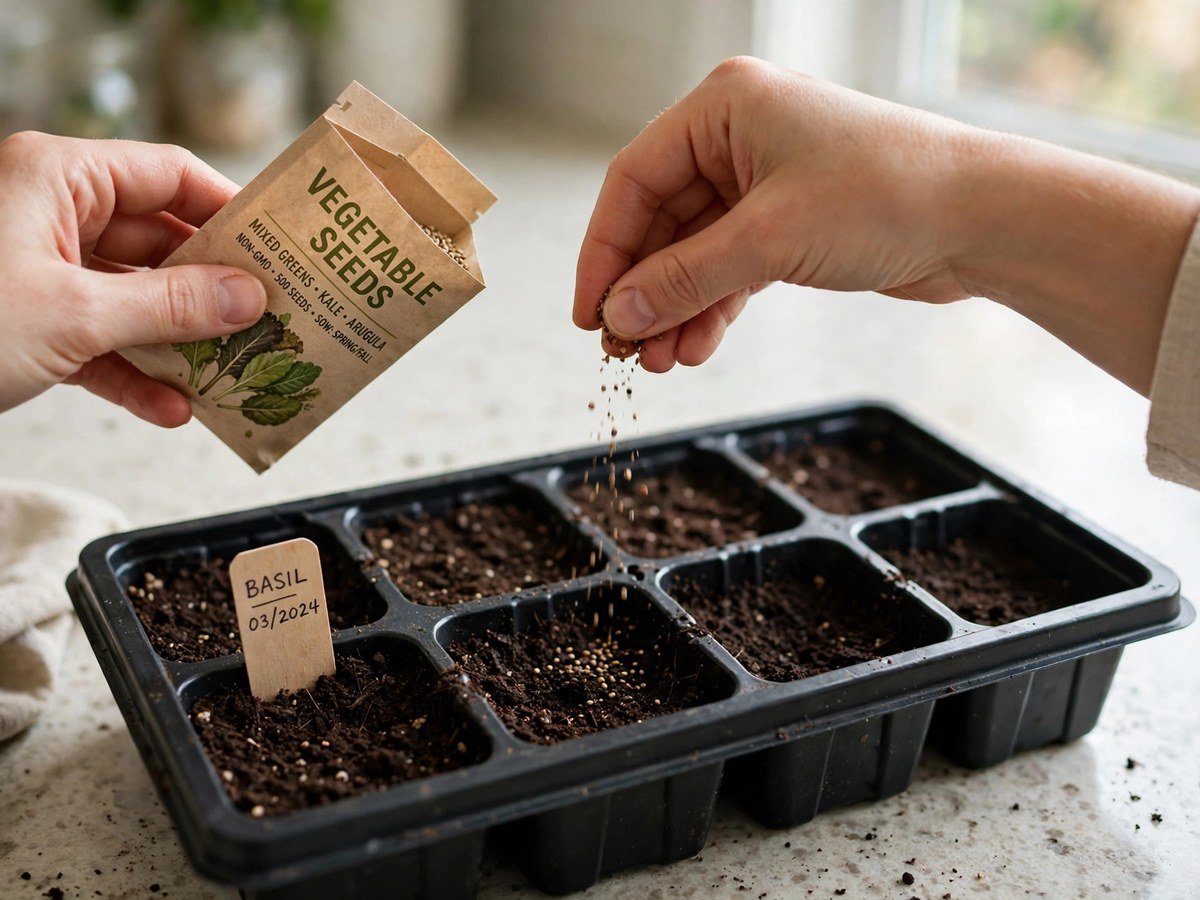
The working rule: sow a seed about twice as deep as the seed is wide. Maryland’s guide gives the same measure; a seed an eighth of an inch wide goes about a quarter of an inch down. Big seed sits deeper, small seed shallower, and the tiniest seed barely needs covering at all. Press it onto the moist surface for contact; lettuce seed can sit on the surface uncovered or under the lightest dusting. Label every tray with crop, variety and date. Seedlings look identical for their first week, and unlabeled trays become a guessing game.
Step 4: Keep the tray warm and moist under a cover
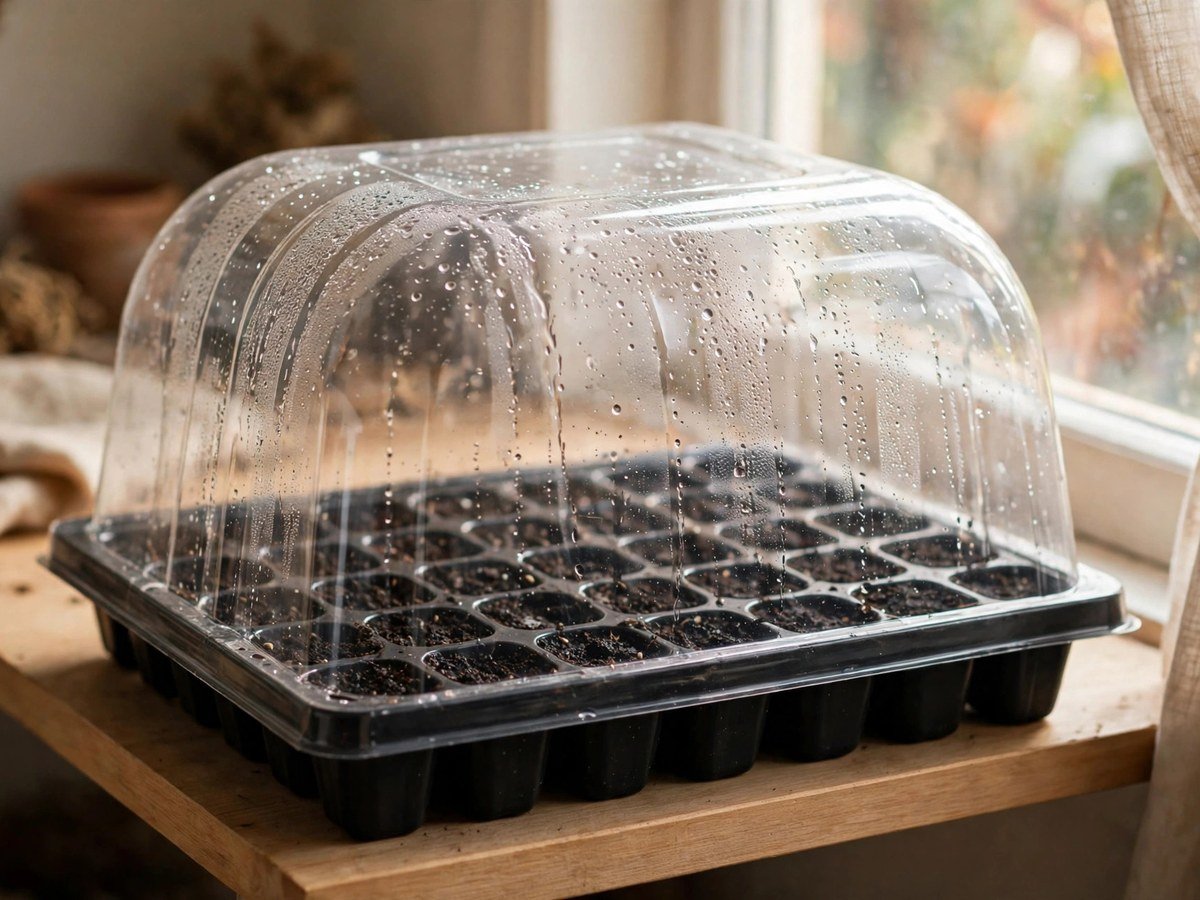
Cover the tray with its dome or a loose sheet of clear plastic and put it somewhere warm. The top of the refrigerator is the classic spot, and a heat mat does the same job in a cold house. Hold the mix inside that 65 to 75°F window and keep it evenly moist. This is the one stage where drying out is fatal. Maryland’s guide is blunt about why: once germination has begun, a dry period kills the embryo inside the seed, and the tray never comes up. Lift the cover the moment green shows. Its work is done.
Step 5: Strong light the moment they sprout
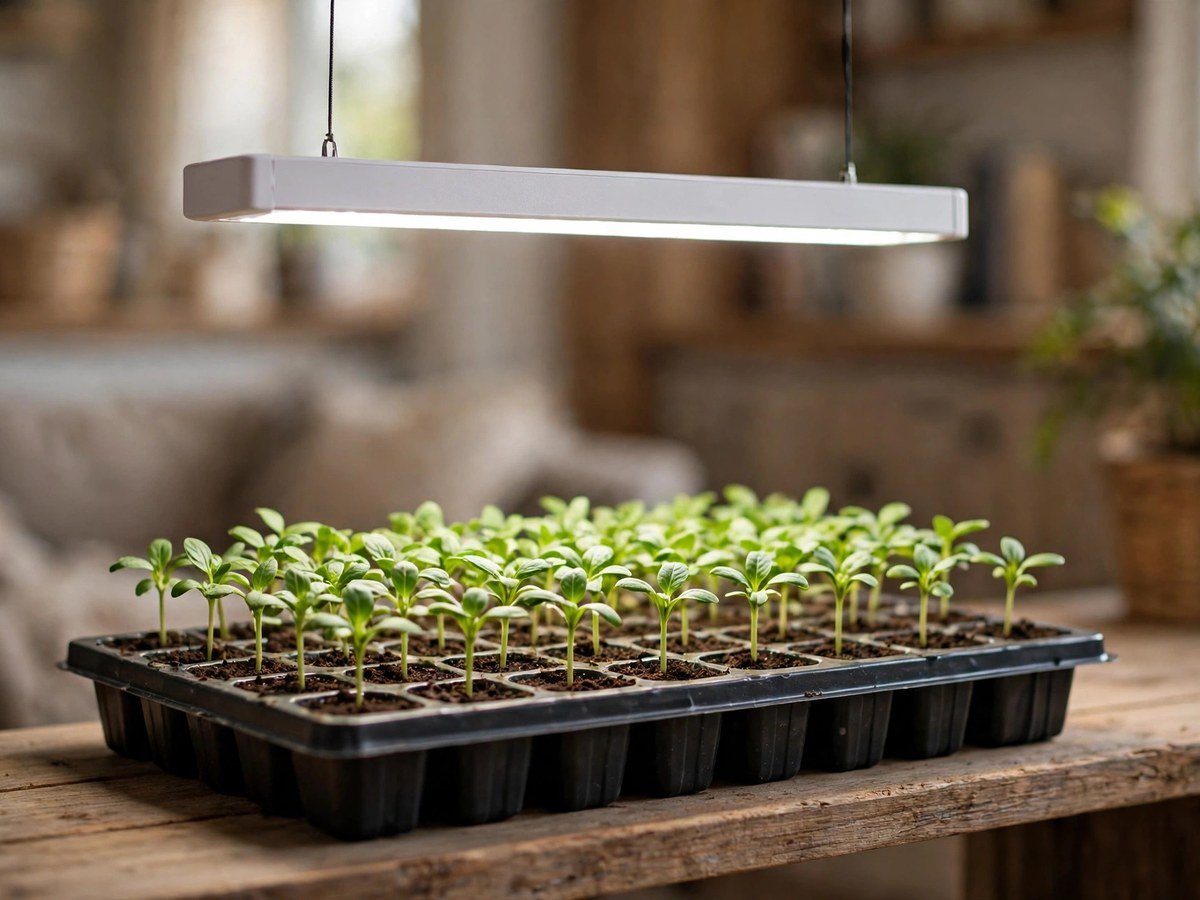
Sprouted seedlings need strong light immediately, 12 to 16 hours a day, with the lamp close overhead. This step is where most indoor starts are quietly lost, so it gets its own section below. The sequence is what matters: cover off, light on, no gap day on a dim windowsill.
Step 6: Harden off, then transplant
The last step moves plants outside in stages rather than in one shock. A week or two of hardening off, set out in full below, teaches seedlings to handle sun, wind and cool nights. Then they transplant into the garden or their final pots, and the indoor season is over.
Light Is Where Seedlings Are Won or Lost
Maryland’s extension guide puts it plainly: natural light from a window is seldom enough for strong seedling growth. Stems stretch toward the glass, lean, and come up weak. The honest exception is a genuinely bright south facing bay window or sunroom, and most houses do not have one spare in late winter.
A simple LED or fluorescent fixture fixes it, hung so it can rise as the plants grow. Two numbers run the setup. Give seedlings 12 to 16 hours of light a day, and keep the lamp 2 to 6 inches above the tops, not up at the ceiling. Light weakens fast with distance, and a lamp hung a foot too high gives the same stretched seedlings as the windowsill, just straighter. A 6500 K cool white tube or a daylight LED is the fitting Maryland recommends.
Once seedlings are up, the room can cool down. Iowa State’s guidance grows them on at around 65°F after they emerge. Warmth was for waking the seed; cool and bright is for growing the plant. The full light tiers for crops that stay indoors all season live in our guide to growing vegetables indoors. Seedlings passing through need only this one setup, done close and done long.
Pot Up, Feed Lightly, and Resist Starting Early
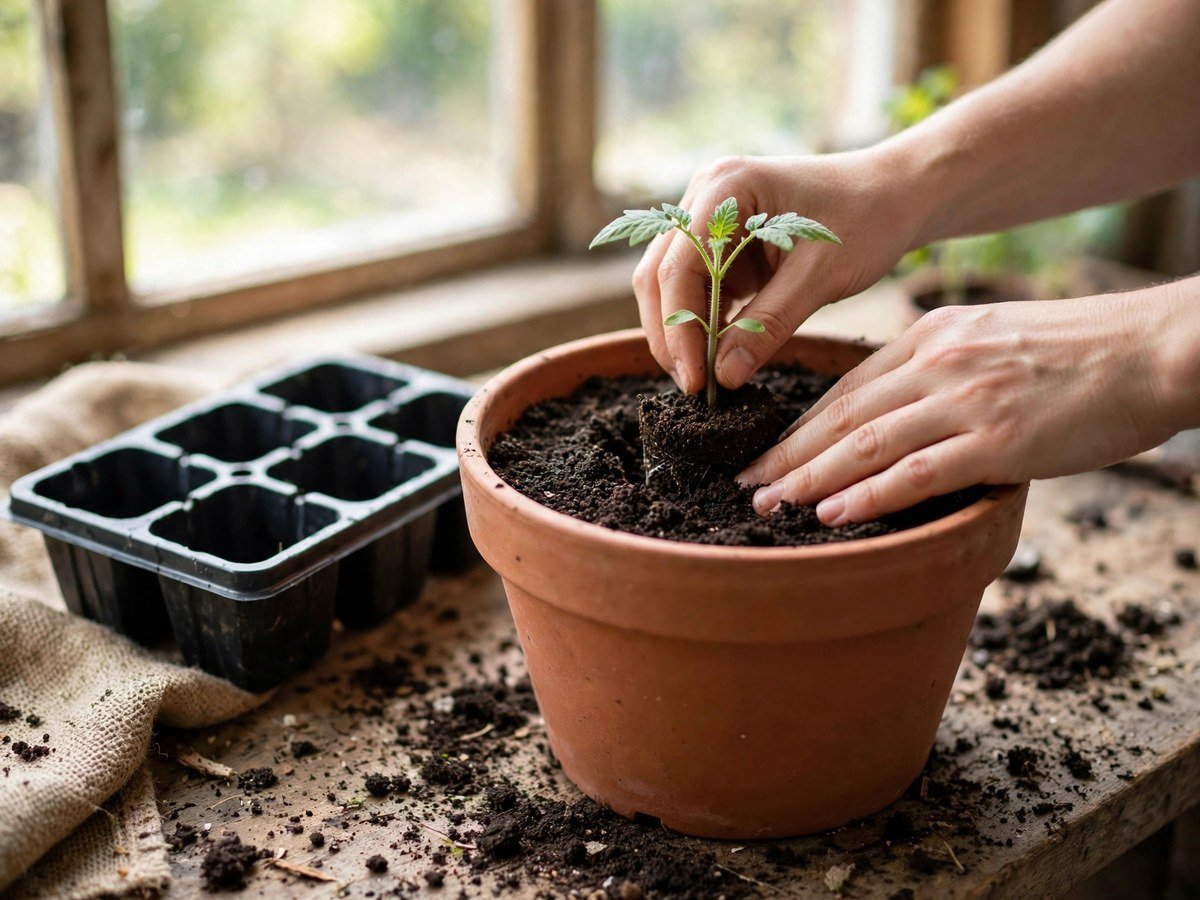
Seedlings outgrow their first cells quickly. When the first or second set of true leaves is in, the shaped leaves that follow the smooth seed leaves, move each seedling into its own bigger pot. Tomatoes, peppers and eggplant are usually started one seed to a cell and moved up 2 to 3 weeks after germination. Handle a seedling by a leaf rather than the stem where you can. A torn leaf regrows. A crushed stem does not.
Seed starting mix is lean food, so once seedlings are growing well, feed gently. The University of Nevada, Reno Extension uses a water soluble fertilizer at one quarter to one half strength once seedlings are up. That is the whole feeding program for the indoor weeks; more is not better on a plant this small.
The trap at this stage is the calendar, not the care. Starting too early is the classic seed starting mistake, and both Maryland and Iowa State name it directly. A seedling sown three weeks early does not become a three week better plant. It becomes a tall, root bound one that transplants poorly and sulks outside. The chart weeks are sized so the plant is ready when the weather is. Trust them. If spring fever hits in January, sow a tray of something fast instead. And if your tomatoes are staying inside for good, our indoor cherry tomato guide picks up from the transplant and grows the plant on under lights.
Hardening Off: The Step Beginners Skip
An indoor seedling has never met wind, direct sun or a cold night. Moved straight from shelf to garden bed, it scorches, wilts and stalls, and the transplanting takes the blame. The fix is a transition. The Almanac allows 7 to 10 days of hardening off; Iowa State allows about two weeks. Use the range, and the weather you actually get.
The method is plain. Set trays out in sheltered shade for a few hours on the first day, out of the wind. Add an hour or two and a little more sun each day, and bring them in at night while frost threatens. By the end, plants stay out all day, then a full night, then they transplant. If a hard frost threatens mid week, pause the clock and keep them in. Hardening off bends around the forecast, not the other way round.

What Goes Wrong
Damping off
Seedlings that pinch thin at the soil line and topple overnight are usually damping off, a fungal failure that thrives in soggy mix and dirty trays. Prevention is the whole cure: sanitized trays, mix that is damp rather than wet, air moving over the trays, and the cover off once seedlings stand up. Telling true mold from harmless root hairs is a diagnosis of its own, and our guide to mold on microgreens works through exactly that question.
Leggy, leaning seedlings
Tall pale stems with wide gaps between the leaves are a light report, not a feeding problem. The lamp is too far away, the hours are too short, or the tray is living on a windowsill. Move the light to within a few inches, run it 12 to 16 hours, and cool the room toward 65°F. Badly stretched seedlings rarely catch up; a fresh sowing at the right date usually beats nursing them.
Seeds that never come up
Work the short list. Seed age first: Iowa State notes that seed two to three years old and older germinates poorly, so fresh seed is the default. Then warmth, since a cold tray can sit for weeks doing nothing visible. Then moisture, since a tray that dried out mid germination is finished even when it looks fine. If all three check out, sow again with a fresh packet and count the first tray as tuition.
Frequently Asked Questions
Which vegetables should I start indoors, and which ones should I sow outside?
Start the slow crops and the tender crops indoors. Peppers, eggplant and onions need the longest run at 8 to 10 weeks, then tomatoes, the cabbage family and lettuce. Sow the fast crops and the root shy crops where they will grow. Beans, peas, corn and root vegetables resent having their roots disturbed, and spinach belongs in that group: sow it straight into its final pot, not a cell tray. Cucumbers, squash and melons sit in between. They dislike being moved, but a careful indoor start of 3 to 5 weeks buys real time in a short season.
Do seeds need light to germinate?
Most vegetable seeds do not. The University of Nevada, Reno Extension notes that most seeds need no light to germinate, so a covered tray in a warm spot is fine until green shows. A few small seeds are the exception, and the packet says so. Maryland’s guide notes that lettuce seed can sit right on the surface, uncovered or under the lightest covering. Light becomes non-negotiable the moment seedlings emerge, a different stage with a different rule.
Can I start seeds in garden soil or regular potting mix?
Garden soil, no. Dug soil is too dense for shallow cells, holds water in the wrong way, and can carry weed seed and disease into a tray of seedlings with no defenses yet. A bagged soilless seed starting mix is the reliable choice: fine, clean, and moist like a wrung out sponge before it meets a seed. Plain potting mix can work for larger seed if you pick out the coarse chunks, but the fine grade gives small seed the close contact it needs.
Do I need a heat mat to start seeds indoors?
No. A heat mat is a convenience, not a requirement. Most vegetable seeds germinate well in mix held at 65 to 75°F, and the top of a refrigerator or a warm room corner reaches that range in most homes; the refrigerator top is the low tech route the University of Nevada, Reno Extension suggests. A mat earns its keep with the slow warm season crops, peppers above all, in a cold house. Whatever the heat source, seedlings come off the extra warmth once they are up, and grow on better at a cooler 65°F or so.
When is it too late to start seeds indoors?
When fewer weeks remain before the last frost than the crop needs indoors, starting it inside stops buying anything. A tomato sown 2 weeks before the frost date goes out small and slow, while a bought transplant is already growing away. At that point, buy transplants for the slow crops and direct sow the fast ones. Lettuce, cucumbers and squash forgive a late start; they grow quickly once the soil warms. Peppers and eggplant do not forgive it, which is why they sit at the top of the chart.
My last frost date is only an average. How exact does my timing need to be?
Not exact at all, and it cannot be. The date is a planning anchor built from past springs, and the Almanac builds its dates on a 30 percent probability threshold, so a real frost still lands after the listed date in some years. The counting still works because the chart ranges are wide: a week either way inside an 8 to 10 week window changes little. What protects the plants is the order at the end, not precision at the start. Cool season transplants go out first and shrug off a light frost. Tender tomatoes and peppers wait until nights turn mild and the soil has warmed, whatever the calendar says.
Sources
University of Maryland Extension, Starting Vegetable Seeds Indoors, updated August 2026 (the chart’s anchor column; germination at a mix temperature of 65 to 75°F for most vegetable seeds; containers at least 2 inches deep; sowing depth about twice the seed’s width; mix moistened like a wrung out sponge; window light seldom enough). The Old Farmer’s Almanac, How and When to Start Seeds Indoors and the Frost Dates Calculator (the chart’s second column; hardening off at 7 to 10 days; seeds sprouting on soil temperature, not the calendar; frost dates on a 30 percent probability threshold). Iowa State University Extension (starting too early, growing seedlings on at around 65°F after sprouting, hardening off at about two weeks, poor germination from seed two to three years old and older). University of Nevada, Reno Extension (tiny seed pressed onto moist mix, most seeds needing no light to germinate, the refrigerator top as a warm spot, water soluble fertilizer at one quarter to one half strength). UMass Extension sanitation guidance, a 10 percent bleach solution for reused trays, as carried in Utah State University Extension’s seed starting materials guide.

5 Comments