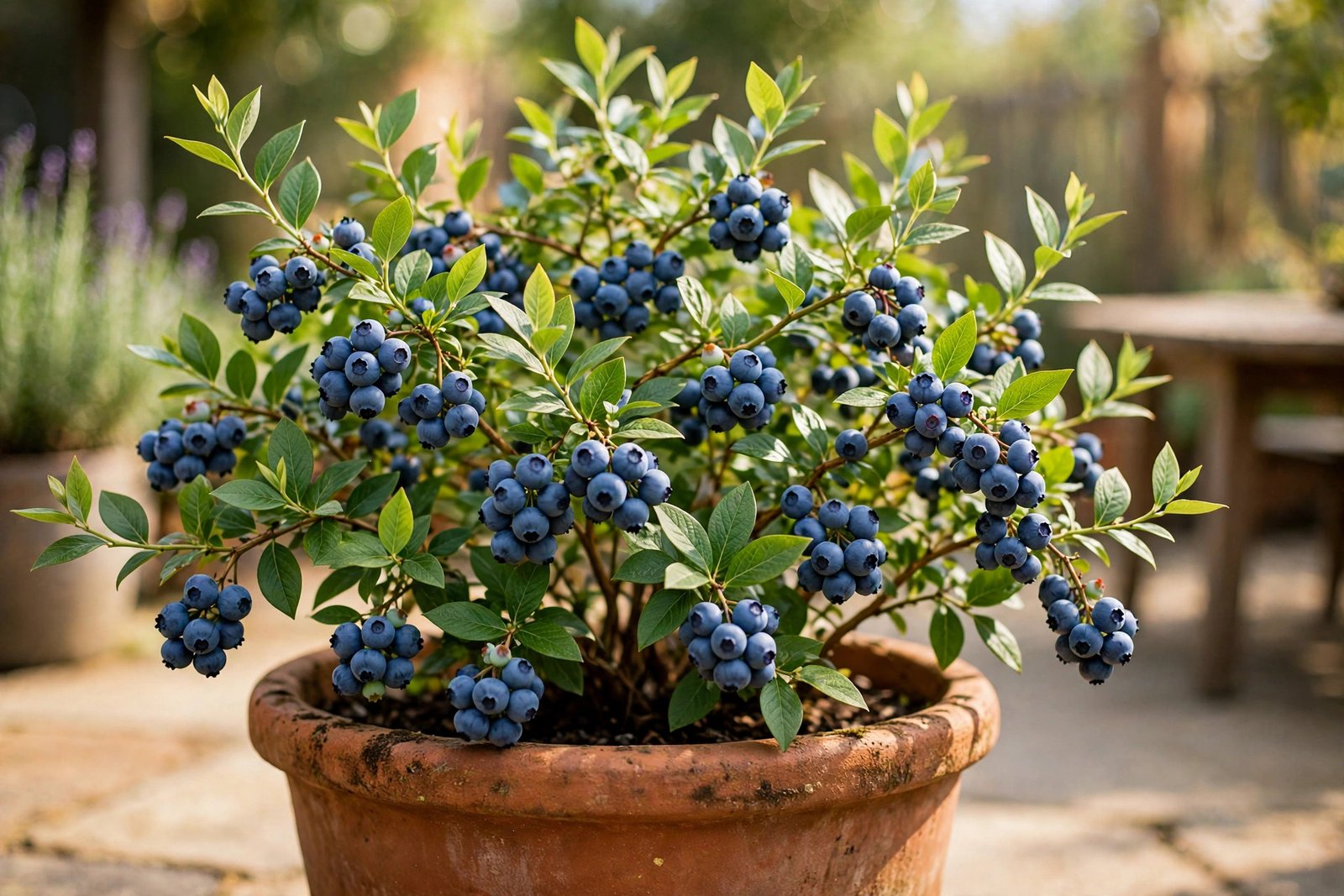
How to Grow Blueberries in Containers: Build the Acid Mix First
Blueberries fail in ordinary soil, and that is the whole problem this guide solves. They need acid soil, and most garden soil is not acid enough. A pot fixes that, because you build the mix from the start instead of fighting the soil you have.
This guide is written in November for planning, not for planting. Blueberries are a woody shrub, not a summer vegetable. Choose the type by zone and the two cultivars now, build the acidic mix recipe now, and buy and plant in spring. A full crop takes about five years, and no honest guide hides that. Buy a nursery plant. Do not sow seed.
The order matters. Pick the type that fits your zone first, then pick two cultivars that bloom together, then build the mix, then pick the pot. Get those four decisions right and the plant mostly looks after itself for years. The University of Wisconsin-Madison Extension calls the ideal soil pH 4.5 to 5.0, and the whole guide hangs on that one range.
Which type fits your zone
Blueberries come in five types, and the type decides the size of the plant, the cold it can take, and the pot it needs. Pick by zone first. A type that cannot take your winter will never fruit well, no matter how good the mix is.
| Type | Height | Zones | Chill need | In a pot |
|---|---|---|---|---|
| Lowbush | About 1 ft | Zone 3 | Needs winter chill | Dwarf types such as Top Hat suit pots |
| Half-high | 2 to 4 ft | Zones 3 to 5 | Needs winter chill | 10 gallons or larger |
| Northern highbush | 5 to 7 ft | Zones 4 to 8 | Needs winter chill | Half wine barrel or 15 to 20 gallons |
| Southern highbush | 5 to 6 ft | Zone 6 and warmer | Needs winter chill | Half wine barrel or 15 to 20 gallons |
| Rabbiteye | 5 to 9 ft | Zones 7 to 9 | Needs winter chill | 20 to 30 gallons |
Chill is the cold hours a type needs to flower well. Illinois Extension describes them as hours below 45 degrees F and above 32 degrees F, and the amount varies by variety. Your local extension office can give the number that fits your zone. Heights and zones above come from Iowa State, Oregon State and UW-Madison Extension, and the sources do not always agree to the inch. Pot sizes are Oregon State’s for northern highbush and half-high, and Texas A&M’s for rabbiteye; southern highbush, another larger type at about 6 feet, takes the same 15 to 20 gallons as northern highbush.
If you want names, start with the half-high list from UW-Madison: Northblue, Northsky, St. Cloud, Polaris, Chippewa, Northland and North Country, all hardy in zones 3 to 5. For a small pot, Top Hat is the dwarf lowbush type UW names, hardy to zone 5 and no more than 12 inches tall. Illinois Extension adds Sunshine Blue, Northcountry and Peach Sorbet to the dwarf list. Order well ahead of spring, because the good cultivars sell out, in the words of Oregon State Extension.
Strawberries are the other container fruit on this site, and the contrast is useful: a strawberry is a quick, shallow-rooted perennial that fruits in year one, while a blueberry is a woody shrub that takes years to a full crop and needs acid soil. Our strawberry container guide covers the fast fruit. This guide covers the slow one.
Two cultivars, not one
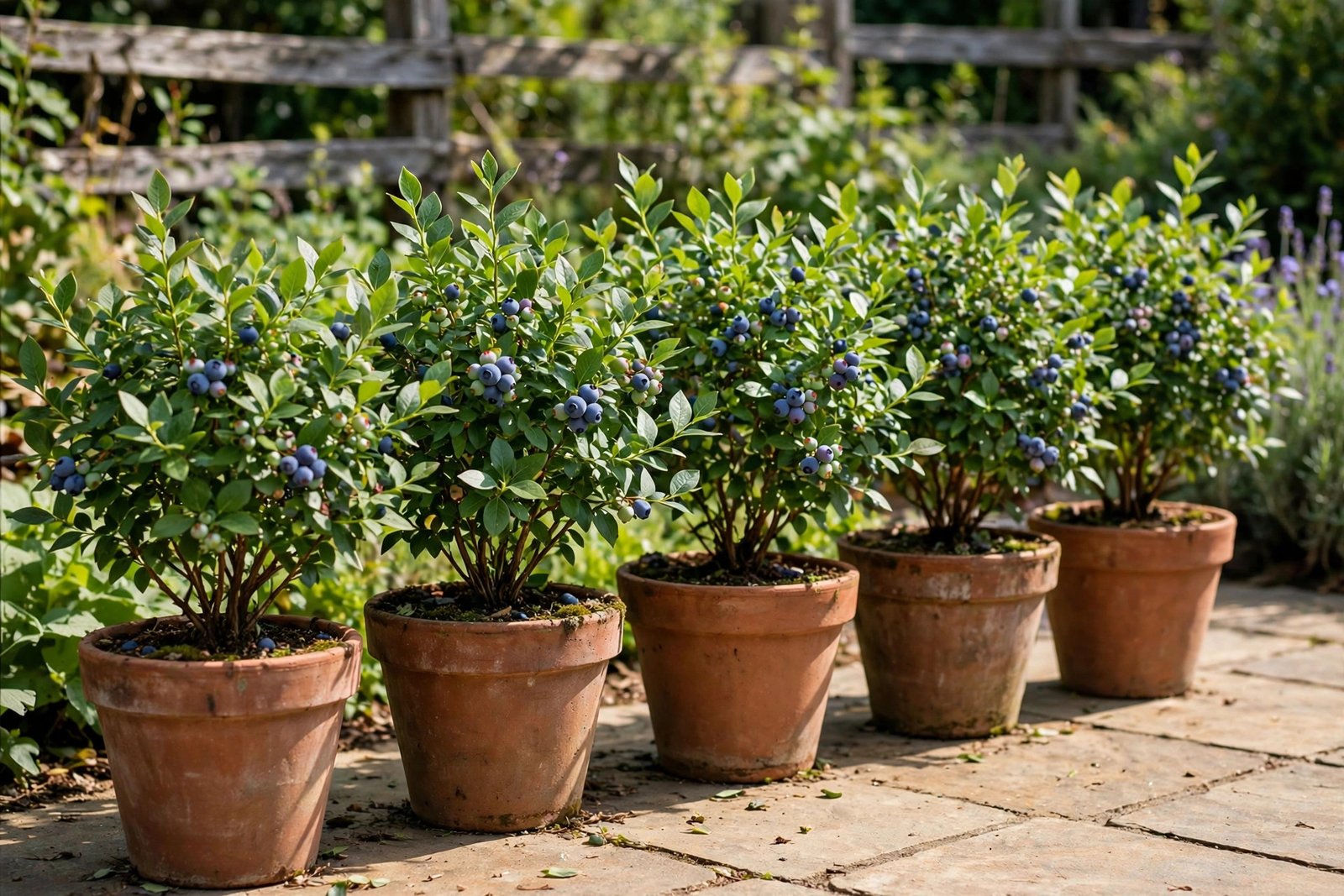
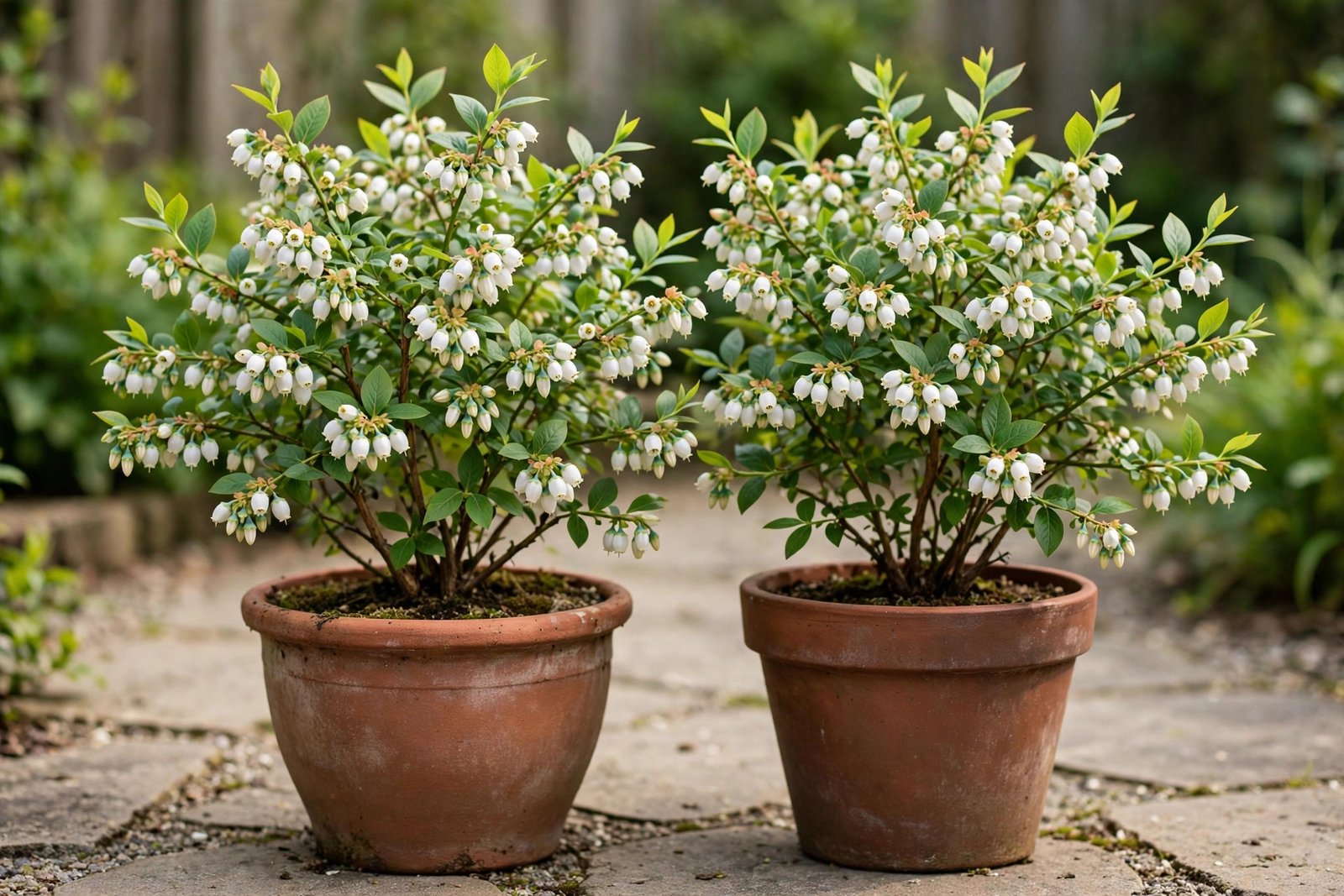
One bush can fruit on its own, but two fruit better. Most blueberry cultivars are self-fruitful, and growing more than one still improves pollination and gives larger berries, in the words of UW-Madison Extension. The rule is simple: plant two different cultivars of the same type, in separate pots, that bloom at the same time.
| Type | Self-fertile? | Partner needed? | Plant this |
|---|---|---|---|
| Northern highbush | Yes, but a partner gives larger berries | Recommended | Any two, e.g. Duke + Bluecrop (all bloom at the same time, Oregon State) |
| Half-high | Little fruit alone | Yes, plant two | Any two, e.g. Northblue + Northsky (UW list) |
| Southern highbush | Yes, but a partner helps | Recommended | Any two southern highbush cultivars that bloom at the same time |
| Lowbush | Mostly self-fruitful | A second cultivar still helps | Top Hat with a second dwarf cultivar that blooms at the same time |
| Rabbiteye | No fruit alone | Yes, mandatory | Two rabbiteye cultivars, e.g. Tifblue + Climax (Texas A&M) |
Plant each cultivar in its own pot, one plant per pot. Do not put two bushes in one pot to save space. Each needs its own mix and its own root room, and a shared pot means shared water and shared problems.
The acidic mix
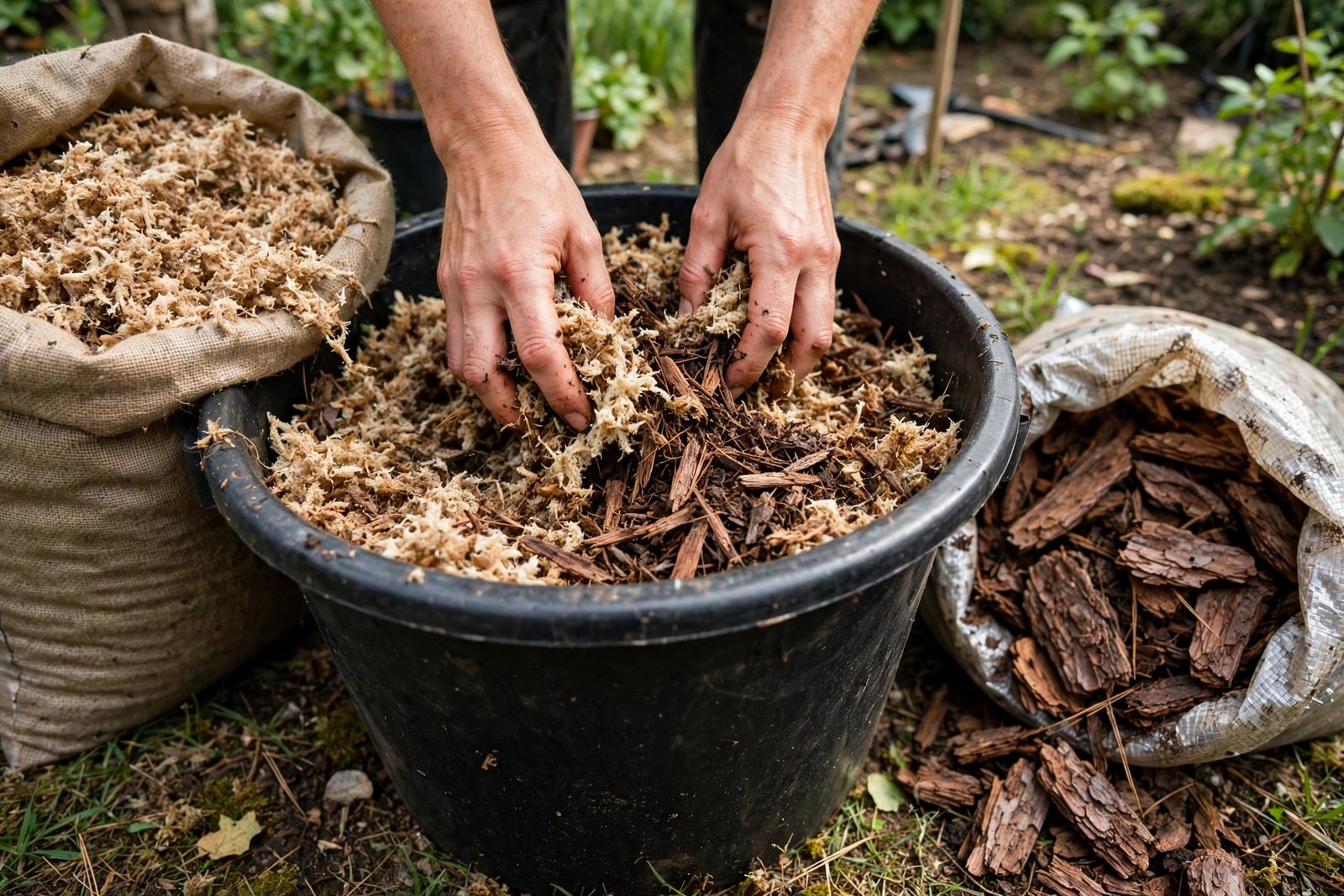
This is the chart that decides whether the plant lives or dies. Blueberries need acid soil, and ordinary potting mix is not acid enough. Build the mix before you buy the plant, and test it before the plant goes in.
| Source | Recipe | Note |
|---|---|---|
| UW-Madison | 1 part sphagnum peat moss + 1 part shredded pine bark; or 2 parts coir + 2 parts peat + 1 part perlite | Mix thoroughly; ideal pH 4.5 to 5.0 |
| Oregon State | 50 to 80% well-aged fine bark, 10 to 40% peat moss, 10% perlite or pumice | No lime, not much compost; more bark dries out faster and is harder to feed |
| Maryland | 50% potting soil + 50% peat moss | Wet the mix thoroughly before filling the pot |
Aim for pH 4.5 to 5.0, the ideal range UW-Madison gives. Other extension pages accept a wider band, 4.5 to 5.5, and Iowa State gives 4 to 5.5. The range is the answer, not one number. Test the mix with a pH meter or test kit before planting, and test again if the leaves turn yellow.
Garden soil does not go in the pot. Texas A&M AgriLife Extension is plain about it: fill the container with an acidic soilless mix such as peat moss, composted pine bark, or a 50/50 mix of the two, and do not use field soils. Ordinary soil is too dense for a pot, and it brings the pH up with it. Our vegetable soil-mix post is a good recipe for vegetables, and the wrong one here. Do not use that mix for blueberries.
Pot by age
A blueberry outgrows its pot, and the pot has to grow with it. Start small, repot as the plant grows, and end with a pot you can barely lift.
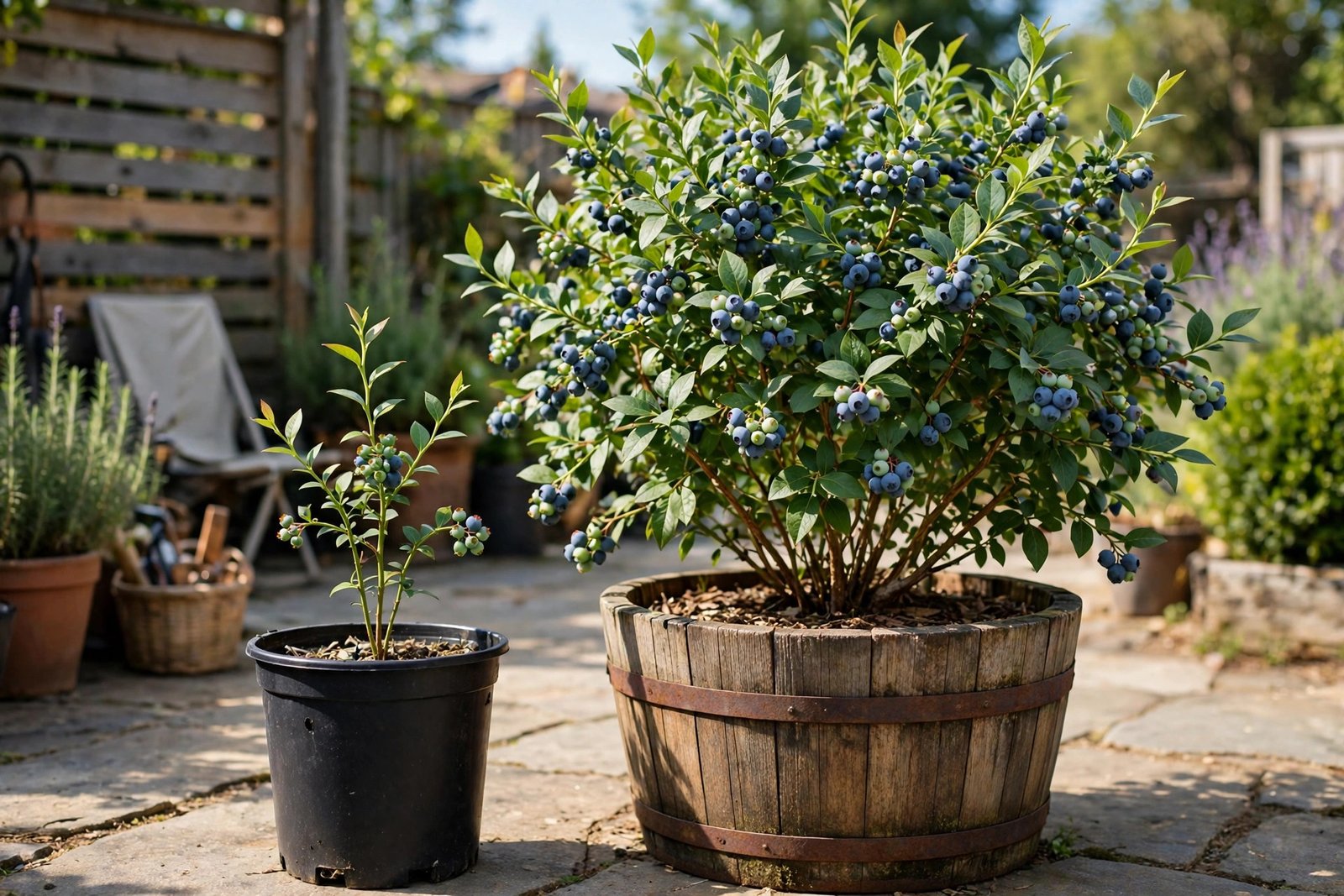
Start a young plant in a 5-gallon pot, one plant per pot (UW-Madison). As it matures, repot it in a 16- to 20-inch pot or a barrel, filled with the same acidic mix (UW-Madison). A mature plant needs a container at least 24 inches deep and about 24 to 30 inches wide, in the words of Maryland Extension, while Illinois Extension sets the minimum at 18 inches deep. The range is honest: 18 to 24 inches deep, and wider than tall, because blueberry roots run shallow, about 1 to 1.5 feet deep (Oregon State).
Every pot needs drainage holes, and a pot on a hard surface should stand on bricks so the water can leave (Maryland). Place the pot in full sun, with some protection from late afternoon sun if your summers run hot (Maryland). Avoid black pots in the sun. UW-Madison warns that black containers absorb heat and dry the mix out faster. A fabric grow bag has the same problem in the other direction: the walls breathe and lose water through the sides, and Maryland Extension notes that porous containers dry out more quickly than non-porous ones. For a shrub that lives in the same pot for years, a rigid pot is the safer pick. Our grow bags versus pots guide compares the two, so you can see the trade-off for yourself.
Repot every 3 to 4 years, in late summer to early fall, so the roots have time to grow before winter (Maryland; UW Extension). Refresh the mix at the same time, because the old mix breaks down and the pH creeps up.
Water, feed and keeping it acidic
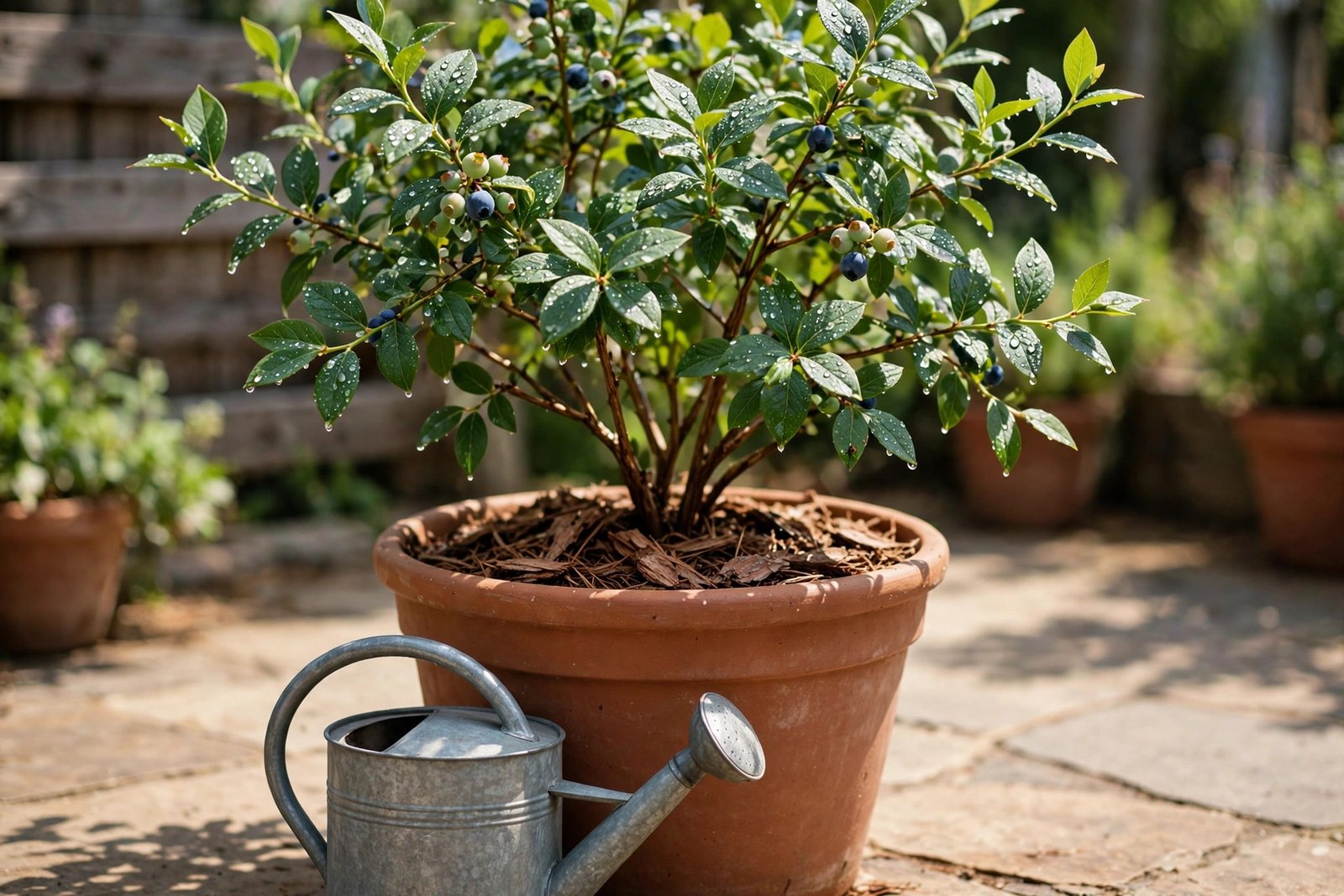
Blueberries are thirsty and fussy about water at the same time. UW-Madison Extension says to water often and lightly, keep the mix moist but not wet or soggy, and give an occasional deep drench to clear out salts. They are very sensitive to dry conditions, in the words of Maryland Extension, so do not let the pot dry out in summer.
Rainwater is the best water you can give them. UW-Madison says collected rainwater is ideal, and typically not as hard, nor as high in pH, as well water. Hard tap water pushes the pH up over time, which is the slow problem every container blueberry faces. Sulfur is the product extension pages name for lowering pH, and it works slowly, so plan ahead (Iowa State). Test the mix pH each spring, and act before the leaves tell you the pH has drifted.
Mulch the surface with 2 inches of pine bark or chipped hardwood bark (UW-Madison). It holds moisture and keeps the roots cool.
Feed light, with an acid fertilizer in early spring, before the leaves expand (Maryland). Avoid fertilizers that contain nitrates or chlorides. Oregon State explains why: the main nutrient blueberries need is nitrogen in the ammonium form, and all-purpose fertilizers such as 16-16-16 are mostly nitrate, which blueberry plants cannot use. Blueberry roots are sensitive to fertilizer salts, so follow the label rate and never overfeed (UW-Madison). The full feeding detail lives in our fertilizer guide for container vegetables.
Winter, and the pot’s second life
A pot does not protect roots the way the ground does. Iowa State Extension warns that root zone temperatures get much hotter in summer and much colder in winter in a container, and that containers need to be mulched in or sunk into the ground for winter. Maryland Extension says to keep containers in a sheltered spot from December to March, out of the winter wind. UW-Madison gives the full version: bury the pot in mid to late October where snow is likely to pile up, mulch with 4 to 8 inches of straw in mid-November or cover with burlap, and lift it back out in early to mid-spring.
Prune only from about year four, in late winter or early spring, and cut out dead, weak and low-growing branches (Illinois). In the first year or two, remove the flowers so the plant puts its energy into roots instead of fruit (Maryland, Illinois). It feels wasteful. It is the reason the plant is still there in year five.
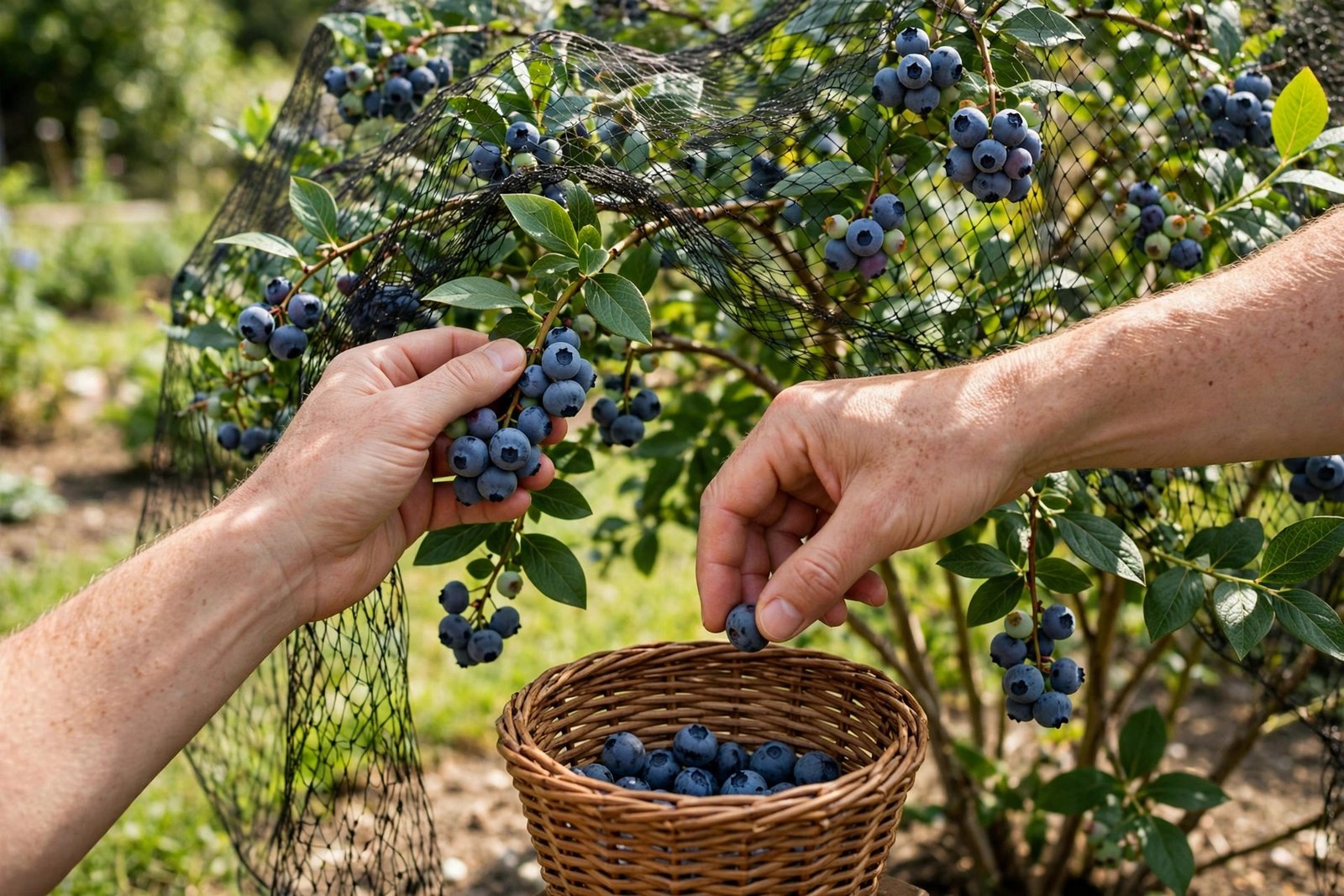
Net the bush when the berries just begin to ripen (Maryland). Birds eat blueberries before you do. Illinois Extension says the same: consider netting the container to keep the birds from eating your berries.
What goes wrong
Most container blueberry problems trace back to pH, water, or the wrong type. Here is the short list, with the cause first.
Yellow leaves with green veins. The pH is too high, and the plant cannot take up iron. Oregon State lists it as the sign of soil pH that is too high, and Illinois calls it chlorosis. Test the pH and acidify the mix. Do not just add iron spray and hope.
No fruit, or few berries. The wrong type for your zone, no partner, or no bees. Check the type chart first, then the two-cultivar chart.
Leaves scorch and the pot dries out fast. A black pot in full sun, or a fabric bag on a hot patio. Move the pot to afternoon shade or change the pot.
Soggy roots and a dying plant. No drainage holes, or the pot sits flat on a hard surface. Lift it onto bricks and let the water leave.
Birds eat the berries first. Net the bush when the berries just begin to ripen.
A blueberry in a pot is a slow project, and that is the point. You choose the type now, you build the mix now, you plant in spring, and the bush pays you back for years. Our best vegetables for pots list shows where blueberries sit beside the other container crops, and our balcony vegetable garden guide shows how a fruiting shrub fits a small space.
Frequently Asked Questions
What soil pH do blueberries need in pots?
Aim for pH 4.5 to 5.0, the ideal range UW-Madison Extension gives for containers. Other extension pages accept a wider band, 4.5 to 5.5, and Iowa State gives 4 to 5.5. Test the mix before planting, and test again if the leaves turn yellow. Yellow leaves with green veins mean the pH is too high and the plant cannot take up iron.
Do I need two blueberry bushes?
Most cultivars are self-fruitful, so one bush can fruit on its own. But two different cultivars of the same type, in separate pots, that bloom at the same time give larger berries and a better harvest. Rabbiteye is the exception: it makes no fruit alone, so a partner is mandatory. Plant one bush per pot, never two in one pot.
How big a pot does a blueberry need?
Start a young plant in a 5-gallon pot, one plant per pot. As it matures, repot it in a 16- to 20-inch pot or a barrel. A mature plant needs a container at least 24 inches deep and about 24 to 30 inches wide, in the words of Maryland Extension, while Illinois Extension sets the minimum at 18 inches deep. Every pot needs drainage holes.
When will my potted blueberry fruit?
Do not expect a harvest in the first year. Remove the flowers on a one-year-old plant so it puts its energy into roots. A few berries may come in year two, and a full crop takes about five years. The plant keeps producing for decades after that, as long as the pH stays acid and the pot stays watered.
Sources and Further Reading
University of Wisconsin-Madison Division of Extension, Growing Blueberries in Containers
Iowa State University Extension and Outreach, Blueberries: Plan Before You Plant
Oregon State University Extension, Growing Blueberries in Your Home Garden (EC 1304)
University of Maryland Extension, Growing Blueberries in Containers
Texas A&M AgriLife Extension, Container-Grown Blueberries (HORT-PU-267)
University of Illinois Extension, Blueberries