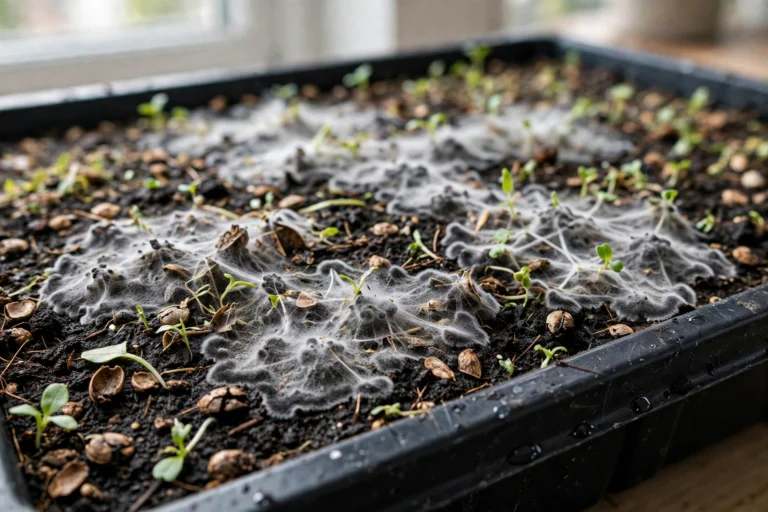

How to Grow Onions in Containers for Big Full Bulbs

Yes, full-size onion bulbs grow in pots. But a bulb onion is not a windowsill crop and it is not a fast crop. It needs an outdoor pot in full sun, months of growth, and a variety matched to your daylight. Get those three things right and a pot of onions earns its place on any patio. Get the variety wrong and you will grow a fine head of green leaves over a marble-sized bulb, no matter how well you water it.
If green tops are what you want this week, this is the wrong guide. Our guide to regrowing green onions indoors gets you cutting in days, from a jar on a windowsill. If you have no outdoor space at all, our guide to growing vegetables indoors is the honest starting point. This guide is for bulbs, outdoors, in pots.
One timing note before anything else. For most readers in the United States, November is a planning month for onions, not a planting month. Long-day and intermediate types go in during early spring. Short-day types are the exception: in the deep South they grow over fall and winter. So this month, choose your type, order your sets or seed, and get your pots ready. If you want a bulb crop actually in the ground this fall, garlic plants in fall by design.
The promise of this guide is simple. Right type, right depth, patience. One set, seed, or transplant makes one onion, so count backward from how many bulbs you want. The rest is steady water and leaving the plant alone until its tops tell you it is done.
Bulbs or Greens? Decide Before You Buy
Onions split into two different harvests, and the pot you need depends on which one you want. Decide now, because the two harvests want different depths and different timelines.
| Goal | Time to harvest | Pot depth | What decides success |
|---|---|---|---|
| Full bulbs | Months. About 100 to 120 days, on Utah State figures. | At least 10 inches of soil | Day-length type, depth, steady water, and curing |
| Green tops | Days to weeks | A shallow pot or a jar | Covered in our green-onions guide, linked above |
Mixing up the two harvests is the most common container mistake. A 6-inch pot is plenty for green onions and far too shallow for full bulbs. The rest of this guide is bulbs only.
Choose by Day Length: The Decision That Decides Everything
Onions do not form bulbs on a schedule. They form bulbs when daylight reaches a threshold built into the variety. Before that cue arrives, the plant builds leaves. After it arrives, growth switches to the bulb. A small plant at switch time makes a small bulb, and no amount of late feeding fixes it. Utah State Extension warns that onions planted too late in spring mostly grow leaves and never form a bulb. Minnesota Extension shows the mismatch case: short-day types grown in Minnesota generally develop small bulbs.
Three types cover the whole country. Pick by where you live, not by what looks good in the store bin.
| Type | Daylight that starts bulbing | Where it fits | If the match is wrong | Example varieties |
|---|---|---|---|---|
| Short-day | About 10 to 12 hours | The South and warm-winter areas, grown over fall and winter | In the North, bulbs form too early, before the plant has grown. Small bulbs. | Texas Grano, Red Burgundy |
| Intermediate, also called day-neutral | About 12 to 14 hours | The middle of the country, the most flexible choice | The forgiving middle option. Still check the label. | Candy, Super Star |
| Long-day | About 14 to 16 hours | The North, where summer days run long | In the South, the cue may never arrive. Leaves, no bulb. | Walla Walla, Yellow Sweet Spanish |
The hour bands vary by about an hour at the edges between sources. Minnesota Extension puts long-day onions at 14 or more hours. Maryland Extension puts them at 15 to 16 hours. Illinois Extension puts them at 14 to 15 hours. Do not chase the exact hour. Match the type to your latitude, and check the label on every bag and bundle. “Yellow” describes color and cooking use, not day length. A yellow onion can be any of the three types.
Buy from a supplier that names the day-length type. Illinois Extension tells of a gardener who bought a store mix of short-day and long-day transplants without knowing it, and got poor bulbs from both. If the label does not name the type, do not buy it for bulbs.
When to plant follows the type. Long-day and intermediate onions go in during early spring, as soon as the soil can be worked. Short-day onions in the South go in during fall and grow over winter, with bulbs forming in spring. There is no single nationwide planting date. Your type and your last frost set the date, and your local extension office can confirm it.
Sets, Seed, or Transplants?
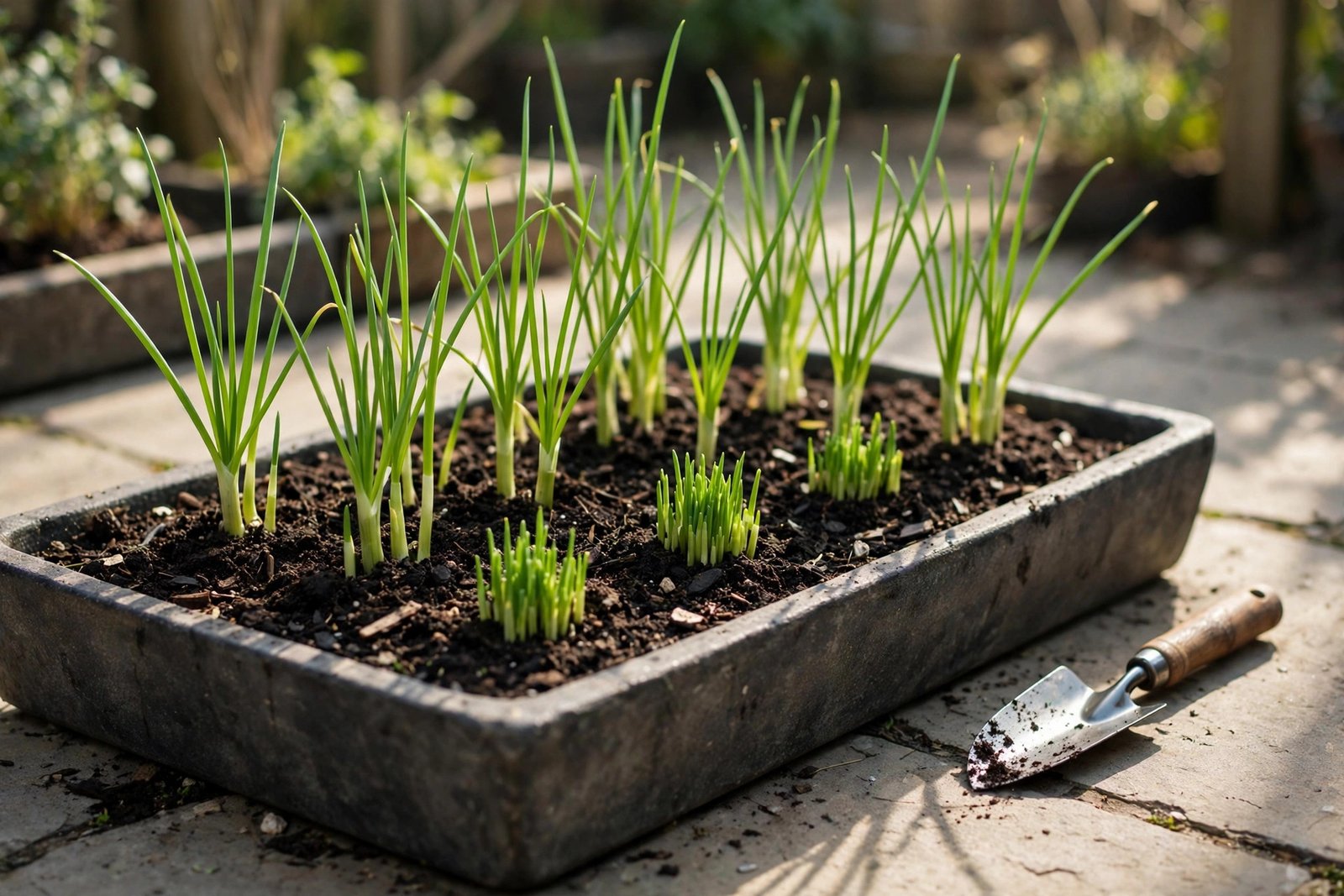
Three routes lead to the same bulb. They differ in cost, effort, and how much choice you get.
| Route | When | Effort | What you get | Who it suits |
|---|---|---|---|---|
| Sets (small bulbs) | Early spring, as soon as soil can be worked | Easiest. Plant and go. | Reliable bulbs. Limited variety choice. | First-time growers, and anyone who wants the simple route |
| Seed | Start indoors 8 to 12 weeks before planting out (see the note below) | Most work. Trays, lights, transplanting. | Cheapest. Widest variety choice. Slowest, about 110 days from seed. | Growers chasing a specific variety |
| Transplants (small plants in bundles) | Early spring. They tolerate light frost and go out once temperatures reach 50°F. | Middle effort. No indoor seed work. | A head start on the season. Good crops. | Growers who want an early start without indoor seed work |
The indoor seed timing needs an honest note, because the sources do not agree on one number. Maryland Extension starts seed indoors about 8 weeks before planting. Utah State gives transplants about 8 weeks of grow time. Minnesota Extension starts seed indoors 10 to 12 weeks before planting outside. Our own seed-starting guide charts onions at 8 to 10 weeks, from Maryland Extension, and notes that the Old Farmer’s Almanac lists onions as direct sow only. The chart sits inside the extension range. Both routes grow the crop: start indoors for an earlier start, or sow direct where your season allows. The tray method itself lives in the seed-starting guide, so this guide does not repeat it.
Bolting caution. Sets and transplants bolt more readily when planted too early, and larger sets bolt more than small ones. Utah State Extension notes that sets and transplants over 5/8 inch across have a greater tendency to bolt, and that planting later in spring lowers the risk. Maryland Extension links cold exposure after early planting to seed stalk development. Seedlings grown from seed bolt less than sets, on the Old Farmer’s Almanac Garden Planner’s guidance. Plant on time, and favor pencil-size sets for your best bulbs.
The Container: Depth First, Then Width
Start with the pot, count the plants second, and buy sets last. That order prevents the most common container mistake, which is owning more sets than the pot can hold.
| What you want | Container | Soil depth | Plants |
|---|---|---|---|
| A few full bulbs | A 5-gallon bucket with drainage holes | At least 10 inches | 6 to 8 onions, on a container-guide figure |
| A box of bulbs | A long trough or wide planter, several feet across | At least 10 inches | 3 to 4 inches of room per onion |
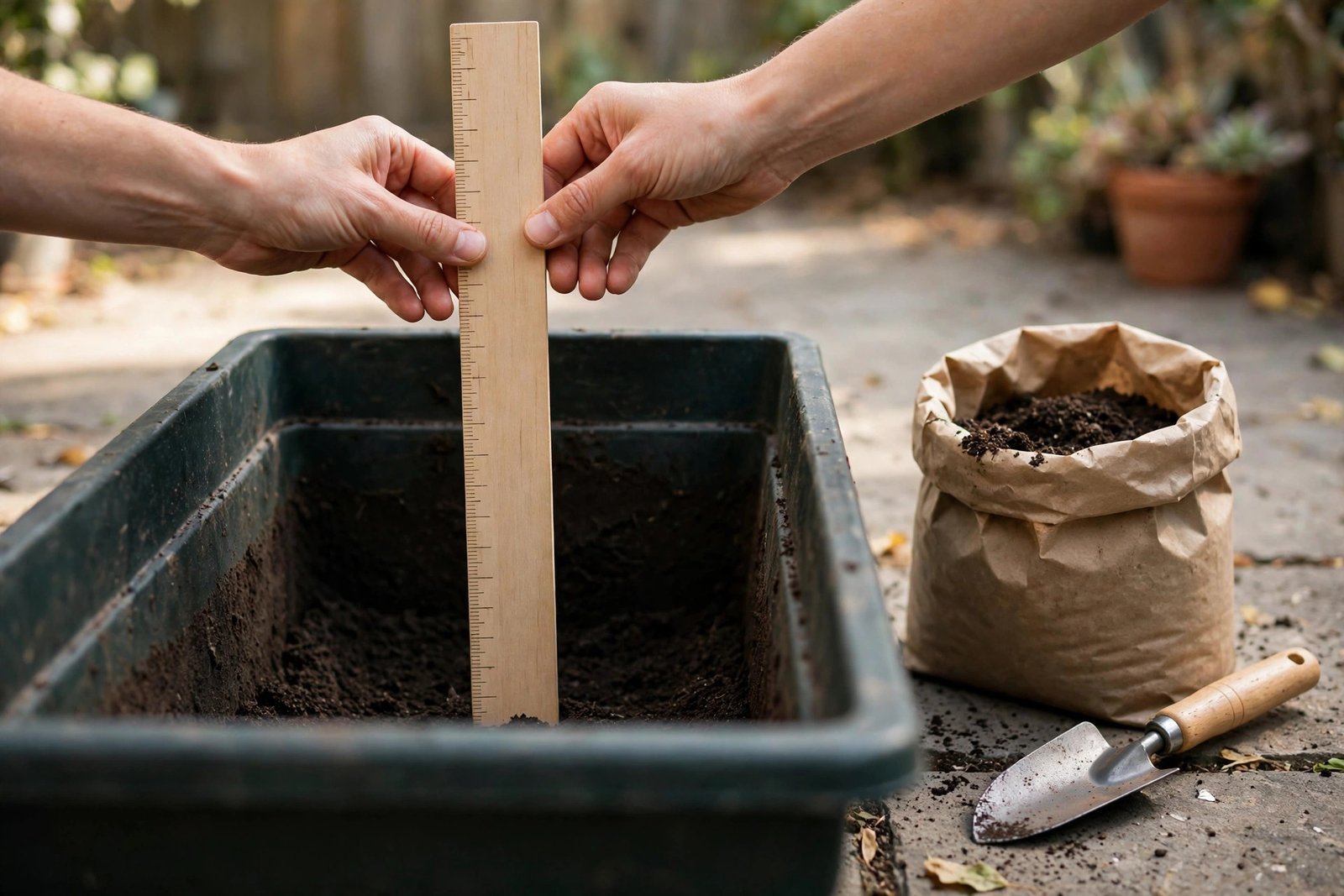
The depth figure deserves a straight answer. Container guides put the working depth for full bulbs at 10 inches. Gardening Know How calls a 10-inch-deep container ideal, several feet across. Plant4Harvest sets 10 inches of soil depth as the minimum practical target for mature bulbs. Guides print a wider range, 8 to 12 inches, and 10 inches is the figure most of them settle on. No university extension figure for bulb onions in containers was found during research for this guide. Colorado State Extension’s container table lists green onions only, at 6 inches deep. That 6-inch figure belongs to green onions. Never read it as a bulb figure.
Onion roots run shallow. Minnesota Extension calls onions shallow-rooted and asks for constant moisture. Utah State notes the shallow rooting depth and the need to keep moisture near the surface. That is why width matters as much as depth past the minimum: a wide pot gives each plant its own room and holds moisture more evenly than a narrow one. Past the 10-inch minimum, width buys more than extra depth, because the roots stay shallow.
Drainage holes are not optional. Gardening Know How warns that an onion left sitting in soggy soil rots within days. Raise the pot slightly on feet or bricks so water can leave freely, and never let it stand in a saucer full of water.
Put the pot in the brightest outdoor spot you have. Maryland Extension asks for full sun, at least 6 hours a day, and prefers 8 to 10 hours. Outdoors matters for more than brightness. The natural seasonal light pattern is what tells a bulb onion when to form its bulb, and a windowsill cannot deliver it.
Fill the pot with a loose, fertile potting mix that drains well, with plenty of organic matter, not soil dug from a garden bed. Minnesota Extension puts the soil pH target at 6.0 to 7.0. The mix itself, and the reasoning behind it, live in our guide to the best soil mix for vegetables in pots. The pot versus grow bag choice, with the trade-offs in full, lives in our grow bags versus pots comparison.
Planting Day: Shallow Sets, a Roomy Grid
Planting depth splits by route, and the sources split with it. Keep the figures apart instead of averaging them.
| Route | How deep | Spacing |
|---|---|---|
| Seed | 1/4 to 1/2 inch deep. Minnesota, Maryland, and Utah State agree. | Thin to 3 to 4 inches apart. |
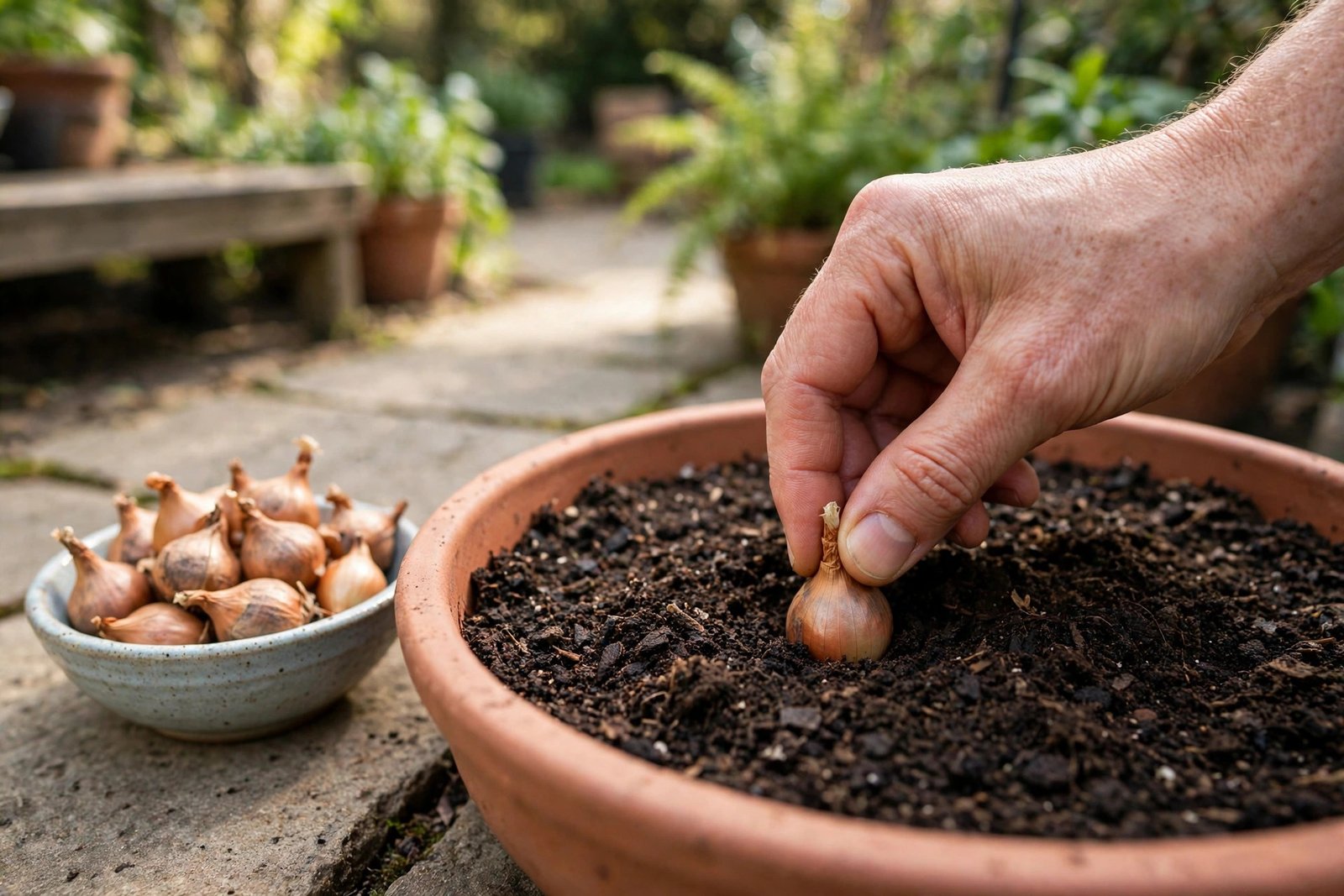
| Sets | About 1 inch deep, pointed end up, tip just covered. Maryland Extension and both container guides agree. Colorado State’s in-ground table allows 1 to 2 inches. | 4 inches apart for full bulbs. See the spacing note below. |
| Transplants | Roots buried, about 1 to 2 inches deep. Minnesota plants 2 inches deep. Plant4Harvest buries the roots and about 1 inch of the lower plant. | 3 to 4 inches apart in the row, on Minnesota and Utah State figures. |
Spacing is where bulb size is won or lost. Utah State notes that high-density plantings reduce bulb size unless water and nutrients keep up. Maryland Extension thins to 4 inches apart for moderate-size bulbs and 8 inches apart for large bulbs. Colorado State’s in-ground table spaces dry onions 4 to 6 inches apart. For a pot, 4 inches apart in all directions is the working figure for full bulbs. If you want the biggest bulbs the variety can give, stretch it to 6 inches apart or wider. Count your own pot before you buy: divide the inside width by your spacing, and that is how many plants fit across.
One spacing trick earns its place here. Plant sets or transplants 2 inches apart, pull every other plant young as a green onion, and leave the rest with room to form full bulbs. Illinois Extension plants closer for exactly this reason, thinning by picking scallions, and Plant4Harvest describes the same harvest-and-thin plan. The thinning is a spacing technique for a bulb crop. It is not the greens method, which lives in the green-onions guide.
Do not hill onions. Maryland Extension is direct: do not hill, because it encourages stem rot. As bulbs enlarge they rise above the soil surface. Let them. The bulb forming half out of the mix is normal, not a problem to fix. One habit to leave behind if you grew potatoes in pots: our potatoes in containers guide builds its harvest on hilling, adding mix around the stems as they grow. Onions get no added mix during the season. Keep the mix loose from the start, because hard mix means smaller bulbs. Water the pot in well after planting, so the mix settles around the roots.
The Growing Season: Steady Water, Light Food, Clean Ground
Onions ask for three things through the season, and all three come back to shallow roots. Water that never fully runs out. Food early, not late. Ground kept clean without deep digging.
Water
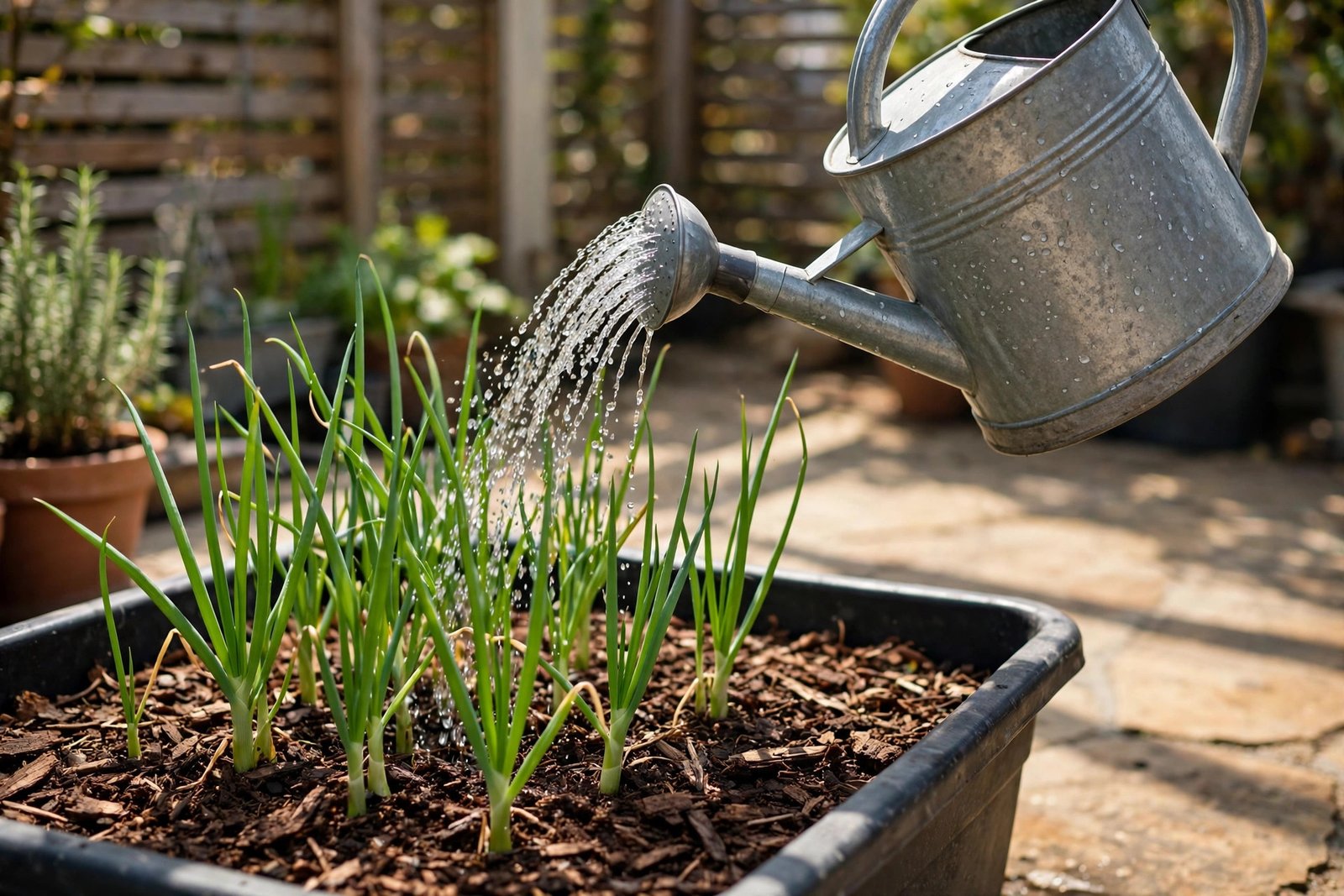
Keep the mix evenly moist, like a wrung-out sponge, and never let it dry right out. Gardening Know How warns that soil dried out completely risks bolting. Utah State notes that drought stress decreases yield, reduces bulb size, and affects flavor. Containers dry faster than beds, so check the top inch of mix: when it feels dry, water deeply until water leaves the drainage holes.
Weekly amounts vary by source, so treat them as a range, not a schedule. Minnesota Extension soaks in-ground onions to at least 1 inch of water a week. Plant4Harvest puts container onions at about 1 to 2 inches a week. Gardening Know How puts them at 2 to 3 inches a week. Heat, wind, pot material, and mulch move the real need around inside and beyond that range. The finger check beats the calendar.
Stop watering when the bulbs reach full size and the tops begin to fall. Minnesota and Utah State agree on the stop. Utah State adds that excess water as onions mature delays curing and causes storage problems.
Food
Feed lightly and early, then stop. Minnesota Extension warns that too much nitrogen causes late maturity, large necks that are hard to cure, soft bulbs, and poor storage. Utah State stops fertilizing after mid-July, because late leaf growth reduces storage potential. Maryland Extension side-dresses 1 to 2 weeks after bulb enlargement begins. For a pot, that adds up to one light feed early in the season and nothing once bulbs start to swell. No fertilizer rate is printed here on purpose: the published rates are per row or per 100 square feet in the ground, and they do not transfer to pots. Follow the rate on the product you use, at the light end.
Weeds
Onions compete poorly. Maryland Extension says so directly, and blames the shallow roots. Utah State calls for weed control especially during the first 2 months. In a pot, pull weeds by hand and cultivate shallowly. Minnesota Extension warns against hoeing deep, because injured bulbs are prone to disease, and mulches with 3 to 4 inches of herbicide-free clippings or straw. A light mulch layer steadies moisture and keeps weeds down, on Illinois Extension’s guidance.
Leave the Tops Alone
Do not cut the green tops off plants you want as bulbs. An Ask Extension answer from university extension services is direct: routine trimming during the growing season is generally not recommended, because the green tops are the plant’s solar panels, cutting them reduces the energy that fills the bulb, and fresh cuts give disease an entry point. No research-based guidance supports trimming as a route to larger bulbs.
One exception proves the rule. Seedlings started indoors may be trimmed to about 4 inches when they develop their first true leaf, on Minnesota Extension’s guidance, to keep them stocky for transplanting. That is a seedling practice, indoors, before transplanting. It is not a reason to cut the tops of growing plants in a pot.
Harvest and Cure: The Tops Tell You
Harvest on the tops, not the calendar. Bulb onions run about 100 to 120 days from seed on Utah State’s figures, and Maryland Extension gives 85 to 120 days to maturity. Either way, the plant decides. When about half to two-thirds of the tops have fallen over and started to dry, the crop is ready to lift. Minnesota Extension harvests at about half the tops falling over and dry. Maryland Extension harvests when about two-thirds of the dried tops have fallen over. Utah State waits for fallen tops plus papery skins. Let the tops fall on their own. Bending or cutting green tops to rush the finish takes working leaves off a plant that is still filling its bulb.
Loosen the mix with a hand fork, then lift each bulb gently with its tops attached. Do not yank bulbs out of firm mix by their tops. Maryland Extension warns against bruising at harvest. Use damaged, soft, or thick-necked onions in the kitchen first, and store only sound bulbs.
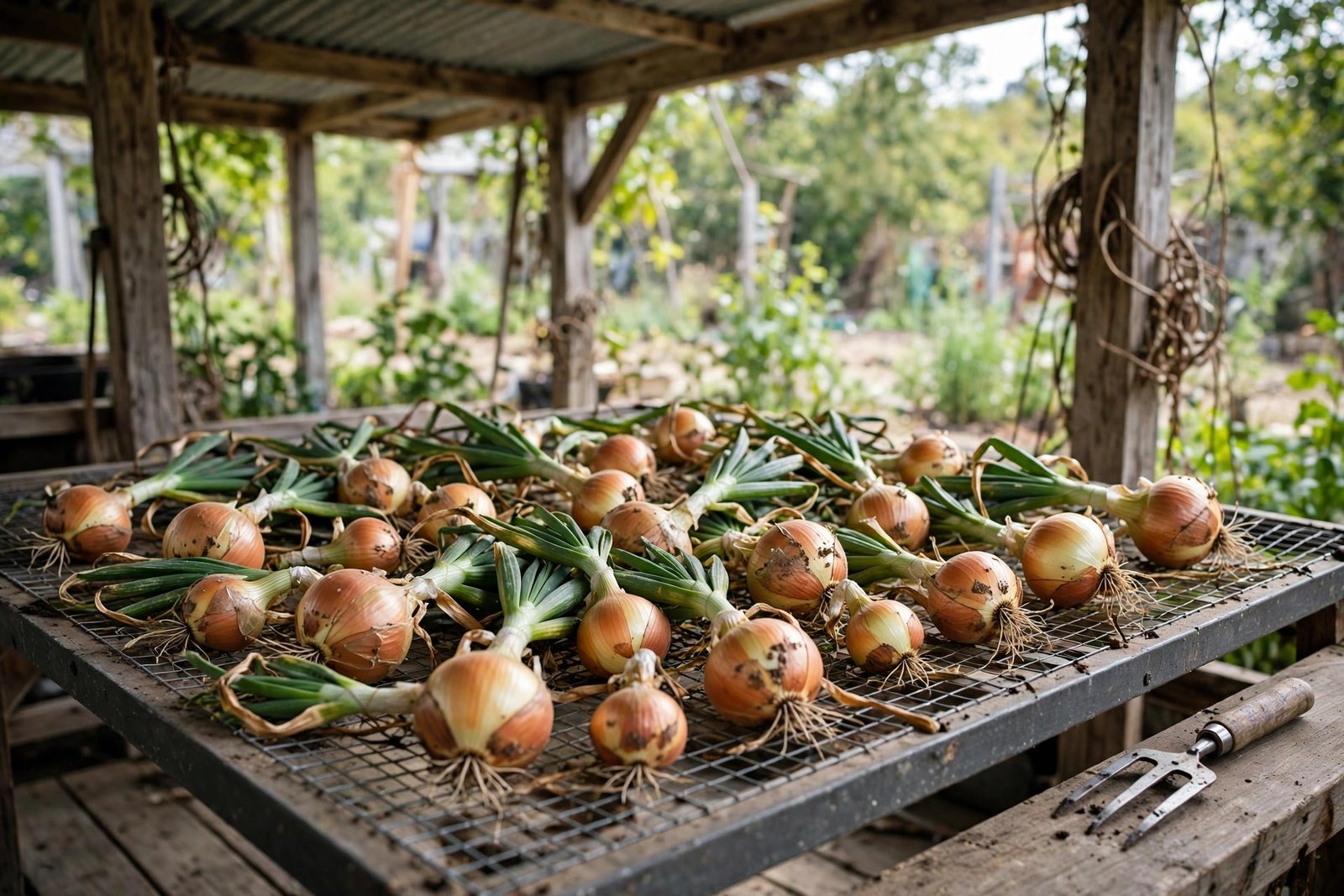
Cure the bulbs before storing them. Spread the plants in a single layer in a warm, dry, well-ventilated place out of direct sun, with the tops still attached. Minnesota Extension cures for 2 to 4 weeks at 75 to 90°F, until the outer scales are dry and the neck feels tight. Shorter cures appear in other sources: Maryland Extension cures for 1 to 2 weeks, Utah State dries bulbs in the garden for 1 to 2 weeks, and the Old Farmer’s Almanac Garden Planner cures for about 10 days. Follow the endpoint, not the shortest number: dry papery scales, a tight neck, dry roots. Minnesota warns that poor curing causes decay in storage.
Once cured, cut the tops off about 1 inch above the bulb on Maryland’s figure, or 1 to 2 inches on Utah State’s. Store the bulbs cool and dry, with air moving around them. Maryland Extension stores at 32°F and 65% to 70% humidity for up to 6 to 7 months. Utah State stores at 32 to 40°F dry, and puts its listed varieties at 2 to 4 months. Warm storage starts sprouting: Minnesota notes that onions sprout if kept above 40°F. Sweet short-day types keep the shortest time. The Farmers Almanac puts sweet varieties at 1 to 2 months and strong storage varieties at 4 to 8 months. Check stored bulbs regularly, and use any that soften or sprout first.
Five Mistakes That Shrink the Bulb
| Mistake | What happens | Do this instead |
|---|---|---|
| Wrong day-length type | Bulbs form too early and stay small, or never form at all. A mismatch cannot be fixed after planting. | Check the label for the type before you buy. Match it to your latitude. |
| A pot too shallow | Bulbs run out of room and stay small. | Use at least 10 inches of soil depth. Never use the 6-inch greens pot for bulbs. |
| Crowded plants | Each plant gets less room, water, and food. Bulbs stay small. | Space 4 inches apart for full bulbs. Wider for the biggest bulbs. Thin early. |
| A pot that dries out | Drought stress shrinks bulbs and raises bolting risk. | Check the top inch of mix. Water deeply when it feels dry. Mulch lightly. |
| Cutting green tops off bulb plants | Less leaf means less energy to fill the bulb, and cuts invite disease. | Leave the tops alone. Trim only indoor seedlings, before transplanting. |
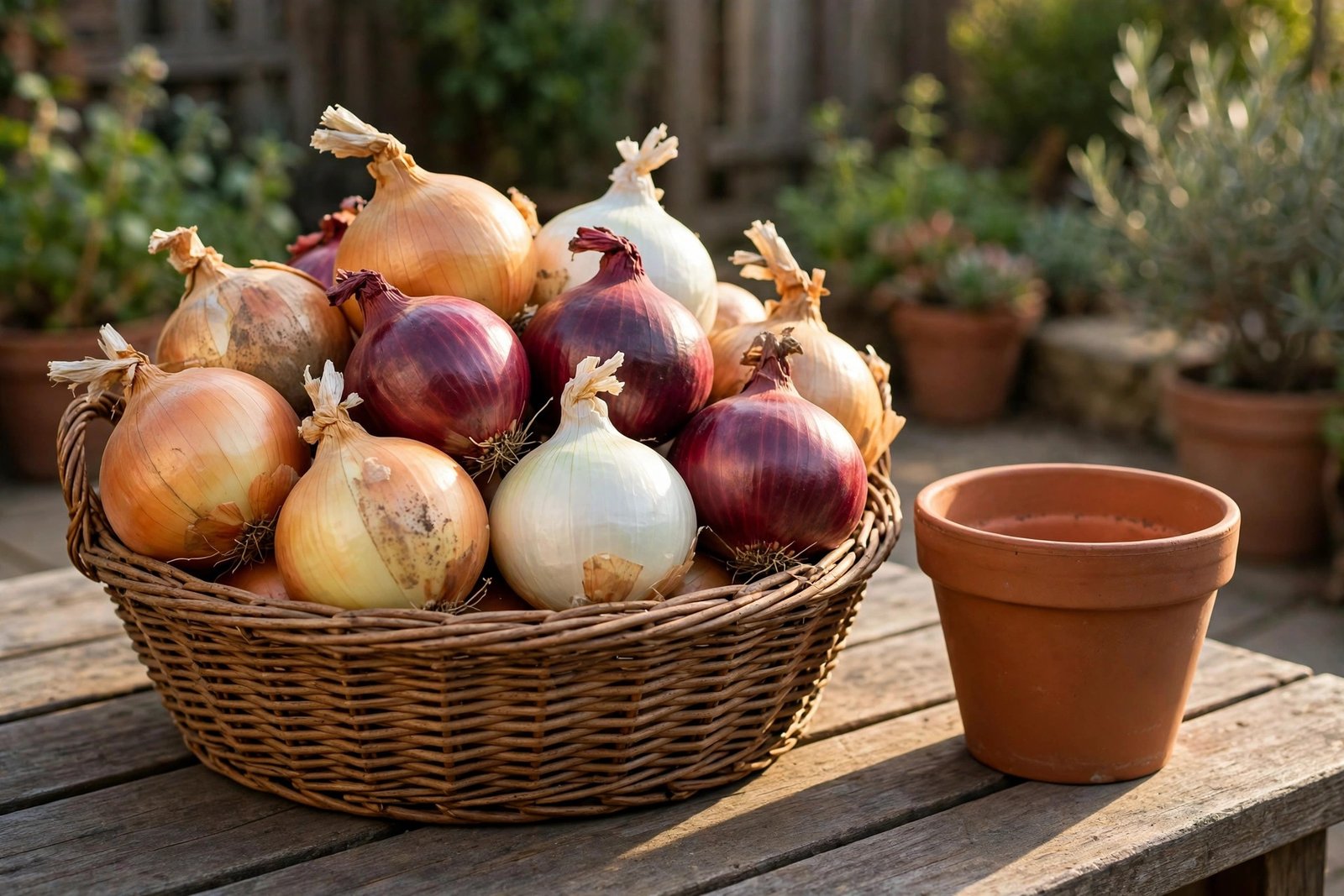
Onions in a pot reward the grower who decides well and then waits. Choose the type your daylight suits. Give it 10 inches of soil and 4 inches of room. Keep the mix moist, feed lightly and early, and let the tops fall when they are ready. Cure until the neck is tight, and the pot you planted in spring feeds the kitchen for months. November is the month to choose and order. The planting can wait for spring. The decision cannot wait, because the wrong type in spring is a season lost.
Growing Onions in Containers FAQs
What is the difference between short-day and long-day onions?
Daylight decides when each type starts forming a bulb. Short-day onions start bulbing at about 10 to 12 hours of daylight and suit the South, where they grow over fall and winter. Long-day onions need 14 to 16 hours and suit the North, where summer days run long. Intermediate or day-neutral types start at about 12 to 14 hours and suit the middle of the country. Plant the wrong type and you get leaves with tiny bulbs, or leaves with no bulbs at all. Match the type to your latitude and check the label before you buy.
How deep does a container need to be for full-size onion bulbs?
Use at least 10 inches of soil depth. That is the working figure container guides settle on, with 8 to 12 inches as the wider printed range. No university extension figure for bulb onions in containers was found during research for this guide. Do not use the 6-inch figure: Colorado State Extension’s container table lists green onions only at that depth, and green onions are a different harvest. A wide pot matters too, because onion roots run shallow and each plant needs room across the surface.
Should I grow onions from sets or seed?
Sets are the easiest route: small bulbs planted in early spring, reliable, with limited variety choice. Seed is the cheapest route with the widest choice, but it needs an indoor start of 8 to 12 weeks before planting out, and about 110 days from seed to bulb. Transplants split the difference: bundles of small plants that go out in early spring and give a head start without indoor seed work. Whichever route you choose, plant on time and favor pencil-size sets, since large sets bolt more readily.
When are container onions ready, and how do I cure them?
Lift when about half to two-thirds of the tops have fallen over and started to dry, usually 100 to 120 days from seed. Loosen the mix with a fork and lift each bulb gently with its tops attached. Then cure the plants in a single layer in a warm, dry, well-ventilated place out of direct sun until the outer scales are dry and papery and the neck feels tight. Minnesota Extension cures for 2 to 4 weeks at 75 to 90°F. Shorter cures of 1 to 2 weeks appear in other sources, so follow the tight-neck endpoint rather than the shortest number. Cut the tops off, and store sound bulbs cool and dry.
Sources and Further Reading
- University of Minnesota Extension, Growing onions in home gardens (read directly during research for this guide): long-day storage onions need 14 or more hours of daylight; short-day types in Minnesota generally develop small bulbs; plant early spring in well-drained soil high in organic matter; soil pH 6.0 to 7.0; shallow-rooted with constant moisture; too much nitrogen causes late maturity, large necks, soft bulbs, and poor storage; seed 1/4 to 1/2 inch deep, thin to 3 to 4 inches; start seed indoors 10 to 12 weeks before planting outside; transplants tolerate light frosts and go out at 50°F, planted 2 inches deep and 3 to 4 inches apart; water at least 1 inch a week, stop when bulbs are full size and tops begin to fall; mulch 3 to 4 inches; harvest when about half the tops are falling over and dry; cure 2 to 4 weeks at 75 to 90°F until scales are dry and the neck is tight; onions sprout if kept above 40°F.
- University of Maryland Extension, Growing Onions in a Home Garden (read directly during research for this guide): long-day onions set bulbs at 15 to 16 hours, short-day at about 12 hours, for deep South winter production; intermediate cultivars exist; plant early spring as soon as the garden can be cultivated; cold exposure after early planting can cause seed stalk development; sets pointed end up covered with 1 inch of soil; transplants from seed started indoors about 8 weeks before planting; full sun at least 6 hours a day, 8 to 10 preferred; 85 to 120 days to maturity; thin to 4 inches for moderate-size bulbs and 8 inches for large bulbs; do not hill; water amply, especially after bulbs begin enlarging; side-dress 1 to 2 weeks after bulb enlargement begins; harvest when about two-thirds of dried tops have fallen over; cure 1 to 2 weeks ventilated out of direct sun; cut tops about 1 inch above the bulb; store at 32°F and 65% to 70% humidity for up to 6 to 7 months.
- Utah State University Extension, How to Grow Onions in Your Garden (read directly during research for this guide): seeds 1/4 to 1/2 inch deep, rows 8 to 16 inches apart, plants 3 to 4 inches apart; thin before plants compete or start to bulb; high-density plantings reduce bulb size; transplants need about 8 weeks of grow time; planted too late in spring, most onions grow leaves and never form a bulb; keep moisture near field capacity and moisten thoroughly to 12 inches; drought stress decreases yield, reduces bulb size, and affects flavor; stop watering when tops fall over; do not fertilize after mid-July; control weeds especially during the first 2 months; bulb onions 100 to 120 days; leave until tops fall over, dry 1 to 2 weeks, cut leaves 1 to 2 inches above the bulb; store cold at 32 to 40°F dry; sets and transplants over 5/8 inch across bolt more readily; one set, transplant, or seed yields one onion.
- Colorado State University Extension, Vegetable Planting Guide, GardenNotes number 720 (read directly during research for this guide): dry onions from seed 4 to 6 inches apart, 1/4 inch deep, 110 days; dry onions from sets 4 to 6 inches apart, 1 to 2 inches deep, 110 days; green onions 2 to 3 inches apart; hardy vegetables plant 2 to 4 weeks before the average last spring frost.
- Colorado State University Extension, Vegetable Gardening in Containers, GardenNotes number 724 (read directly during research for this guide): the container table lists green onions only, at 6 inches deep with 8 hours of sun, with a constant water supply and soil never allowed to become dry. No dry or bulb onion row exists in this table, and the 6-inch figure must not be cited as a bulb figure.
- University of Illinois Extension, Growing Onions in Central Illinois (read directly during research for this guide): long-day onions need 14 to 15 hours of sunlight to form bulbs, short-day onions 10 hours, intermediate or day-neutral 12 to 14 hours; long-day types suit northern areas above the 35th latitude and short-day types the South; short-day varieties grown in Illinois will not form bulbs of decent size; transplants jump-start the season over seed or sets; plant with the bottom covered but not too deeply, and let bulbs rise out of the soil as they form; plant closer and thin by picking scallions; at least 1 inch of water a week; light mulching retains moisture and keeps weeds down.
- Ask Extension, Trimming onions (read directly during research for this guide): routine trimming of tops during the outdoor growing season is generally not recommended by university extension services; green tops are the plant’s solar panels, cutting reduces energy production and can limit bulb development, and fresh cuts can become entry points for pathogens; trimming seedlings indoors to about 4 inches at the first true leaf, on Minnesota Extension guidance, is a separate seedling practice.
- Old Farmer’s Almanac Garden Planner, Onion Growing Guide, United States and Canada (read directly during research for this guide): single plants 5 inches each way minimum, rows 3 inches apart with a 7-inch row gap; start seeds in pots under cover in late winter or plant sets in spring; short-day types suit southern latitudes and long-day types northern areas; seedlings are less likely to bolt than bulb onions grown from sets; harvest when bulbs form and tops fall over, then cure in a warm place for about 10 days.
- Farmers Almanac, How to Grow Onions: Day Length and Method (read directly during research for this guide): short-day onions form bulbs at 10 to 12 hours of daylight, long-day at 14 to 16 hours, day-neutral at 12 to 14 hours; example varieties Texas Grano and Red Burgundy for short-day, Yellow Sweet Spanish, Walla Walla, and Red Wing for long-day, Candy and Super Star for day-neutral; the earlier onions are planted, the more leaves they grow before bulb formation and the bigger the eventual bulb; sweet varieties keep 1 to 2 months and strong storage varieties 4 to 8 months.
- Gardening Know How, Growing Onions in Containers: A How-To Guide (read directly during research for this guide): an ideal onion container is 10 inches deep and several feet across; extremely good drainage, since an onion in soggy soil rots within days; short-day onions need 10 to 12 hours of day length and are planted in fall to overwinter in southern states; intermediate onions need 12 to 14 hours; long-day onions need 14 to 16 hours; seeds start indoors 8 to 10 weeks before the last frost; sets plant 1 inch deep 2 to 4 weeks before the last frost; soil kept consistently moist like a wrung-out sponge; containers dry faster than the ground and need at least 2 to 3 inches of water a week.
- Plant4Harvest, Growing Onions in Containers (read directly during research for this guide): 10 inches of soil depth is the minimum practical target for mature bulb onions, with 3 to 4 inches of room per onion and 6 to 8 hours of direct sun; a 5-gallon bucket holds 6 to 8 onions; bunching onions need only 6 inches of depth; sets plant 1 inch deep with the pointed tip up; transplants bury the roots and about 1 inch of the lower plant; pencil-size sets give the best bulbs; container onions need about 1 to 2 inches of water a week, watering deeply when the top inch of soil feels dry; harvest when about half the tops have fallen over and dried; cure at 75 to 90°F for 2 to 4 weeks until scales are dry and the neck is tight.