
How to Prune and Harvest Basil So It Keeps Growing

Yes, one basil plant can keep producing for months. The trick is not a special cut. It is a steady rhythm of light cuts, a rescue done early when the plant stretches or hardens, and a plan for the glut at the end of the season. Harvesting and pruning are the same act with basil. Every leaf you pick is also a pruning cut, and every pruning cut decides how much the plant gives you next.
This guide covers the part that comes after the first pinch. It sets out the harvest rhythm, with the honest disagreements left visible. It gives a rescue procedure for leggy, woody, and flowered plants. And it ends with the whole-plant harvest and three ways to keep it. Growing the plant from seed or cutting, and the setup and watering around it, lives in our indoor basil guide. What follows starts with the plant already growing.
The Move You Already Know
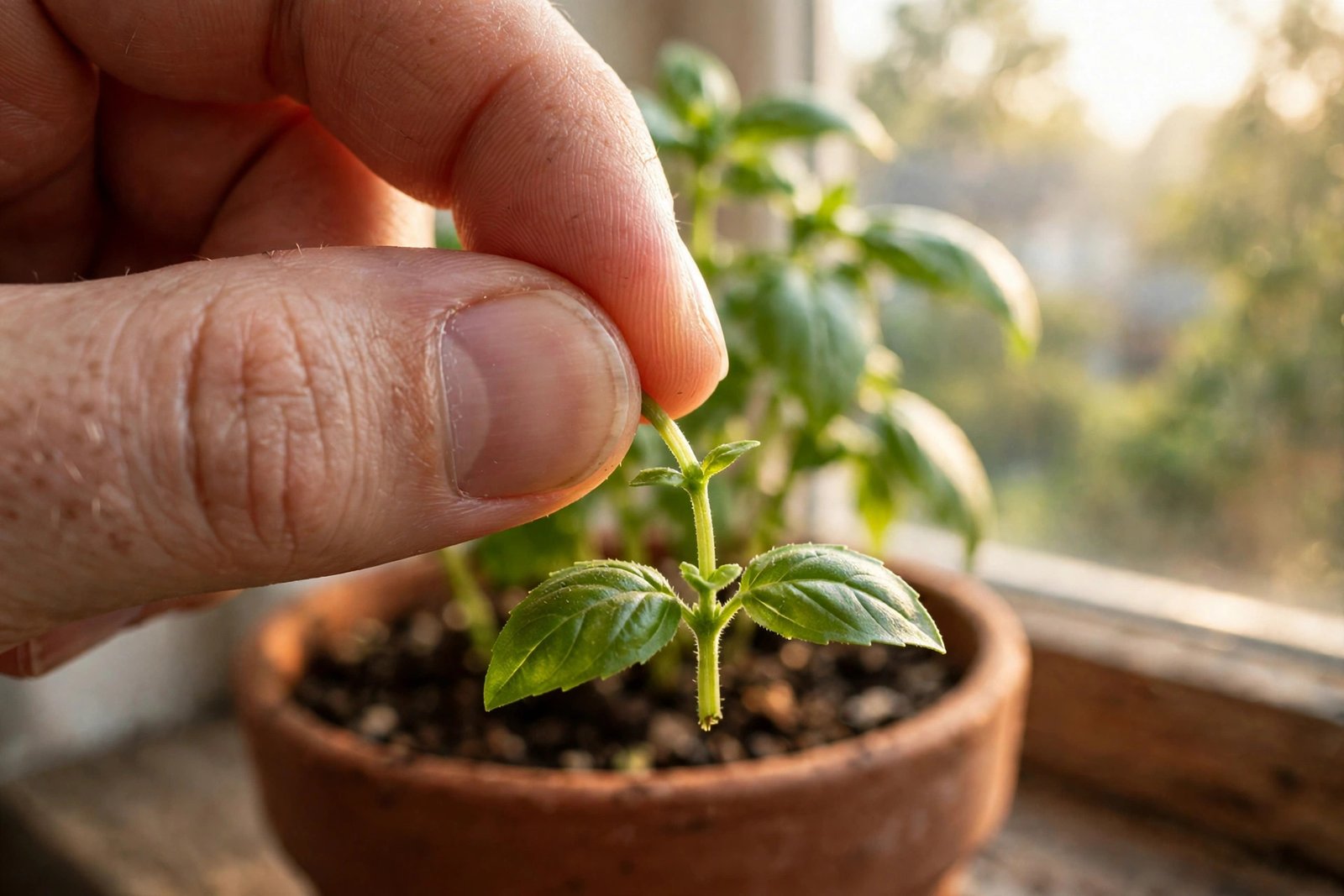
The whole technique fits in one sentence. Pinch or snip the stem tip just above a pair of leaves, and the two side buds at that pair wake up and grow into new branches. Every harvest after that follows the same rule. Take the tip, always above a leaf pair, and each cut doubles the growing points below it. Keep the cuts light and regular, and never take more than about a third of the plant at once. Flower buds come off the moment they appear, because a plant allowed to flower puts its energy into seed and the leaves turn bitter. New growth shows at the cut point within about a week. That is the entire move. Our guide to growing basil indoors teaches it from the first pinch, with the setup and watering the plant needs around it. This guide picks up where that one leaves off.
The Harvest Rhythm: Light Cuts, Steady Pace
A rhythm beats a single heroic cut. Basil branches from every tip you remove, so small cuts taken often build a bushier plant than one big chop taken rarely. The table below is the whole system. Two rows carry open disagreements, and both sides are named rather than averaged.
| Question | The honest answer |
|---|---|
| First harvest | At about 6 inches tall, with 2 to 3 sets of true leaves. The Old Farmer’s Almanac puts the same moment at 6 to 8 inches. |
| How often | Two ranges, both published. UF/IFAS Extension says pinching every 1 to 2 weeks prevents leggy growth. Our indoor basil guide and Farmer’s Almanac say every 2 to 3 weeks. Fast summer growth refills in the shorter span. Slower indoor winter growth needs the longer one. |
| How much at once | About one third is the cap most guides use, including The Old Farmer’s Almanac. Farmer’s Almanac is more cautious, at 20 percent. Take the smaller share from a young, stressed, or just rescued plant. |
| Time of day | Morning, after the dew dries and before the heat of the day. Clemson Extension’s herb guidance sets that window, and Penn State Extension also says to harvest preferably in the morning. |
| Tools | Clean, sharp scissors for thicker stems. Fingers are fine for soft young tips. Never tear. UF/IFAS Extension notes that clean, sharp cuts heal quickly and lower the chance of infection. |
Two habits sit underneath the table. The first is the light snip. The University of Minnesota Extension says to harvest at any time by snipping fresh young leaves as needed, and that stays true all season. A few leaves for tonight’s cooking need no schedule. The cadence in the table is for stem-tip cuts, the ones that shape the plant. The second habit is dryness after a cut. Clemson Extension notes that gray mold often starts on the fresh cuts left by harvesting, and the stems heal completely within about 48 hours. Harvest dry plants, keep the cuts dry, and water at the base for a day or two after a heavy session.
The cue that settles both arguments: watch the regrowth, not the calendar. When the new side branches have put on a few inches of fresh growth with new leaf pairs, the plant is ready for the next round. A fast plant in summer sun gets there in a week or two. A slow plant on a winter sill takes closer to three. The ranges disagree because the plants grow at different speeds.
Rescue the Plant You Have
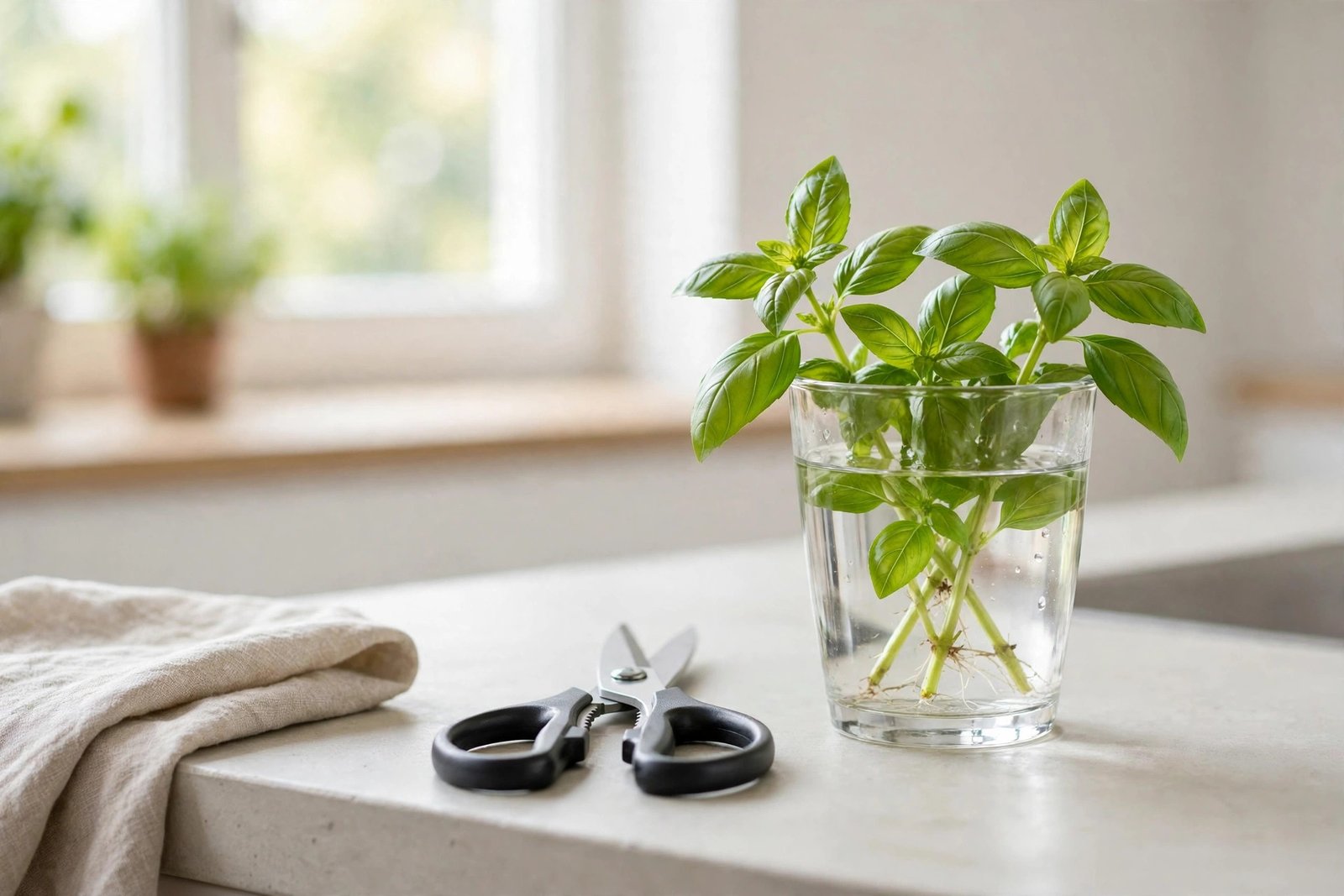
A basil plant that got away from you is not a lost plant. It is a plant that needs one decisive cut and better light. Work out which of the three states yours is in, because each one gets a different cut.
Leggy: long stems, sparse leaves, leaning toward the light
Legginess means the plant spent its energy reaching for light it never got. More water will not fix it, and neither will fertilizer. The fix is a cut plus a brighter spot.
- Cut each long stem back to just above the lowest healthy pair of leaves. Leave every healthy leaf pair below the cut. The plant will look bare for a while. That is part of the deal.
- Move the pot to the brightest spot you have, or add light hours under an LED. A cut without more light just grows leggy again.
- Wait for the regrowth. New growth shows at the cut points within about a week, on the University of Minnesota Extension timetable. Judge the rescue by the new shoots, not by the bare stems.
Do not feed heavily to rush it. Clemson Extension warns that over-fertilized basil grows fast and tastes worse. A recovering plant needs steady care, not a push.
Woody: a brown stem with leaves only at the top
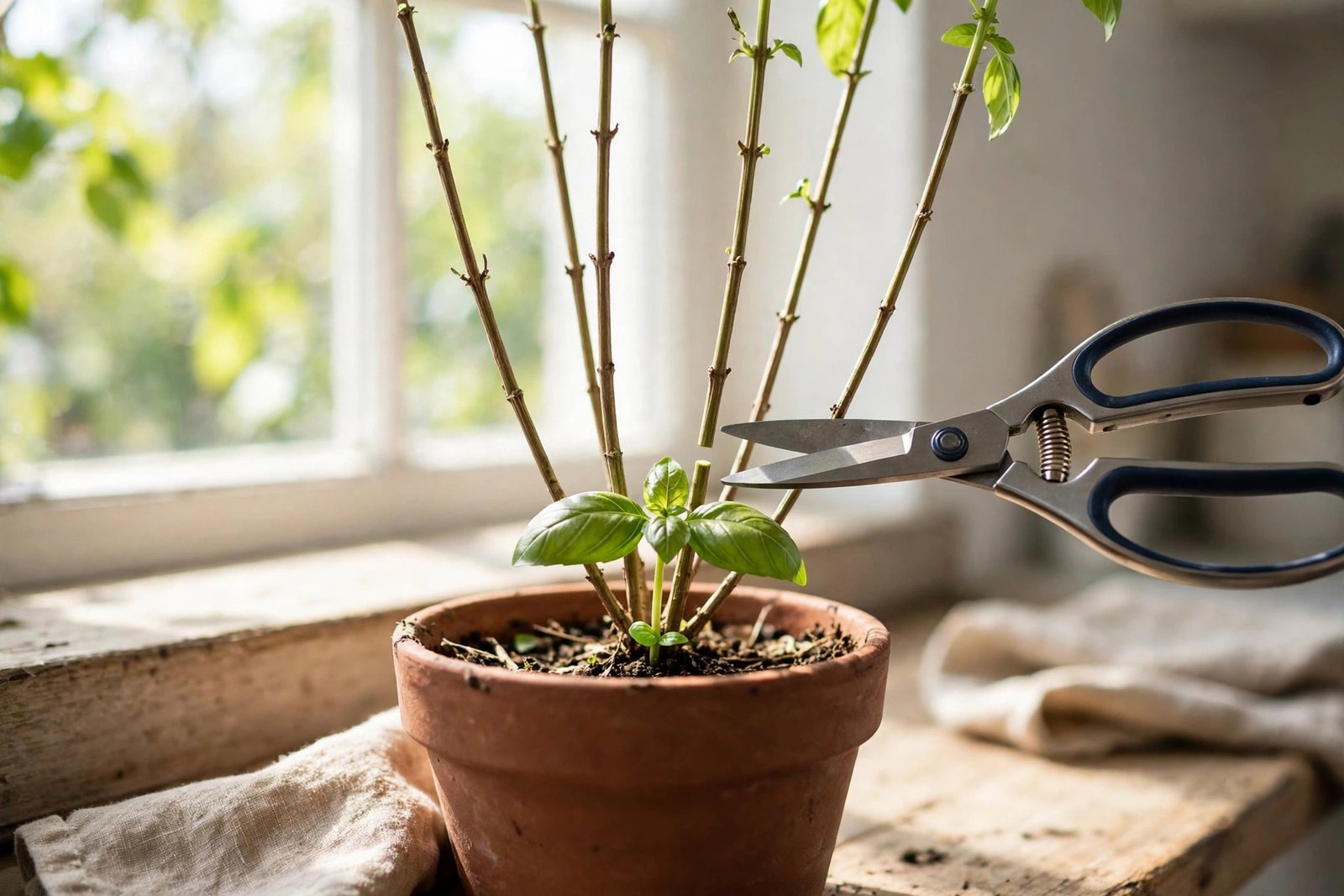
Woodiness is what flowering leaves behind. The University of Minnesota Extension is blunt about it. A basil plant allowed to flower and set seed turns woody, yields drop considerably, and the flavor turns bitter. The stem hardens, the lower leaves fall, and growth retreats to the tips.
Rescue starts with insurance. Take cuttings from the healthiest green tips before the hard cut, because cuttings root easily in water, as Penn State Extension notes. If the old plant fails to restart, the cuttings carry the variety forward.
Then make the hard cut. Growing guides put the rescue cut at 4 to 6 inches above the soil, just above the lowest living leaf pair or visible dormant buds. Give the plant warmth and strong light, water at the base, and leave it alone. A hard-pruned plant restarts more slowly than a pinched tip, so give it time before you call it.
Rescue or restart? Rescue the plant when the stem still carries living leaf pairs or visible buds low down, the stem is still flexible, and the flowering is recent. Restart from cuttings when the stem is bare brown wood to the base, when no buds show below the top, or when a plant you already rescued once has stalled again. Basil is an annual, and the University of Minnesota Extension notes that basil plants flower and die eventually, even indoors. A fresh cutting is not giving up. It is the faster plant.
Flowered: buds open, flavor already changing
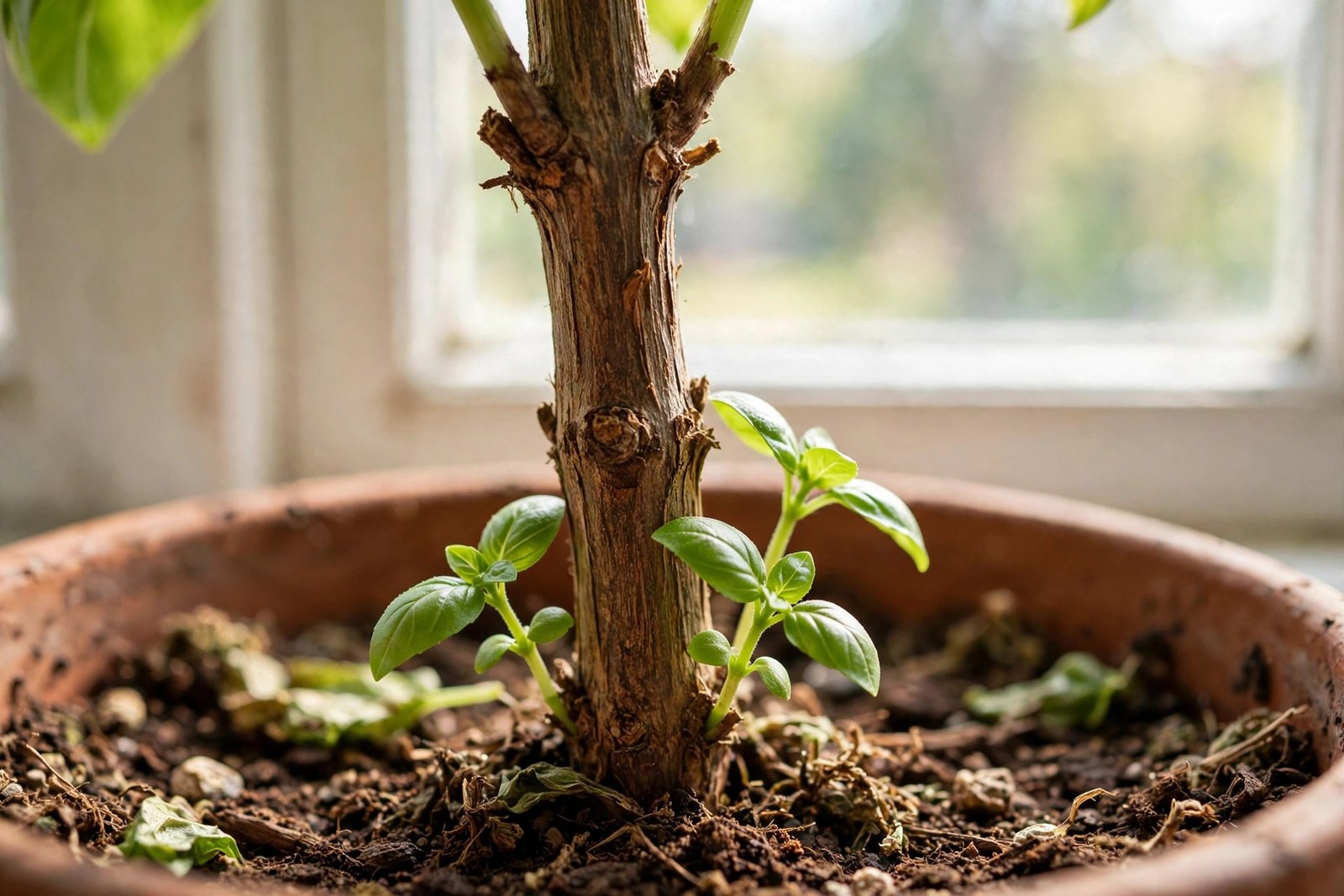
If the buds are still closed, pinch them off the moment you spot them. Clemson Extension says flower buds should come off as soon as they appear if you want the most flavorful foliage, and Penn State Extension notes that leaf flavor declines after bloom. If a stem has already bloomed, cut that stem back below the flowers to a leaf pair, and expect the leaves on it to taste weaker and more bitter than the pickings from before it bloomed. If the whole plant has flowered, take cuttings from any tips that have not, and let the old plant finish. Our guide to growing basil indoors covers the flower-bud habit in full, including when to start a fresh plant instead of fighting the old one.
One aftercare note. If leaves yellow in the days after a heavy cut, do not answer with more water or more feed. Work through our guide to why basil leaves turn yellow and match the pattern to the cause first.
End of the Season: Take It All, Then Keep It
Every basil plant ends the same way. Leaves deteriorate when temperatures fall below 50°F, Penn State Extension notes, and the first fall frost kills the plant outright. Clemson Extension gives the outdoor instruction plainly: before the first fall frost kills the basil, cut the plants back for harvest. For a pot that has lived indoors all winter, the ending looks different. The plant tires, the stems harden, and new growth slows to a stop. That is the annual lifecycle finishing, not a failure. Take the last big harvest the same way. Cut the stems at the base, keep the best leaves for the kitchen, and preserve the rest the same day.
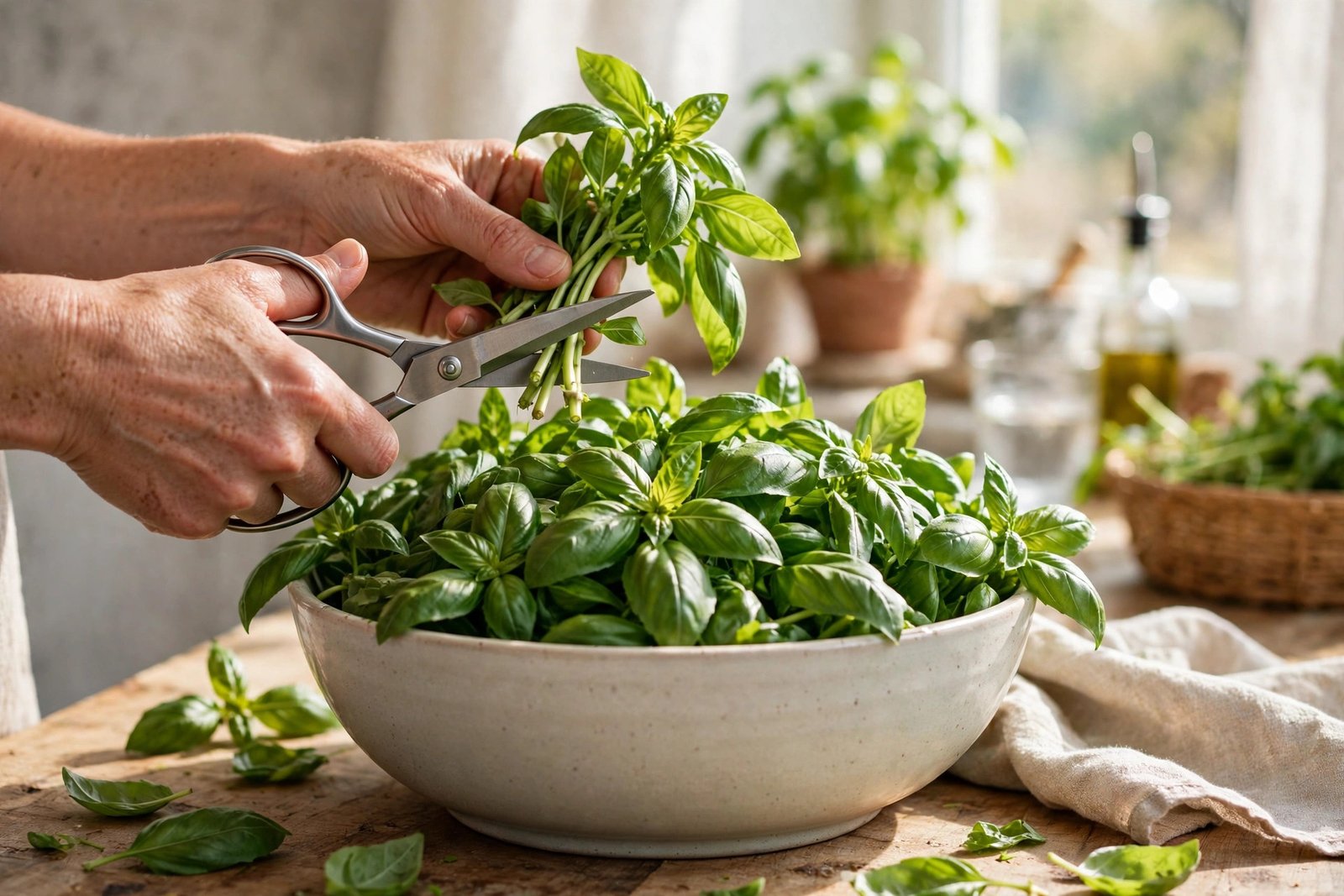
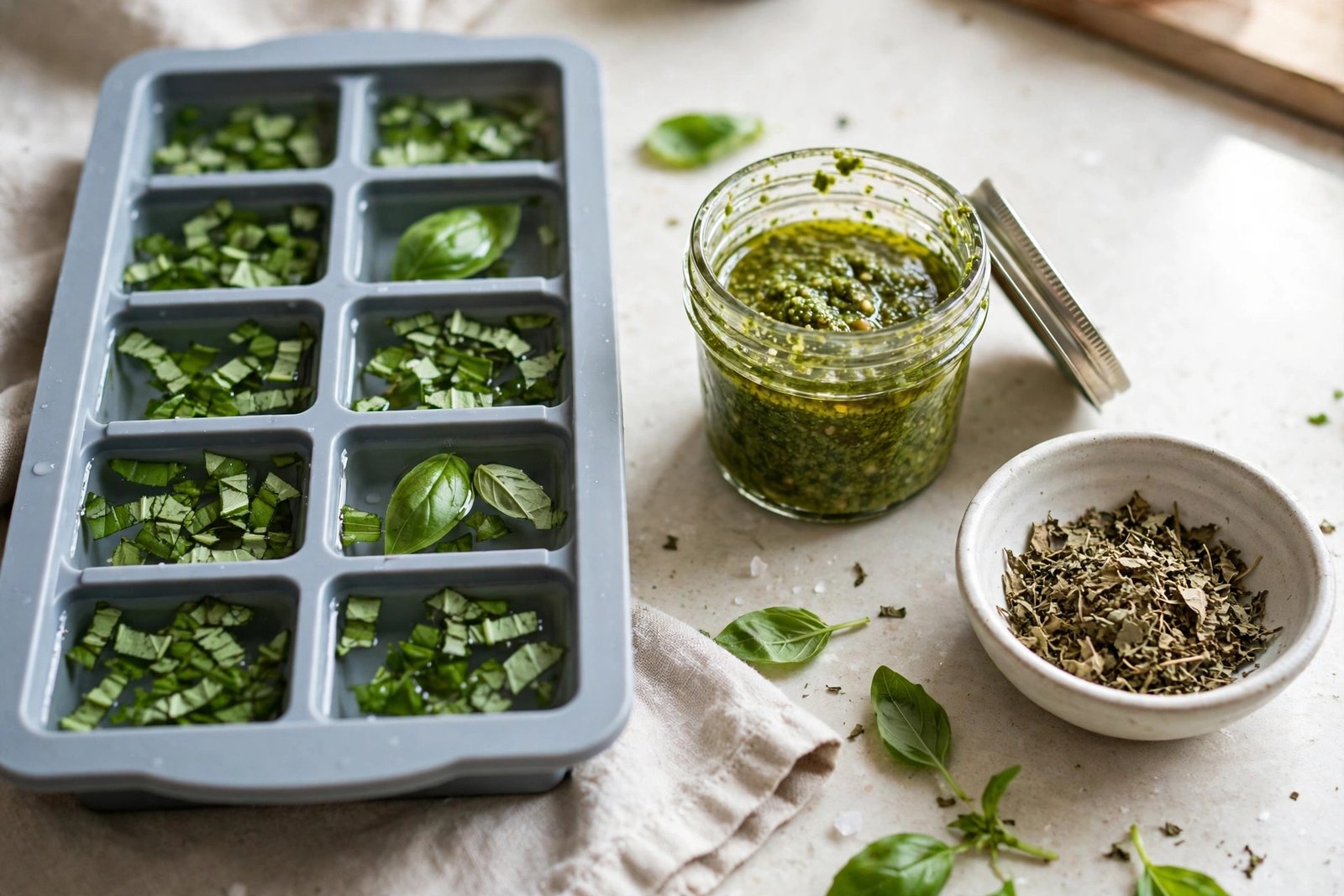
Fresh basil does not wait. Penn State Extension puts cut stems in a glass of water at room temperature for a few days, or in a plastic bag wrapped in a paper towel in the refrigerator for up to a week. For anything bigger than a few days, preserve it. The University of Minnesota Extension basil guide walks through all three methods below, and it is blunt about which one wins on flavor.
| Method | How | Keeps | Flavor |
|---|---|---|---|
| Freeze (best) | Chop leaves and freeze in ice cube trays topped with water, or freeze whole leaves in small bags. A spoonful of oil mixed through chopped basil freezes well too. | Use within a year. | Closest to fresh. Both the University of Minnesota Extension and Clemson Extension say freezing keeps basil’s flavor better than drying. |
| Dry | Hang small bundles upside down in a warm, dry, ventilated room for about a week, or spread leaves flat. Crumble fully dry leaves into small airtight containers. | About a year, up to 12 months. | Fades. The University of Minnesota Extension notes air-dried leaves turn an unpleasant brown. |
| Pesto | Blend the glut into pesto and freeze it in small containers. Leave the cheese out if the batch is for the freezer. | Frozen, within a year. | Pesto-ready months later. |
One drying detail splits the extension sources, so here it is plainly. The University of Minnesota Extension and Clemson Extension both hang small bundles of stems upside down in a warm, ventilated room. Penn State Extension says the opposite: spread the leaves flat on a tray and do not hang them in bundles, because bundled leaves dry too slowly and can mold. Both sides agree on the conditions that matter: dry air, moving air, and no damp. If your room is dry and airy, small loose bundles work. If the air is humid, spread the leaves flat. Either way, do not oven-dry them. Penn State Extension warns the leaves scorch.
Five Mistakes That Cost the Next Harvest
Most basil pruning problems are not diseases. They are cuts in the wrong place, cuts too big, or cuts left too late. The table is the short version of this whole guide.
| Mistake | What it costs | Do this instead |
|---|---|---|
| Stripping leaves from the base | The bottom leaves power the plant. Farmer’s Almanac calls them the powerhouses: they take in the sunlight that feeds regrowth. Strip them and the plant has nothing to rebuild with. | Take stem tips from the top, always above a leaf pair. |
| Cutting below the lowest leaf pair | A stem cut below its last living pair has no buds left to wake. It dries back instead of branching. | Cut just above the lowest healthy pair, never into bare wood with no buds. |
| Taking more than a third at once | The plant stalls while it rebuilds enough leaf area to grow again. | Stay inside a third, or inside 20 percent if the plant is young or stressed. |
| Leaving flower buds for the weekend | A bud left for a few days opens, and the plant shifts energy to seed. Flavor drops and leaf production slows. | Pinch buds the moment you spot them. |
| Harvesting wet plants, or wetting fresh cuts | Clemson Extension notes gray mold often starts on fresh harvest cuts, and wet foliage invites it. Cuts stay vulnerable for about a day and heal fully by about 48 hours. | Harvest dry plants, keep cuts dry, and water at the base. |
The short version of everything above: pinch the tips, keep the rhythm light and regular, rescue early while buds still show low on the stem, and take the whole plant before the cold does. The plant does the branching. Your job is the calendar, the scissors, and the morning you pick.
Pruning and Harvesting Basil FAQs
How often can I harvest basil?
Snip a few young leaves any time you need them. For real stem-tip harvests, the published ranges run from every 1 to 2 weeks to every 2 to 3 weeks. UF/IFAS Extension puts pinching every 1 to 2 weeks for fast-growing plants, while our indoor basil guide and Farmer’s Almanac use every 2 to 3 weeks. Let the regrowth decide. When the new side branches have put on a few inches of fresh growth with new leaf pairs, the plant is ready for the next round.
My basil has turned woody. Can I save it?
Sometimes. Cut the woody stems back to 4 to 6 inches above the soil, just above the lowest living leaf pair or visible buds, and move the plant into strong light and warmth. Take cuttings from the healthiest green tips first, because cuttings root easily in water and the old plant may not restart. If the stem is bare brown wood with no buds low down, restart from cuttings instead. Basil is an annual, and a plant allowed to flower turns woody with lower yields and bitter leaves, so an old woody plant often gives a worse return than a fresh cutting.
Can I harvest basil after it flowers?
Yes, the leaves are still usable, but they will not taste their best. Penn State Extension notes that leaf flavor declines after bloom, and the University of Minnesota Extension adds that a plant allowed to flower and set seed turns woody with considerably lower yields. Cut the flowered stems back below the blooms to a leaf pair, keep pinching new buds, and take cuttings from any tips that have not flowered. The best-flavored leaves are picked before the plant blooms.
How do I store a big basil harvest?
Freeze it. Chop the leaves and freeze them in ice cube trays topped with water, freeze whole leaves in small bags, or blend the glut into pesto and freeze it in small containers without the cheese. Use frozen basil within a year. Drying works too. Hang small bundles upside down in a warm, dry, ventilated room, or spread the leaves flat, then store them airtight for up to about a year. Dried basil loses flavor and browns, so freezing keeps more of the fresh taste. For a few days only, stand cut stems in a glass of water at room temperature.
Sources and Further Reading
- University of Minnesota Extension, “Growing basil in home gardens” (read directly): prune periodically to maintain succulent, productive growth; flowering leads to woody plants, considerably lower yields, and bitter flavor; cut whole stems just above a pair of leaves, with new growth visible within a week; drying, freezing, and pesto methods; use frozen basil within a year; basil is an annual that flowers and dies eventually, even indoors.
- Penn State Extension, “Herb Garden Plants: Basil” (read directly): leaf flavor declines after bloom; pinch growing tips to retard flowering and promote branching; harvest before flowers bloom, preferably in the morning; spread leaves flat to dry and do not hang in bundles, which dry too slowly and can mold; leaves deteriorate below 50°F; cut stems keep a few days in water at room temperature or up to a week refrigerated in a bag wrapped in a paper towel; do not oven-dry; cuttings root easily in water.
- Clemson Extension, HGIC “Herbs” factsheet (read directly): harvest just prior to blooming, when essential oils are at peak; harvest early in the morning, after the dew dries, but before the heat of the day; freezing is an excellent method for basil, which loses flavor when dried; prune and harvest regularly; good sanitation and removal of weak growth.
- Clemson Extension, HGIC 1327 “Basil” (read directly): pinch terminal growth periodically to encourage branching and thicker plants; flower buds pinched as soon as they appear for the most flavorful foliage; before the first fall frost, cut plants back for harvest and pot up roots for indoor growth; leave enough foliage so growth is not significantly reduced; air-dry or dehydrate under 125°F, small bundles hung upside down in a warm, ventilated room, airtight storage up to 12 months; gray mold begins on stem cuts made during harvest, stems much less susceptible at 24 hours and completely healed at 48 hours, do not harvest in wet weather.
- UF/IFAS Extension, EDIS EP622 “Pruning, Harvesting and Maintenance of Florida-Friendly Edible Landscapes” (read directly): pinching back basil stems every 1 to 2 weeks prevents leggy growth; clean, sharp tools make precise cuts and allow plants to heal quickly, reducing the chance of infection; clean and sanitize tools before use on other plants.
- Farmer’s Almanac, “8 Tips for Big Bushy Basil Plants All Summer” (read directly, updated July 21, 2026): harvest only 20 percent of the plant each time; repeat pinching every 2 to 3 weeks; first pinch at 6 inches tall with 2 to 3 sets of true leaves; keep the large bottom leaves intact, as they are the powerhouses of the plant.
- The Old Farmer’s Almanac, “Growing Basil” (page text verified in search results): start harvesting at about 6 to 8 inches tall; harvest in the morning after the dew has dried; remove no more than about one third of the plant at once; continue pinching or harvesting every week or two.
- University of Illinois Extension: leaf damage starts at about 50°F, with blackening in the 40s, already cited on-site in the basil-indoors and yellow-basil posts.
- Guide practice, labelled as such in the article rather than as extension fact: cutting a leggy plant back to the lowest healthy leaf pair; the woody hard prune to 4 to 6 inches above dormant buds with a cuttings restart; the honest line that a very old woody plant is often not worth saving.