
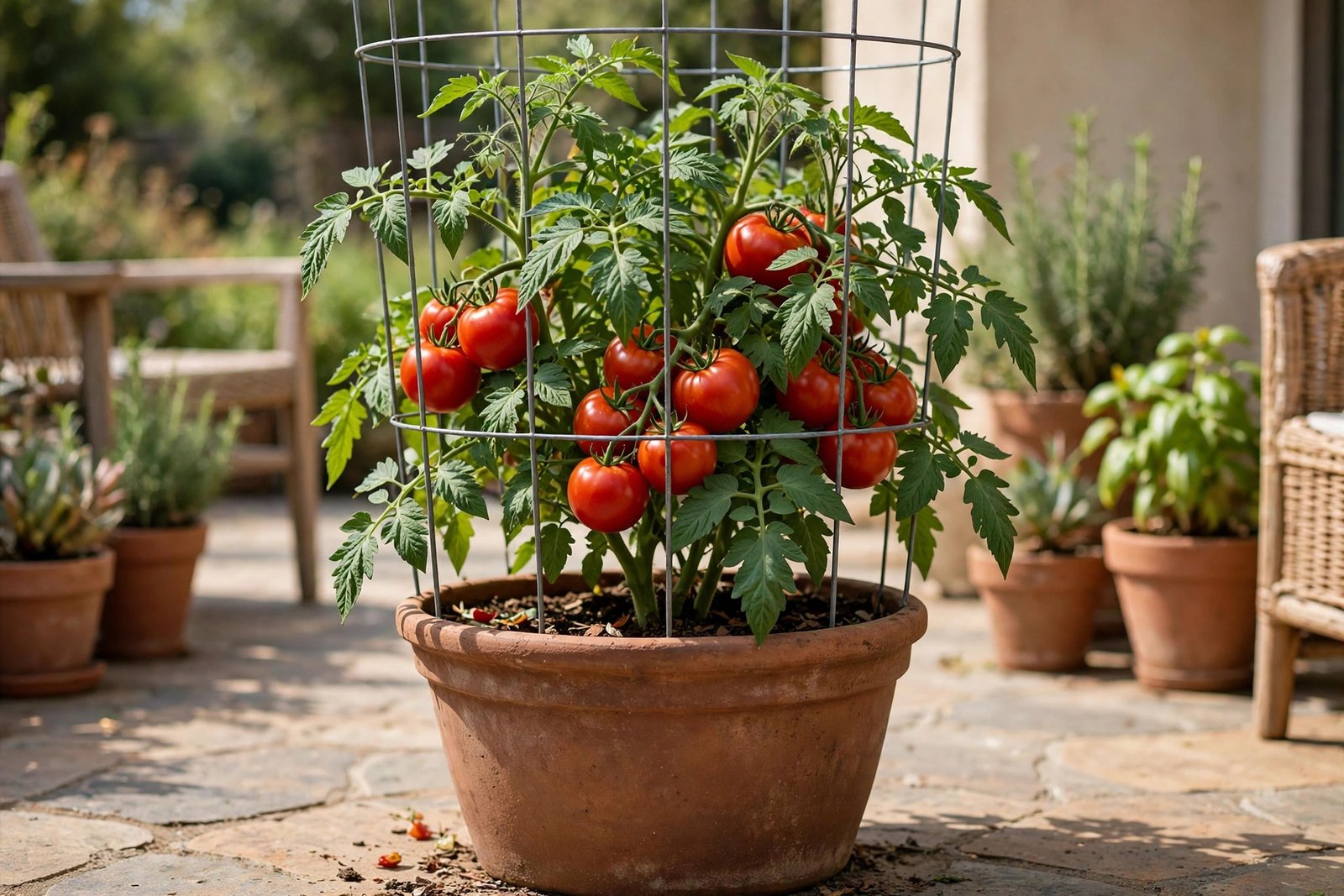
How to Grow Tomatoes in Containers: Determinate First, One Plant Per Pot
A tomato in a pot on a sunny patio can feed you all summer, but only when the plant type fits the pot. This guide is about full tomatoes grown outdoors, on a patio, a balcony or a sunny doorstep, in pots. It is not the indoor cherry tomato guide. If you want cherry tomatoes under grow lights inside, start with our guide to growing cherry tomatoes indoors, and come back here when you have outdoor sun to offer.
November is planning time, not planting time. Tomatoes die in frost, so nothing goes outside until after your last frost, in spring. What you can do now is pick the type, buy the pot, and learn the two or three moves that decide whether the plant thrives or struggles. The first move is the plant type, so that is where this guide starts.
The short version: pick a determinate or dwarf variety, give it a 5 to 10 gallon pot, put it in the sunniest spot you have, set the cage in at planting time, and water deep and steady. An indeterminate vine is a different job, and this guide treats it as one.
Pick the Plant Type First
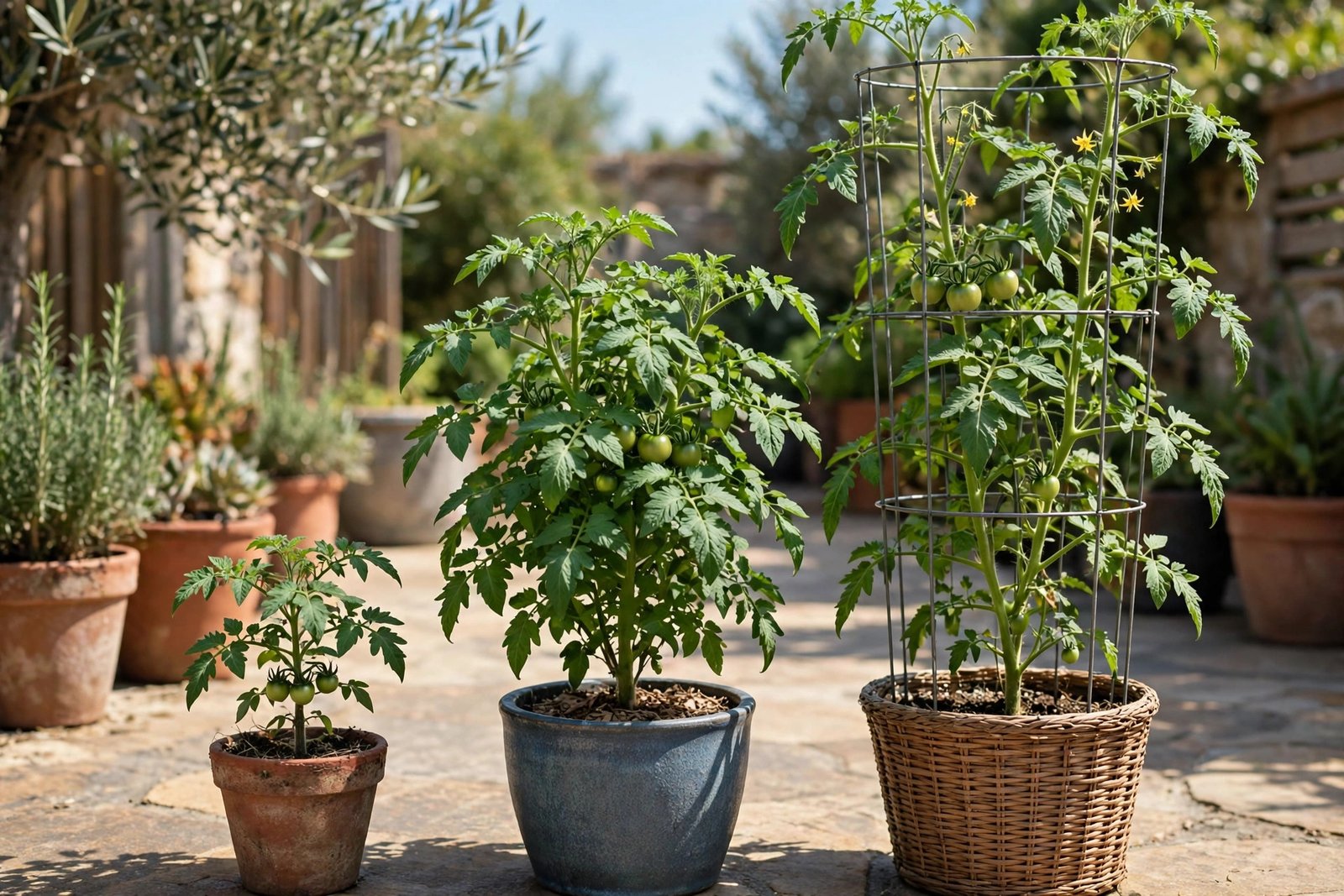
Tomatoes come in three growth habits, and the habit decides the pot, the support and the work. Pick the habit before you buy anything. The table below is the whole decision. The rest of this guide follows from it.
| Plant type | How it grows | Fruit pattern | Pot it needs | Support |
|---|---|---|---|---|
| Determinate, or bush | Grows to a set height, about 2 to 3 feet, then stops | Most fruit ripens in one 4 to 6 week window, good for sauce and canning | 5 gallons minimum, 7 to 10 gallons better | Little or none; a small stake helps |
| Dwarf or patio | Bred to stay small, often 1 to 2 feet tall | Steady fruit over the season on a small plant | 5 gallons is plenty | Usually none |
| Indeterminate, or vining | Keeps growing and fruiting until frost kills it, 5 feet or more | A few fruit at a time, all season long | 15 to 20 gallons only, with a tall cage | Tall cage or stake, plus pruning all season |
If you buy one plant this spring, buy a determinate. It fits a normal patio pot, needs little support, and gives you a real harvest in one window. Save the indeterminate vine for the year you have a 15 to 20 gallon pot, a tall cage and time to water it every day in July.
An indeterminate is not a bad plant. It is a big plant. It wants 5 feet of height and room to spread, and it drinks a lot in summer. In a 5 gallon bucket it will not stay small. It will dry out fast, get stressed, and give you less fruit than the same variety in the ground. Grow one only when you can give it the big pot, the tall cage and the daily watering it asks for.
What Size Pot Does a Tomato Need?
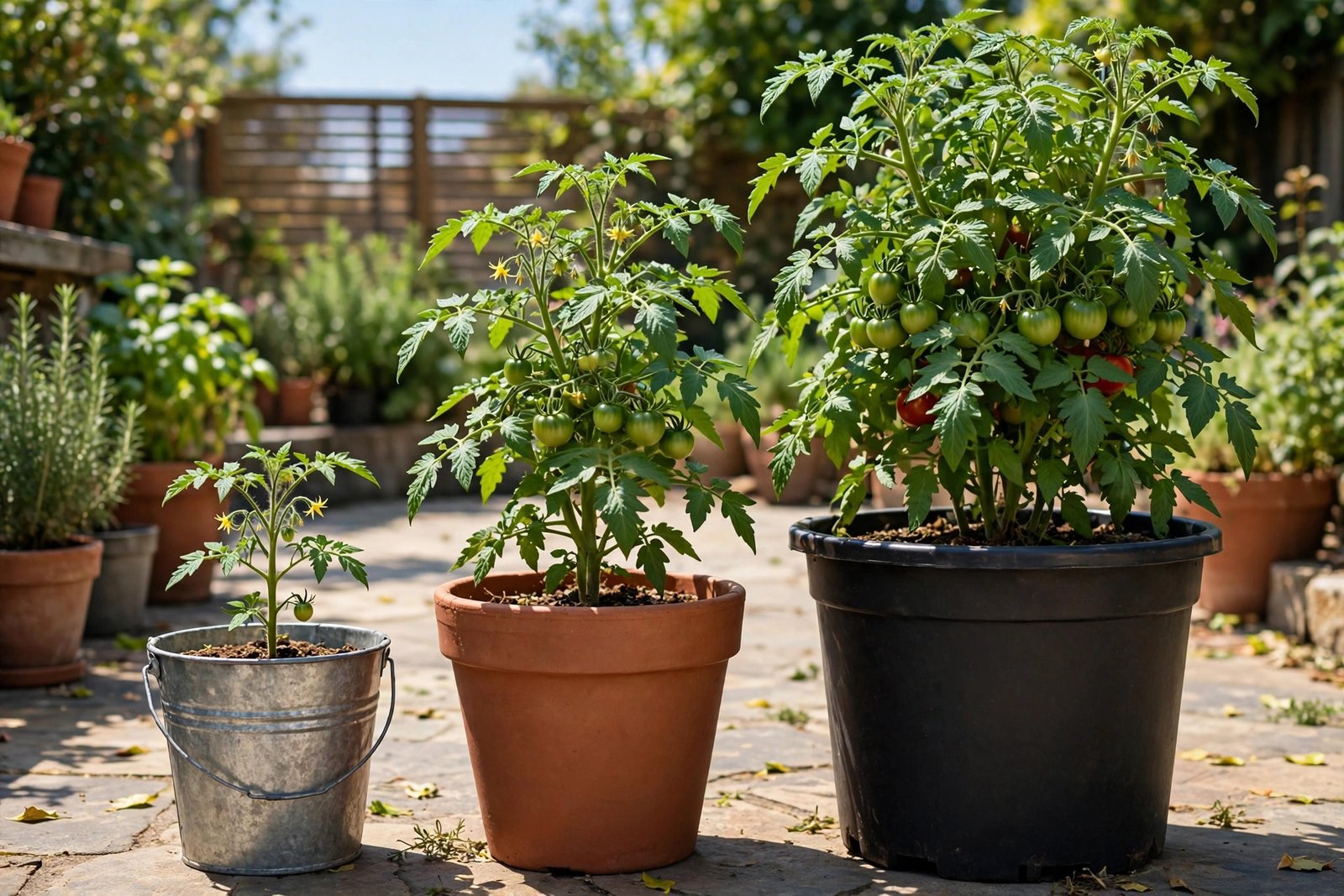
Ask five guides what size pot a tomato needs and you get five answers. That is not sloppiness. Each answer fits a different plant size. The honest way to show it is the table below, with each source named, so you can match the number to your plant. The full guide behind the first row is Iowa State Extension’s Growing Tomatoes in Containers.
| Source | What it says | Fits which plant |
|---|---|---|
| Iowa State Extension | Cherry: at least 2 gallons, about 10 in across. Standard: at least 4 gallons, about 12 to 14 in across | Cherry types; standard slicing types |
| Epic Gardening | A 14 in pot is the minimum; bigger is better | Any tomato, as a floor |
| Gardening Know How | At least 12 to 14 in across, at least 12 in deep | Any tomato |
| Penn State Extension | At least 20 in wide for a single tomato | One full-size plant |
| Container-growing guides | Determinate: 5 gallons minimum. Indeterminate: 15 to 20 gallons | Bush types; vining types |
The determinate and indeterminate gallon figures in the last row come from container-growing guides, not from extension. Every other row is extension guidance, and the Penn State row is quoted in our best vegetables to grow in pots guide.
What to buy: a 10 gallon pot with drainage holes covers a determinate or dwarf plant with room to spare. A 5 gallon bucket is the floor, not the goal. For an indeterminate vine, buy 15 to 20 gallons, or do not grow it in a pot at all. Drainage holes are not optional. A pot without them keeps roots wet and invites rot. One plant per pot, so watering stays predictable and air can move around the plant.
Material matters less than size and drainage. Plastic holds water longest, terra cotta dries fastest, and fabric breathes. A big pot is heavy once it is full of wet mix, so put it in its final spot before you plant.
Varieties That Fit a Pot
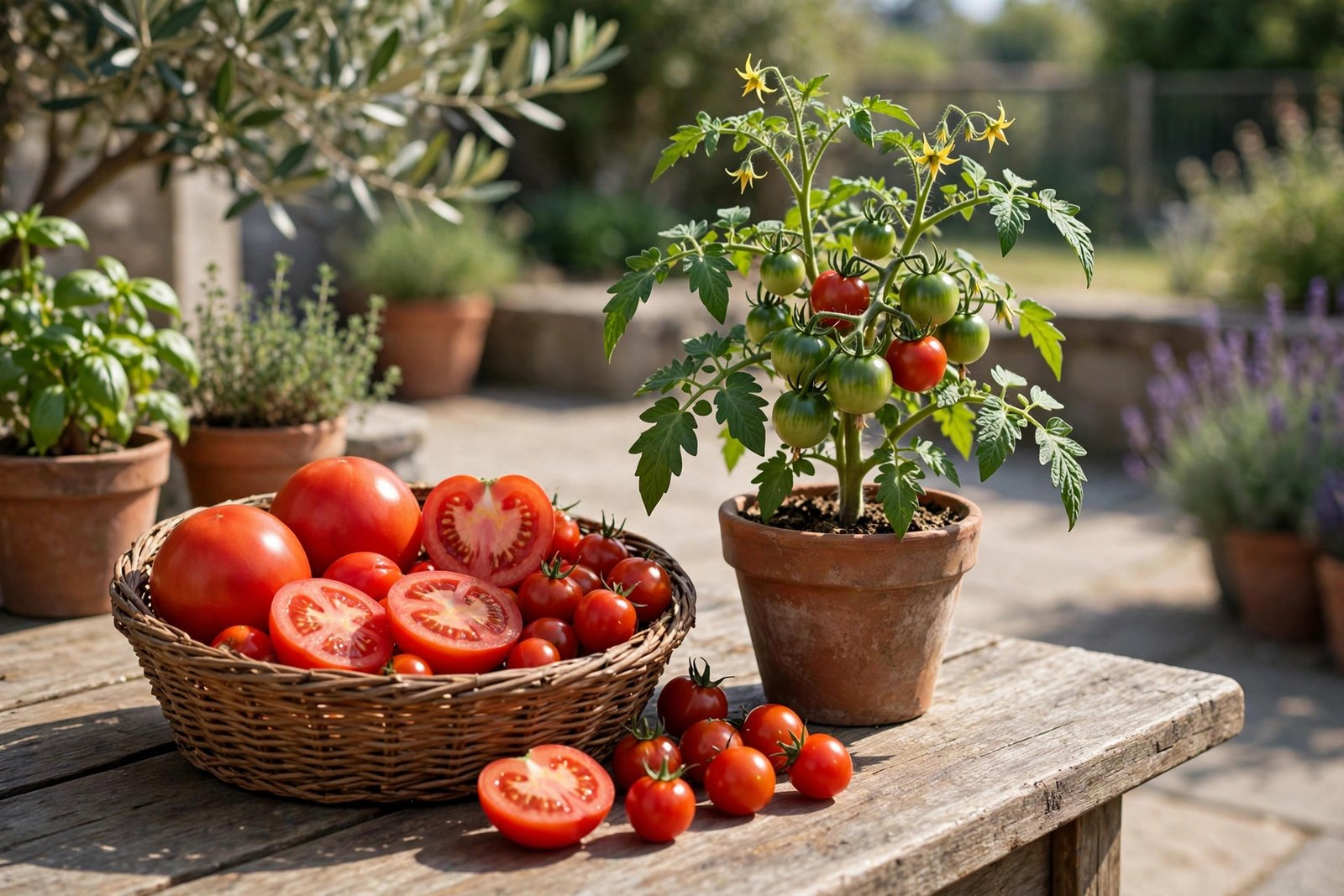
Buy the variety by its type, not by the photo on the packet. Read the tag or the seed listing for the words determinate, dwarf, patio or bush. The names below are the ones Iowa State Extension lists for containers, plus two sauce and slicing names from Gardening Know How. If a variety is not on a list like this, check its type before you buy it.
| Group | Varieties | What you get | Note |
|---|---|---|---|
| Standard | Bush Early Girl, Celebrity, Jetstar | Full-size slicing tomatoes | Iowa State Extension’s suggested container cultivars; check each tag for determinate habit |
| Patio | Patio Hybrid, Patio Princess, Mega Bite | Full-size fruit on a small plant | Bred for pots (Iowa State Extension) |
| Cherry | Little Sun Yellow, Terenzo | Small sweet cherry fruit | Compact types for pots and baskets (Iowa State Extension) |
| Sauce and slicing | San Marzano, Bush Beefsteak | Paste tomatoes; large beefsteak fruit | San Marzano is a determinate sauce tomato; Bush Beefsteak is a bush beefsteak (Gardening Know How) |
If you grow for sauce, San Marzano is the classic pick. If you want slicing tomatoes for sandwiches, Celebrity or Bush Early Girl fit a pot. For snacking, the compact cherry types are the easiest win. Skip tall cherry vines like Sweet 100 for a first pot. They pass 6 feet and demand strong light over a large area.
When to Start and When to Plant
Tomatoes are warm-season plants and they are not frost hardy. One night below 32 degrees F will kill them, so they go outside only after your last frost date, when night temperatures are safely in the 50s. That is the whole calendar. Everything else is counting back from it.
- Start seeds indoors 5 to 6 weeks before your last frost. Gardening Know How gives that timing, and our guide to starting seeds indoors walks through the method step by step. Wait until seedlings are a few inches tall with four sets of true leaves, then harden them off before they move outside.
- Or buy transplants. Pick compact green plants with leaves free of spots or discoloration.
- Plant out after the frost-free date. Tomatoes do their best work when days run 70 to 82 degrees F and nights run 62 to 64 degrees F. If a cold night is coming after you plant, cover the plant or bring the pot close to the house.
In November, the job is to buy seed and the pot, and to mark your last frost date on the calendar. Nothing living goes outside until spring, and that is fine. The planning is the work right now.
Planting Day: Pot, Mix and Support
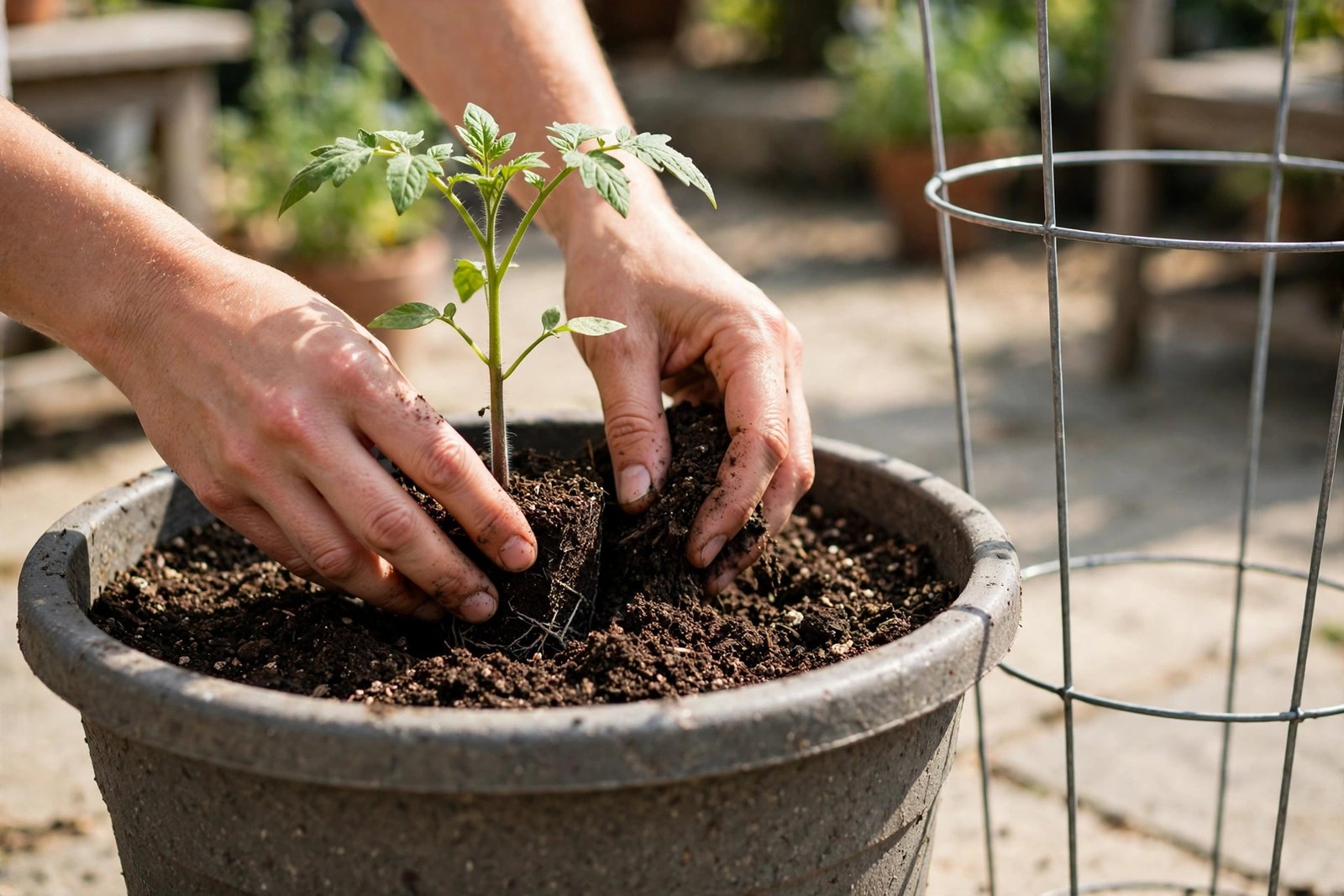
Planting day has four moves, in this order: mix, depth, support, water. Get them right once and the plant does the rest.
- Fill the pot with mix. Use a soilless potting mix made for containers, never soil from the garden. Garden soil is heavy, it compacts in a pot, and it can carry disease. Leave about 2 in between the soil line and the rim. For mix detail, see our guide to the best soil mix for vegetables in pots.
- Plant it deep. Strip the leaves off the bottom two-thirds of the stem, then set the plant in so about two-thirds of the stem is buried. Roots grow along the buried stem, and the extra roots make a stronger, more stable plant. That is University of Georgia Extension’s advice, and it is the single most useful move on planting day.
- Set the support now. Put the cage or stake in at planting time, before the plant grows. It is the easiest time to do it, and a plant without support flops over and can snap. For a standard variety, Iowa State Extension suggests a cage at least 24 in across. Tie stems loosely to a stake as they grow. Epic Gardening makes the same point: the easiest time to install support is when you plant.
- Water it in, then put the pot in full sun. Water well so the mix settles around the roots.
One plant per pot. Two plants in one pot share the same small amount of water and food, and both do worse.
Water, Food and Sun Through Summer
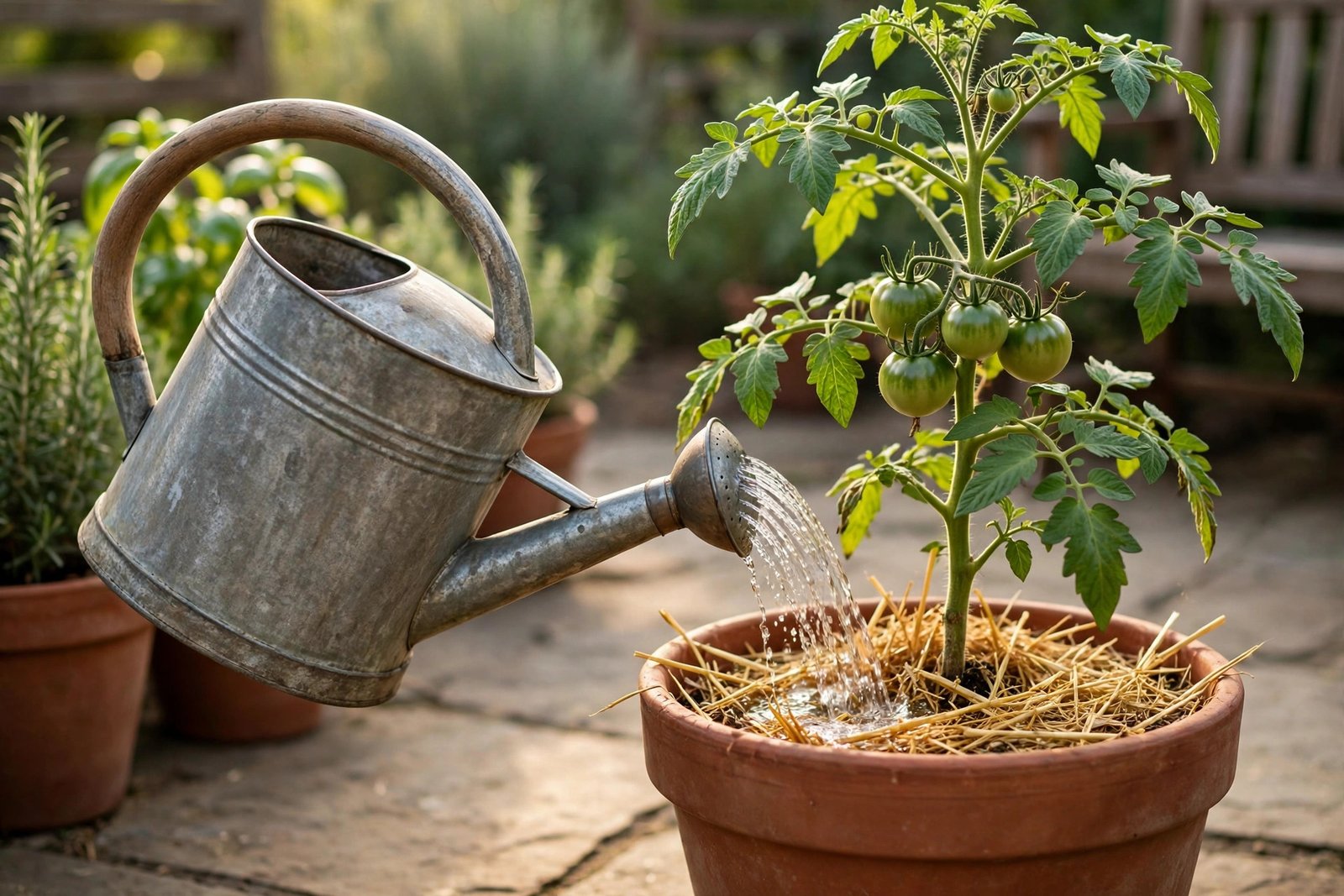
A tomato in a pot dries out fast. Sun and wind pull water out of a small volume of mix, and a big plant in July can need water every day. The routine below is the whole job.
Water deep, not often and shallow. Water until it runs out of the drainage holes, then stop. Deep watering beats small frequent sips. Check with your finger down to the second knuckle. If the top 2 in feel dry, it is time to water. In hot weather that can mean twice a day.
Water the soil, not the leaves. Wet leaves invite disease, so water at the base, in the morning when you can. Do not let the pot dry out completely. Iowa State Extension warns that a plant left to dry out fully can drop its flowers and fruit, and that uneven watering is behind cracking and blossom end rot. A 2 to 3 in layer of mulch on top of the mix holds moisture in through the middle of summer.
Feed little and often, by the label. A pot holds little food, so container tomatoes need feeding more often than garden plants. A soluble feed every week or two works, and Iowa State Extension names 15-30-15 or 20-20-20. If your mix already has slow-release food, wait until mid-summer to start. Once flowers form, switch to a lower-nitrogen bloom feed. Too much nitrogen grows leaves and little fruit. Our fertilizer guide for container vegetables has the label-led routine.
Give it real sun. Iowa State Extension sets the minimum at 6 hours of direct sun a day. Epic Gardening says a tomato needs at least 8 hours to thrive, and Gardening Know How agrees that 8 or more is better. Give the plant the sunniest spot you have, ideally the south or west side, and do not expect much from a shady corner.
Watch the heat. Fruit set fails when nights drop below 50 degrees F, and it is poor when days pass 90 degrees F. In a heat wave, move the pot closer to the house for afternoon shade, or accept a pause and keep watering. Above 90 degrees F, red fruit may even ripen yellow-orange, because the red color does not form well in that heat.
Prune only a vine. If you grow a non-dwarf indeterminate, pinch out the small shoots in the leaf joints through the season, keeping one or two besides the main stem. Determinate and dwarf plants do not need pruning.
Picking, and What Goes Wrong
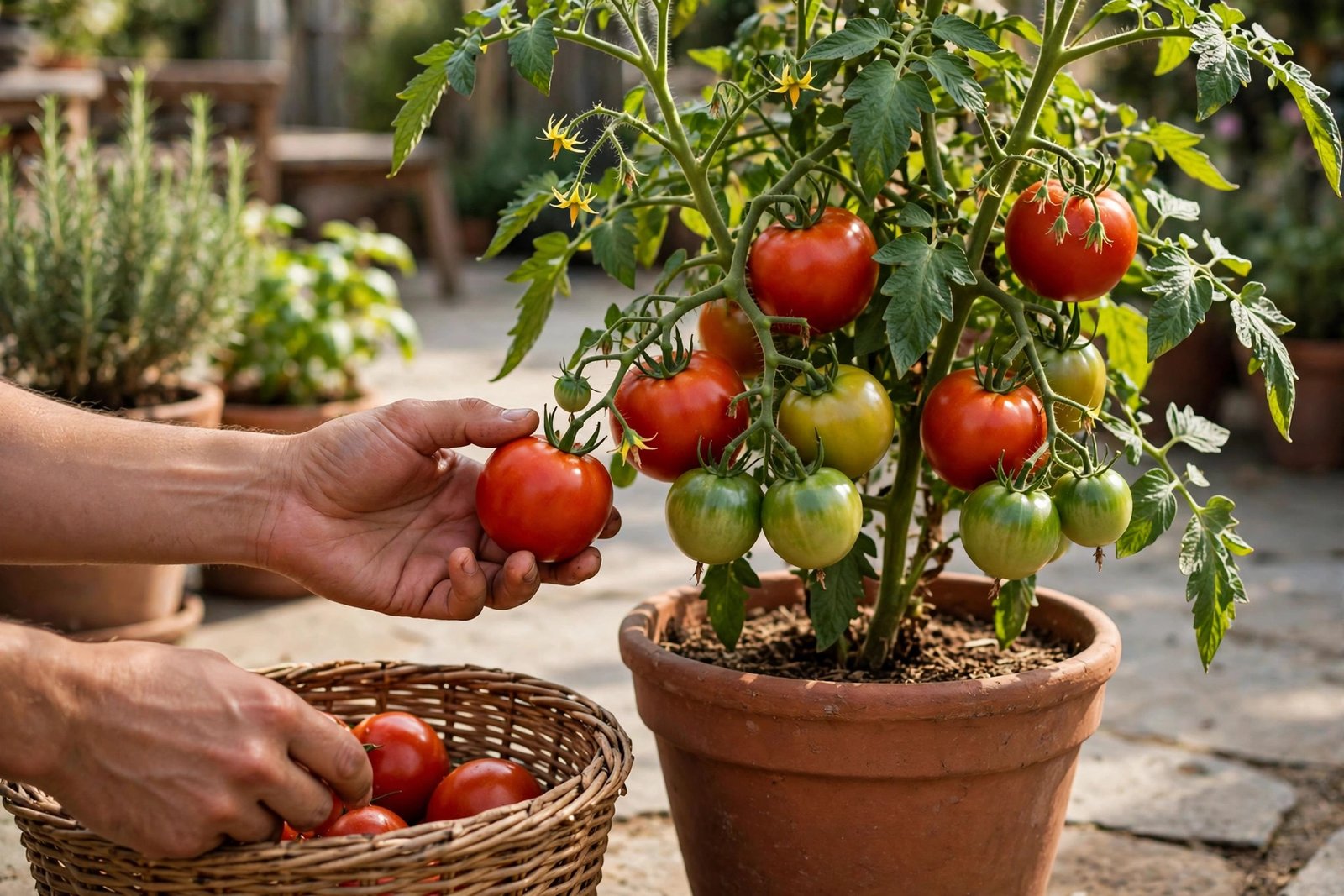
Pick when the fruit is glossy, firm with a slight give, and fully colored. Let it ripen on the plant for the best flavor. A determinate plant ripens most of its fruit in one 4 to 6 week window, so pick often and plan to use or preserve a lot at once. An indeterminate plant keeps giving a few at a time until frost. If a cold snap threatens, pick everything, even the green ones, and let the green ones ripen in a paper bag.
Iowa State Extension notes that most cultivars start to ripen in August, and early types in mid to late July. Your own dates shift with your local season and your variety, so watch the plant, not the calendar.
Blossom end rot and cracking. Both are common when watering is uneven, according to Iowa State Extension. The fix is steady water and mulch, not a spray or a supplement. Keep the mix evenly moist from flowering onward, and do not let the pot swing between soaked and dry.
Spotted or yellowing leaves. These often start with wet foliage or tired mix. Water the soil, keep the leaves dry, and start with fresh mix each year.
Pests. Hornworms are big enough to pick off by hand. Aphids wash off with a strong spray of water in the daytime, when the leaves have time to dry before night.
One plant, one pot, one sunny spot.
Frequently Asked Questions
How big a pot does a tomato need?
It depends on the plant type. A determinate tomato needs at least 5 gallons, and 7 to 10 gallons is better. Iowa State Extension says a standard tomato needs at least 4 gallons, and a cherry tomato at least 2 gallons. An indeterminate vine needs 15 to 20 gallons. Buy the pot for the mature plant, not for the seedling.
Can I grow an indeterminate tomato in a pot?
Yes, but only in a 15 to 20 gallon pot with a tall cage and daily watering in summer. It grows 5 feet or more and fruits until frost. If this is your first tomato in a pot, start with a determinate or dwarf variety instead.
Why do my tomatoes crack or get blossom end rot?
Both are common when watering is uneven, according to Iowa State Extension. Keep the mix evenly moist, water deep until it drains, and mulch the surface. Do not let the pot dry out fully between waterings.
When do I pick tomatoes?
Pick when the fruit is glossy, firm with a slight give, and fully colored. A determinate plant ripens most of its fruit in one 4 to 6 week window. An indeterminate plant keeps fruiting until frost. If a cold snap threatens, pick all the fruit and ripen the green ones in a paper bag.
Sources and Further Reading
Iowa State University Extension, Growing Tomatoes in Containers
Epic Gardening, 13 Tips For Growing Tomatoes in Pots or Containers
Gardening Know How, Growing Tomatoes in Containers: Tips For A Bountiful Harvest
University of Georgia Cooperative Extension, Grow your own tomatoes for tastier mater sandwiches this summer
Penn State Extension, Container Vegetable Gardening: Four Keys to Success (pot width, as cited in our Best Vegetables to Grow in Pots guide)

One Comment