
How to Grow Eggplant in Containers
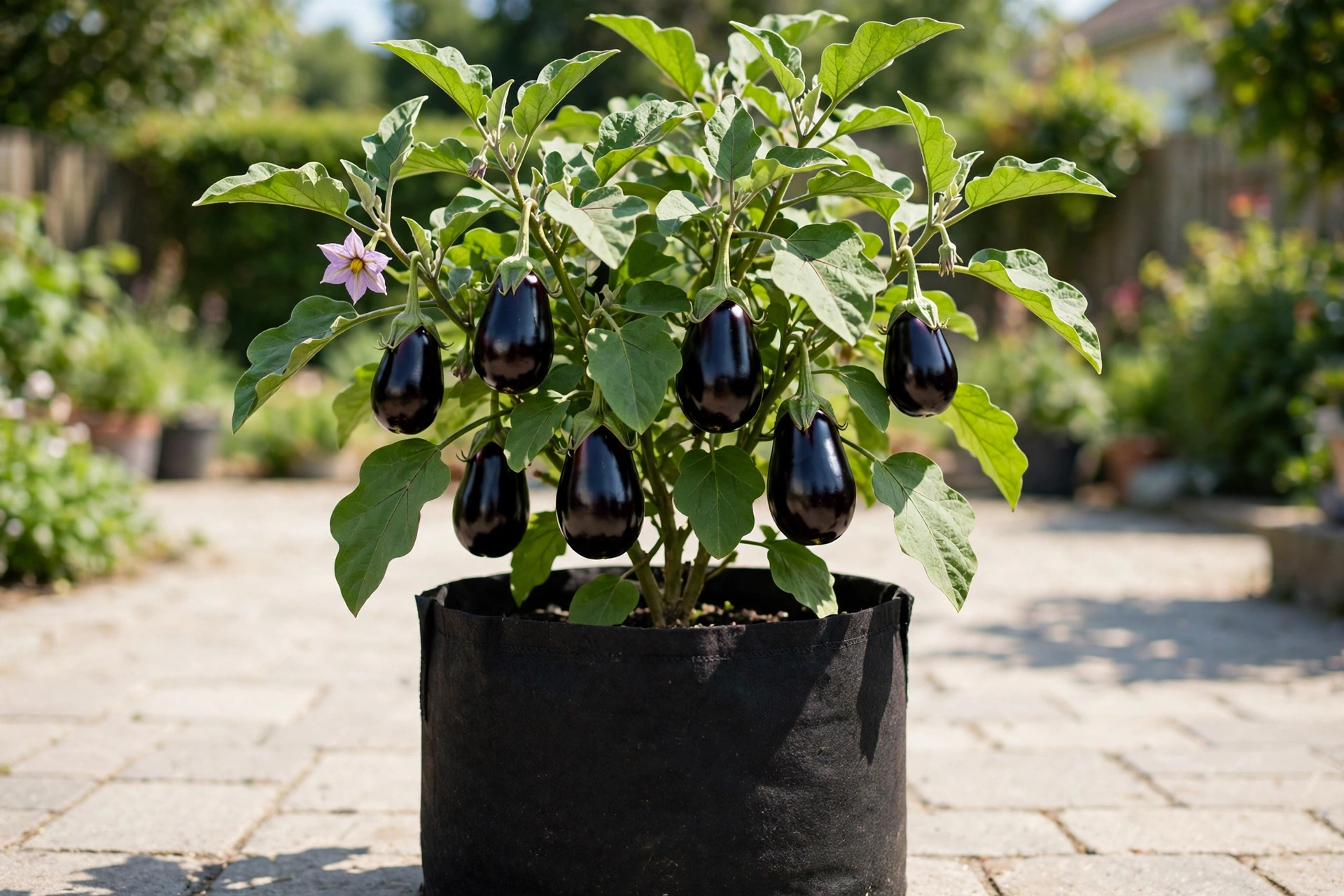
Eggplant container gardening works beautifully, and in a pot it rarely fails for lack of effort. It fails on temperature. Give one plant a 5 gallon pot, pick a compact variety, and wait for warm nights before setting it outside. Do those three things and one patio plant feeds you glossy fruit all summer.
Skip them and you get the classic complaints. A starved plant in a small pot. Flowers that drop without setting fruit. Bitter fruit at the end. This guide works through each cause in order, from spring variety choice to the August harvest. Still deciding which crops earn your pots this year? Eggplant belongs on any shortlist of the best vegetables to grow in pots.
Eggplant in Containers at a Glance
The whole crop fits on one card. Warmth runs through every line of it.
| Item | Eggplant in a container |
|---|---|
| Pot size | 5 gallons minimum per plant. 7 to 10 for standard types |
| Plants per pot | One. Always |
| Sunlight | Full sun. 6 hours minimum, 8 or more for a real harvest |
| When to transplant | After night temperatures stay above 50 °F |
| Best growing weather | Days of 70 to 85 °F with warm nights |
| Seed starting | Indoors, 8 to 10 weeks before transplanting |
| First harvest | 45 to 55 days after transplant (compacts). 65 to 80 (standard types) |
Start With the Variety, Not the Pot
Choose the variety first, because the variety decides the pot. A mini type thrives in 5 gallons. A globe type squeezed into the same pot spends the summer root-bound and thirsty.

Patio Baby: the true mini
Patio Baby (F1) is the variety bred for exactly this job. A 2014 AAS Regional Winner, it stays about 16 to 24 inches tall and starts bearing 45 to 50 days after transplant, per its seed producers. The fruit are small, around 2 to 3 inches, thin-skinned and spineless. Pick them young and it keeps setting more. Burpee, one seller, claims 25 to 50 fruit per plant per season. Treat that as a seed company figure for a mini type, not a promise. Minis give lots of small fruit, picked little and often.
Fairy Tale, Hansel, and Gretel: the cluster types
These three AAS Winners fruit in clusters and reward frequent picking. Fairy Tale stays around 18 to 24 inches, with lavender fruit striped white, best picked at about 4 inches and roughly 50 days after transplant. Hansel reaches no more than about 3 feet, setting clusters of slender fruit you can pick from 2 to 10 inches while they stay mild and nearly seedless, at around 55 days. Gretel is its white companion. NC A&T State University’s container guide independently lists all three as container-suitable.
Standard globe types and the middle path
Yes, you can grow a standard globe eggplant in a pot. You pay a size tax. A full-size plant wants 7 to 10 gallons, a real cage, and patient watering. For slender Asian-style fruit without the bulk, Little Fingers is the middle path, setting clusters of thin fruit about 2 to 5 inches long on a manageable plant.
The Pot: Five Gallons Is the Floor
One plant per pot, in at least 5 gallons of mix. That is the floor, not a suggestion. University of Maryland Extension’s container table lists eggplant at a 5 gallon minimum, and NC A&T gives the same number for fruiting vegetables in pots.
When to go bigger, and when smaller works
Standard globe types earn their keep in 7 to 10 gallons, where roots stay cooler and the mix holds moisture through a hot day. Compact types are widely grown in about 3 gallons and crop fine there. The trade is your time. A smaller pot dries out faster and needs far more summer watering. In eggplant container gardening the rule never changes from there. One plant per pot. Two sharing a container compete for water and food, and both lose.
Material matters more than it looks
A dark pot is a spring asset and an August liability. Dark walls warm the mix early, when eggplant wants heat. The same walls can cook roots on hot concrete in midsummer, and a stressed root zone is one reason potted plants drop blossoms in heat waves. Shade the pot wall, mulch the surface, or shift the pot so the plant gets sun while the pot gets relief. Fabric grow bags breathe and run cooler but dry out faster than plastic. Terracotta dries fastest of all. The full comparison lives in our guide to grow bags vs. pots for vegetables.
The mix inside the pot
Use a quality potting mix, never garden soil from a bed. Eggplant wants it rich and free-draining, with a pH around 5.8 to 6.8. Empty any saucer that stays full. The recipe itself lives in our guide to the best soil mix for vegetables in pots, so this article keeps to what eggplant itself needs from it.
Warmth Decides the Planting Date
Eggplant is one of the most cold-sensitive vegetables in the garden, and the calendar does not set the planting date. The night temperature does. A plant set out into cold nights can stall so badly it never really recovers. A plant set out two weeks later into warm nights overtakes it.
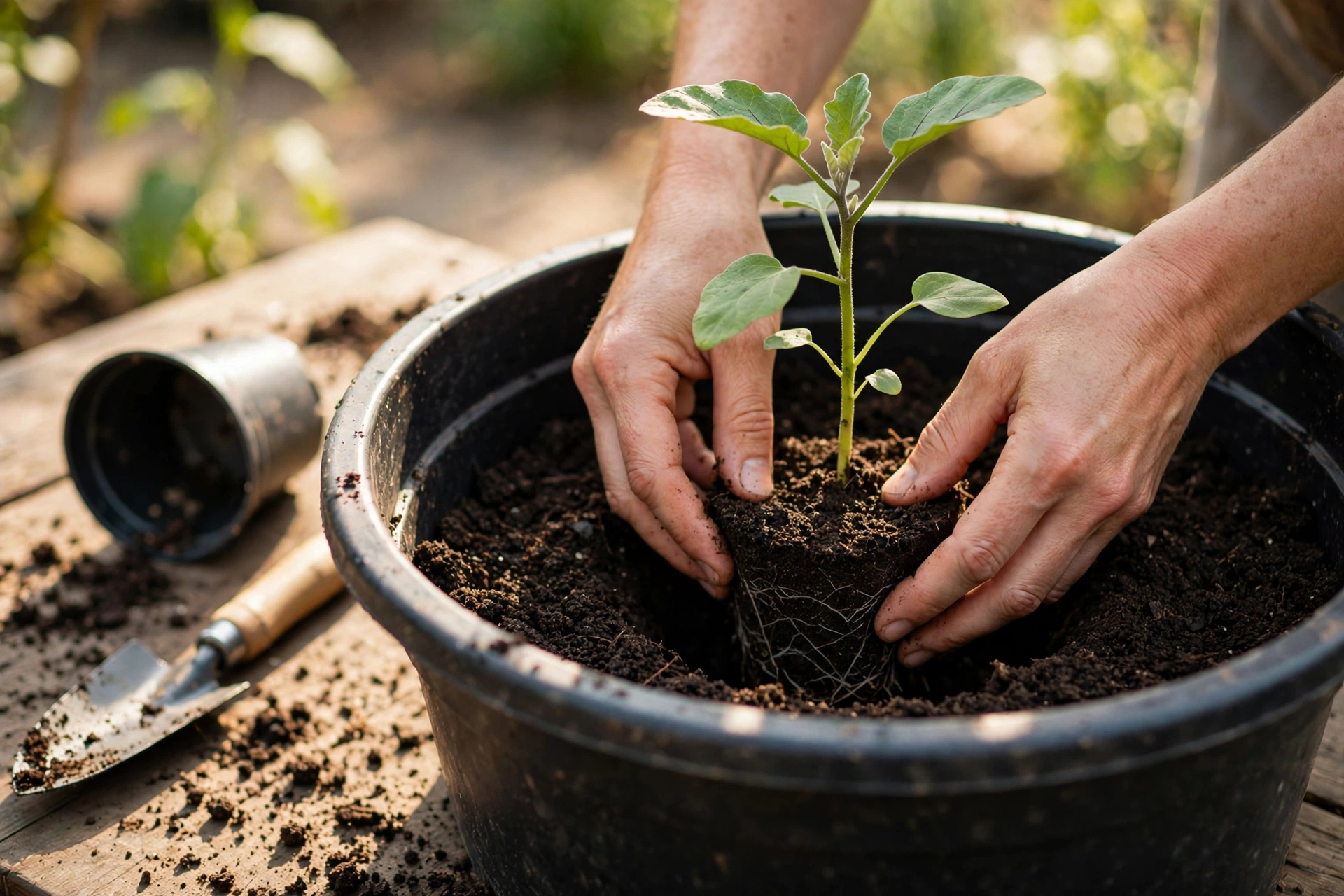
Start seed indoors, 8 to 10 weeks early
Start seed indoors 8 to 10 weeks before your planned transplant date. It germinates in warm soil, roughly 70 to 90 °F, so a heat mat or warm shelf makes a real difference. Buying a sturdy transplant instead is a fair shortcut.
The transplant rule: nights above 50 °F
University of Minnesota Extension‘s rule is plain. Transplant eggplant outside only after nighttime lows are consistently above 50 °F. Plants put out earlier suffer from the chill and may never recover enough to bear fruit. Many growers wait for nights of 55 to 60 °F before calling a plant settled. That comfort line sits above the extension floor, and in a short season it is optional. The 50 °F floor is not.
Use the pot’s mobility
Here is where containers beat the ground. Cold snap coming? Carry the pot under an eave or into a garage for the night. Heat wave baking the patio? Shift the pot to morning sun and afternoon relief. Chasing the season like this is the container grower’s real advantage.
What about growing eggplant indoors? Only with serious light, and it becomes a different project. This guide stays outdoors. If indoor growing is your setup, our guide to growing cherry tomatoes indoors shows what that light level and care actually look like.
Sun, Water, and Food: The Care Routine
Once the plant is out in warm weather, the routine is simple. Full sun, even moisture, and steady food. The three habits below are the whole job.
Sunlight: six hours is the floor
Give the plant full sun. Six hours of direct sun is the minimum, and 8 or more is where the harvest lives. Extension guidance for warm-season container crops agrees. If you are unsure how much sun your patio really gets, our guide to how much sunlight indoor herbs need shows how to judge a spot honestly. The pot can move with the season.

Watering: even moisture, checked daily
Check the pot daily in summer. A 5 gallon pot in real heat can need water every day. Water when the top 2 inches of mix feel dry, and keep the soil moist but never soggy. Mulch on the surface slows drying between waterings. Consistency matters because quality rides on it. University of Minnesota Extension notes that inconsistent soil moisture makes eggplant bitter and cuts yields. Water swings also sit behind the blossom end rot covered below.
Feeding: the schedule that works in pots
Most bagged mixes carry only about two weeks of fertilizer charge. NC A&T State University’s container protocol lays the schedule out clearly. Feed weekly with a water-soluble balanced fertilizer once the starter charge runs out. When flowering begins, switch to a feed with more potassium, the last number in the ratio, such as 9-15-30. Prefer the easy route? Work a slow-release balanced fertilizer into the mix at planting and top it up once mid-season.
The too-much-nitrogen trap. More fertilizer is not more eggplants. Too much nitrogen grows a big, leafy, beautiful plant that is slow to flower and slower to fruit. If your plant is all leaves, ease off the high-nitrogen feeds before you change anything else.
Stake It Before It Needs It

Put the support in at transplant time, while the roots are still small. A stake or cage pushed in later tears through established roots, and fruit weight bends branches until one splits at the stem. Compact types like Patio Baby often need only a short stake. Standard types need a real cage. NC A&T’s container protocol also prunes for shape. Train the plant to about three main stems by pinching out extra suckers. A top-heavy plant in a light pot can also tip in wind. A heavier pot or a wall-sheltered spot solves it. Our growing cucumbers in containers guide makes the same support point for a fellow warm-season crop.
Flowers but No Fruit? Fruit Set, Diagnosed in Order
Blossom drop is this crop’s signature frustration, with a short list of causes. Work through them in order before changing anything. Most dropped flowers trace back to weather or water. One caution. Young plants drop some early flowers while sizing up. That is normal. Judge the established plant that drops everything.
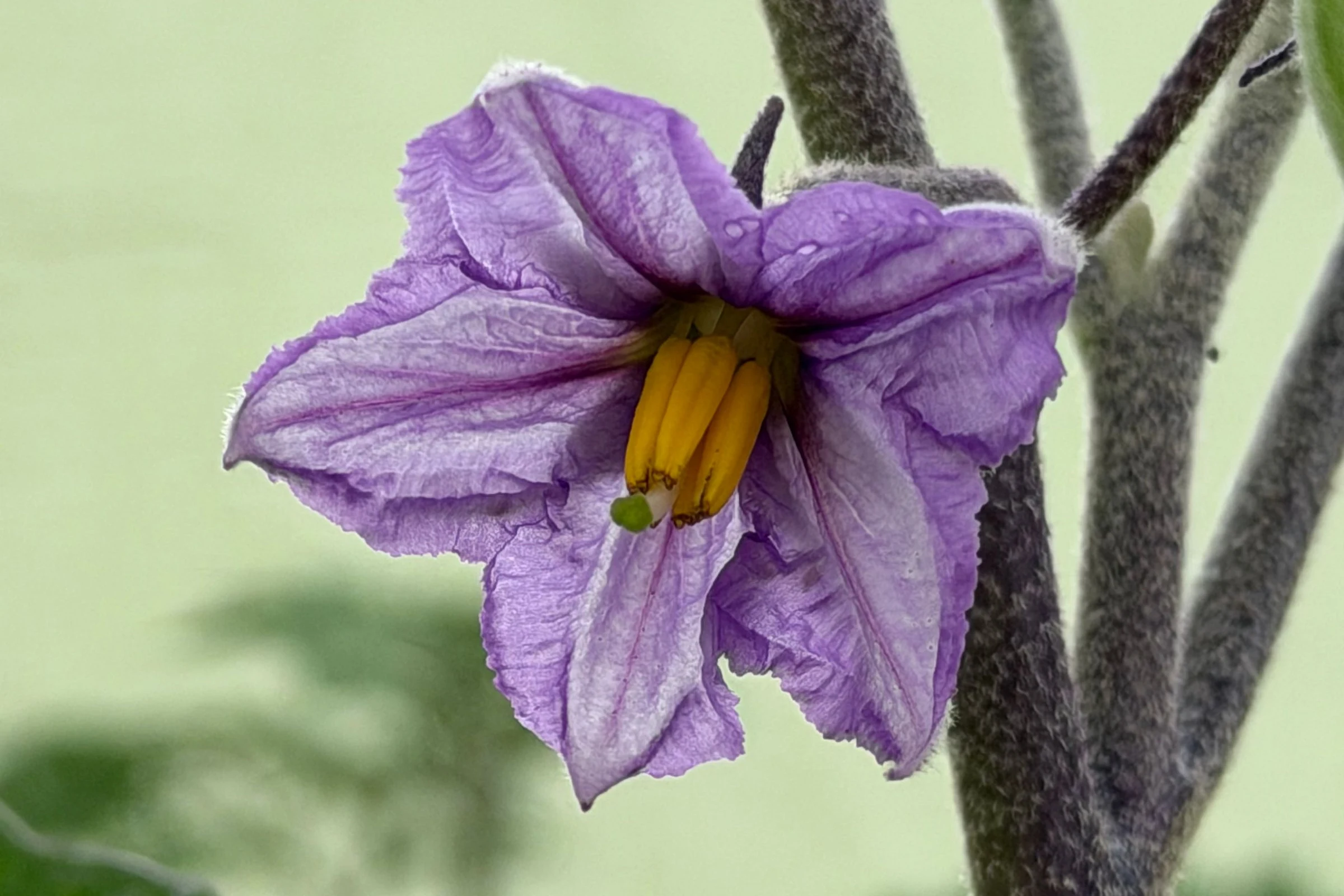
How eggplant pollination actually works
Eggplant flowers are self-fertile. One plant sets fruit entirely on its own. The catch is mechanical. Pollen sits inside anthers that release it only through tiny pores at the tip, and it escapes when the flower is vibrated. Bumble bees do this naturally with buzz pollination. Outdoors, bees and wind usually shake enough flowers for a good set, and you never think about it.
The shake fix, and when it cannot help
When the air is still, the porch is screened, or bees are scarce, do the bee’s job yourself. Tap the flower clusters daily as you pass, shake the plant gently, or touch a running electric toothbrush to a flower stem for a few seconds. It works where pollen release is the problem. Eggplant shares its flower mechanics with tomato, and the full method breakdown lives in our guide to how to pollinate cherry tomatoes indoors. But know the limit. Shaking cannot fix a flower dropping because the plant is cold, heat-stressed, or thirsty. That covers most cases, so work through the next section first.
The real drop causes, in order
Check temperature first. University of Minnesota Extension names the windows precisely. Drought, daytime temperatures above 90 °F, and night temperatures below 60 °F or above 70 °F can all cause poor flowering and fruit set. Set fails at both ends. Chilly nights stop it, and so do hot nights in a heat wave. In containers, the fixes are the mobility moves from earlier. Shift the pot, shade the pot wall, and wait out the window.
Check water second. A pot that swings between dry and soaked drops flowers. Return to the even-moisture routine and give it a few days. Check feeding third. A plant on heavy nitrogen makes leaves, not fruit. Ease off and let it rebalance. Only after those three should you suspect pollen release, and reach for the toothbrush.
Harvest: Young, Glossy, and Often
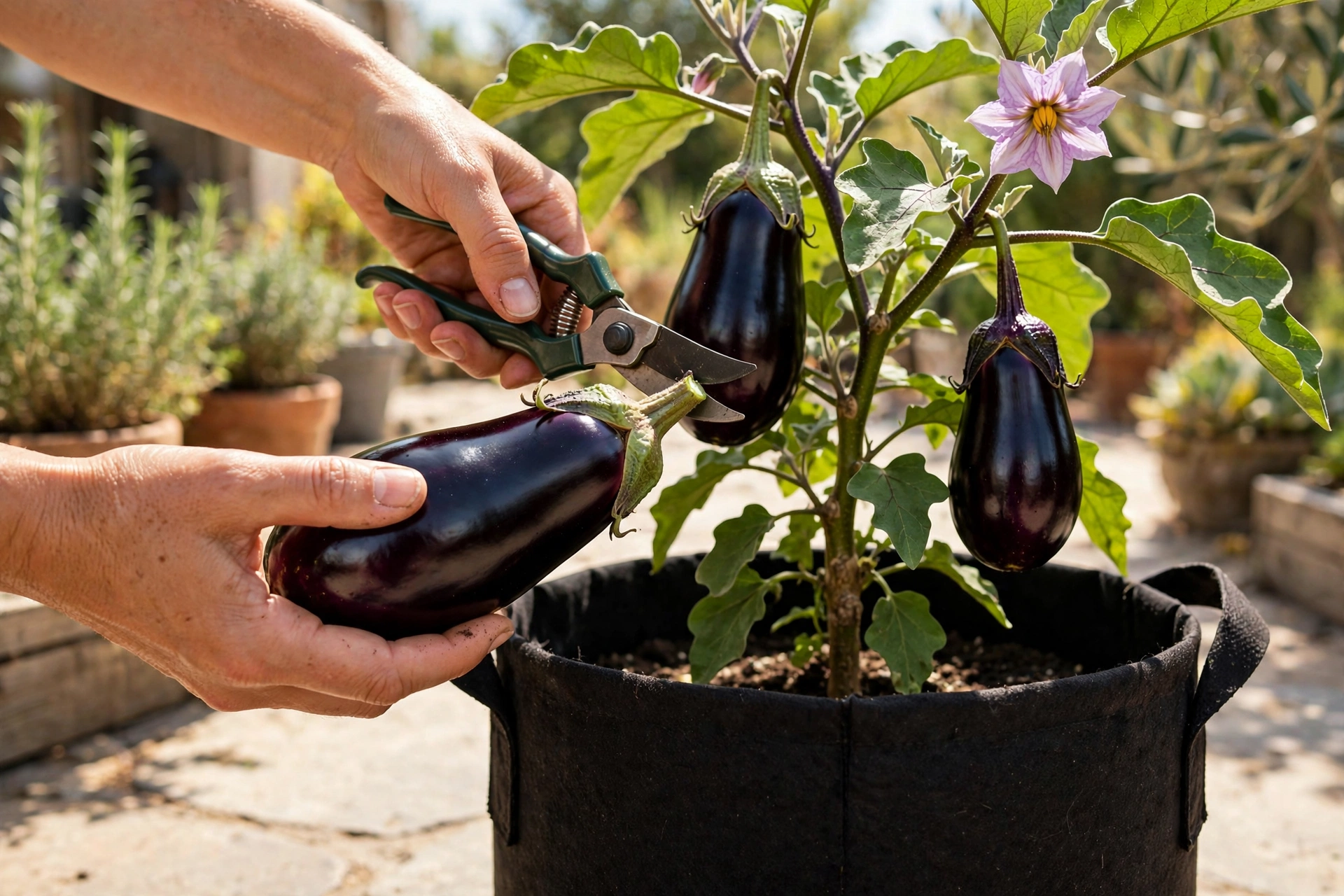
Pick eggplant young, while the skin is glossy and firm. Waiting for bigger fruit is how quality dies. Compact types start cropping 45 to 55 days after transplant. Standard types take 65 to 80 days. Once the skin dulls and seeds harden, the fruit is overripe and flavor falls off fast.
Clip fruit off with shears or a knife. Never pull it. The stem is tough, and tugging tears the branch. Then keep picking. A harvested plant keeps setting new fruit, while fruit left hanging tells the plant its job is done. A standard plant in a 7 to 10 gallon pot gives a steady succession of full-size fruit across the season, not one big haul. Minis give dozens of small fruit across the summer, picked a few at a time.
Common Problems in Pots
Flea beetles: the shot-hole pest
If tiny holes pepper your eggplant leaves in the first weeks, it is flea beetles. Clemson Extension calls eggplant a particular favorite of these small black beetles, and the damage is worst when the plant is young and small. The fix is protection, not spray. UC IPM recommends covering young plants with floating row cover until they are established, around the sixth-leaf stage, then taking it off at flowering so pollinators can reach the blooms. Established plants usually outgrow the chewing on their own, and insecticides are rarely needed or effective here. Clear plant debris at season’s end to cut overwintering sites.
Blossom drop
Covered in full in the fruit set section above. In short: temperature first, then water, then nitrogen, and only then pollen.
Bitter fruit
Bitterness has two causes, and both are in your control. The first is uneven watering, which stresses the plant as fruit forms. The second is fruit left hanging too long, past the glossy stage. Mulch the pot, keep the moisture even, and pick younger than feels natural. A bitter fruit will not improve in the fridge. Pick the next ones earlier.
Blossom end rot
A dark, sunken patch on the bottom of the fruit is blossom end rot. In containers it usually tracks uneven watering disrupting the plant’s calcium uptake, not a mix that simply lacks calcium. Steady moisture is the fix. Marked fruit will not heal, but fruit setting after your watering settles should come clean.
Also glance for Clemson’s other eggplant pests while you inspect: Colorado potato beetle, aphids, and hornworms. Hand-picking and a hard spray of water handle most home-scale cases.
Frequently Asked Questions
How big of a pot do I need for eggplant?
At least 5 gallons for one plant. University of Maryland Extension lists 5 gallons as the minimum container volume for eggplant. Standard globe types do better in 7 to 10 gallons. Compact types can manage in about 3 gallons with more frequent watering. One plant per pot, whatever the size.
What is the best eggplant variety for containers?
Patio Baby is the safest first choice. It stays about 16 to 24 inches tall, crops 45 to 50 days after transplant, and was bred for pots. Fairy Tale and Hansel are close behind for cluster fruit picked small. All three are AAS Winners that extension container guides list as container-suitable.
How many eggplants will one potted plant produce?
Mini types are the countable ones. Burpee claims 25 to 50 small fruit per plant per season for Patio Baby, and that is a seed company figure, not an extension measurement. Standard types give fewer, larger fruit in a steady succession. Picking often raises the total either way.
Why are my eggplant flowers falling off without making fruit?
Check temperature first. Nights below 60 °F or above 70 °F, and days above 90 °F, all cause poor fruit set. Then check drought and uneven watering. Then feeding, because excess nitrogen grows leaves instead of fruit. Poor pollen release is last, and shaking fixes only that one.
Do I need to hand-pollinate eggplant growing in pots?
Usually not outdoors. Bees and wind vibrate the flowers and release the pollen for you. It helps on screened porches, in still air, or where bees are scarce. Tap the flower clusters daily, shake the plant gently, or touch an electric toothbrush to the flower stem for a few seconds.
How much sun does eggplant in a container need?
Full sun, with 6 hours of direct light as the minimum. Aim for 8 or more hours for a real harvest. One advantage of a pot is that you can move it. Shift the plant to your sunniest spot, and again as the sun’s angle changes.
Why do my homegrown eggplants taste bitter?
Usually two things: inconsistent watering, and fruit left hanging too long. Keep the moisture even, mulch the pot surface, and pick while the skin is still glossy and firm. Fruit picked young from a steadily watered plant tastes mild.
What is eating tiny holes in my eggplant leaves?
Flea beetles. These small black beetles chew tiny shot-holes in the leaves, and they hit young plants hardest. Cover transplants with floating row cover until flowering, then remove it so pollinators can work. Established plants usually outgrow the damage without any spray.
Final Thoughts
Eggplant container gardening is a warmth problem wearing a gardening costume. Get the variety right, give it 5 gallons or more, wait for warm nights, and keep the water and food steady. The plant does the rest. Start with one Patio Baby in your sunniest spot, and let a summer of small glossy fruit argue for a second pot next year.
Sources and Further Reading
- University of Maryland Extension: Growing Vegetables in Containers and Salad Tables. The 5 gallon eggplant minimum and compact types in smaller pots.
- NC A&T State University Cooperative Extension: container guide for fruiting vegetables. One plant per container, the weekly feeding schedule, the potassium switch at flowering, three-stem pruning.
- University of Minnesota Extension: Growing Eggplant. Nights above 50 °F to transplant, the temperature windows behind poor fruit set, and harvest guidance.
- Clemson University Extension: eggplant and eggplant insect pest factsheets. Growing temperatures, seed timing, flea beetles.
- UC IPM: Flea Beetles. Shot-hole damage, row cover protection for young plants, and why insecticides are rarely needed.
- Johnny’s Selected Seeds and Burpee: Patio Baby pages. Producer specs and Burpee’s yield figure, labelled as a producer claim in the text.
5 Comments