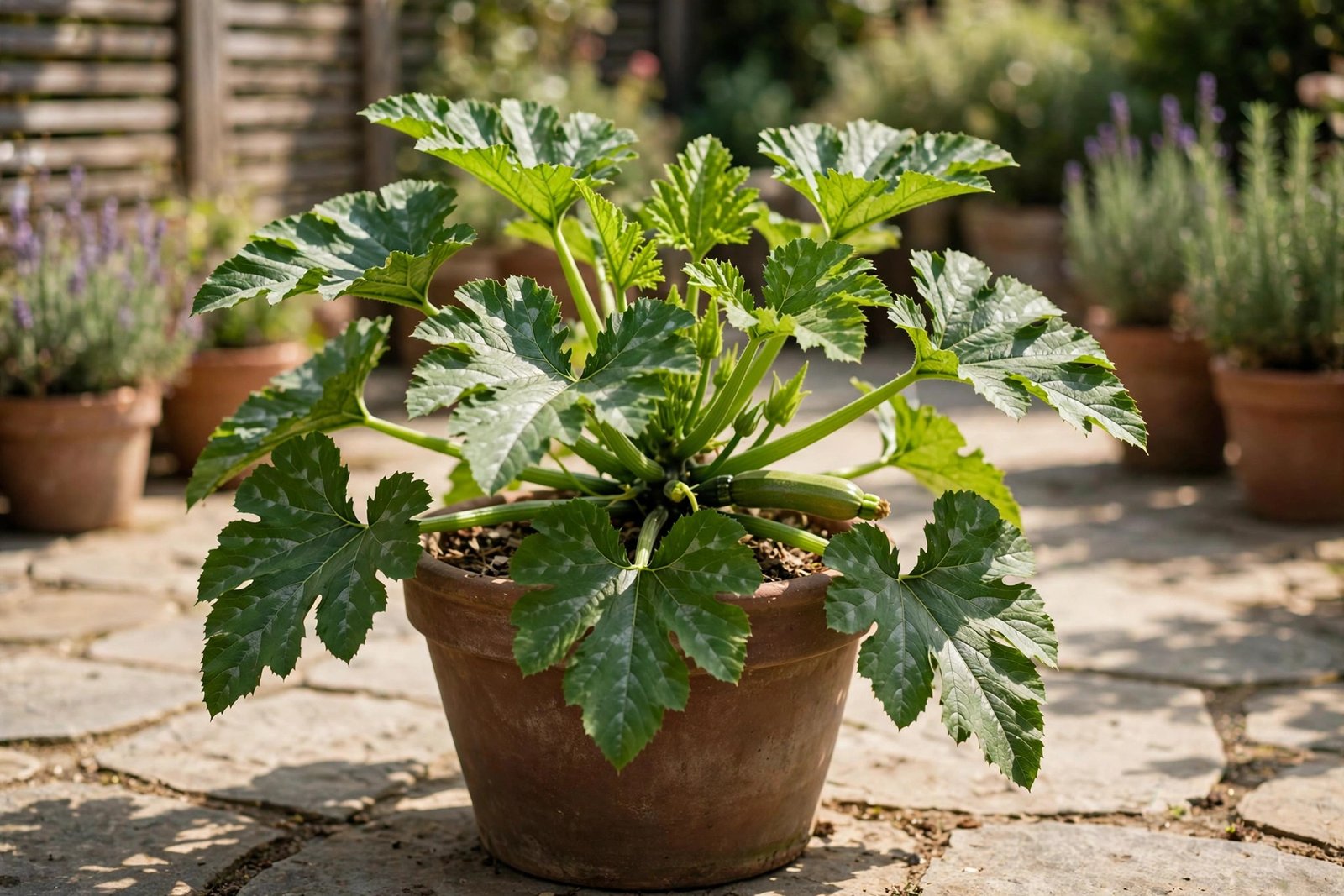
How to Grow Zucchini in Containers: One Bush Plant, One Big Pot
Zucchini in a pot works, but only when the pot is big enough and the plant is a bush. Give one bush plant a large pot, a warm spot, and steady water, and it will feed you all summer. Crowd two plants into a small pot and you get a tangle of leaves, no fruit, and a lot of watering for nothing.
This is a plan-now guide. Choose the variety and the pot now, while the seed catalogs are fresh, and sow after the last frost, once the soil is warm. Zucchini hates cold. Nothing in this guide asks you to sow in November or guess a planting date for your town. When the frost is past and the soil is warm, you sow.
One plant is plenty for a household. A single healthy bush keeps a household in zucchini through the summer, so start with one pot and add a second only if you love it. Zucchini is one of the warm-season crops in our list of the best vegetables to grow in pots, and it earns the spot because the work is small and the result is real.
Bush Only, One Plant per Pot
Start with the variety, because the variety decides everything else. Some zucchini grow as long vines that roam across a bed. Those are wrong for a pot. Bush types stay compact, with short stems and big leaves close together, and they fit a small space. The University of Minnesota Extension calls bush types a good fit for small gardens, and the University of Maryland Extension notes that summer squash grows on non-vining bushes.
| Type | Growth | Pot fit | What to expect |
|---|---|---|---|
| Bush | Short stems, compact, stays in place | Yes, one per large pot | Fruit close at hand, easy to pick |
| Vining | Long runners that spread across the ground | No, needs a bed and a lot of space | Same fruit, harder to reach and water |
One plant per pot. No exceptions. Two plants in one pot fight for water and light, and both lose. Sow two or three seeds, then thin to the single strongest seedling when the first true leaves show. Cut the extra seedling at the soil line with scissors instead of pulling it, so you do not disturb the roots of the one you keep.
Good bush choices include ‘Astia’, bred for containers, plus ‘Black Beauty’, ‘Eight Ball’, ‘Sweet Zuke’, and ‘Zebra Zuke’. The University of Wisconsin Extension container list names ‘Astia’, ‘Golden Scallopini Bush’, ‘Golden Zebra’, ‘Multipik’, ‘Supersett’, ‘Sweet Zuke’, and ‘Zebra Zuke’ as squash suited to containers.
Cucumber is the close cousin that confuses people: it is a vining Cucumis sativus grown up a trellis, while zucchini is a bush Cucurbita pepo, one plant per large pot, picked at 6 to 8 inches. Our cucumber container guide covers the trellis method, and this guide covers the bush method. The two crops share a family, not a method.
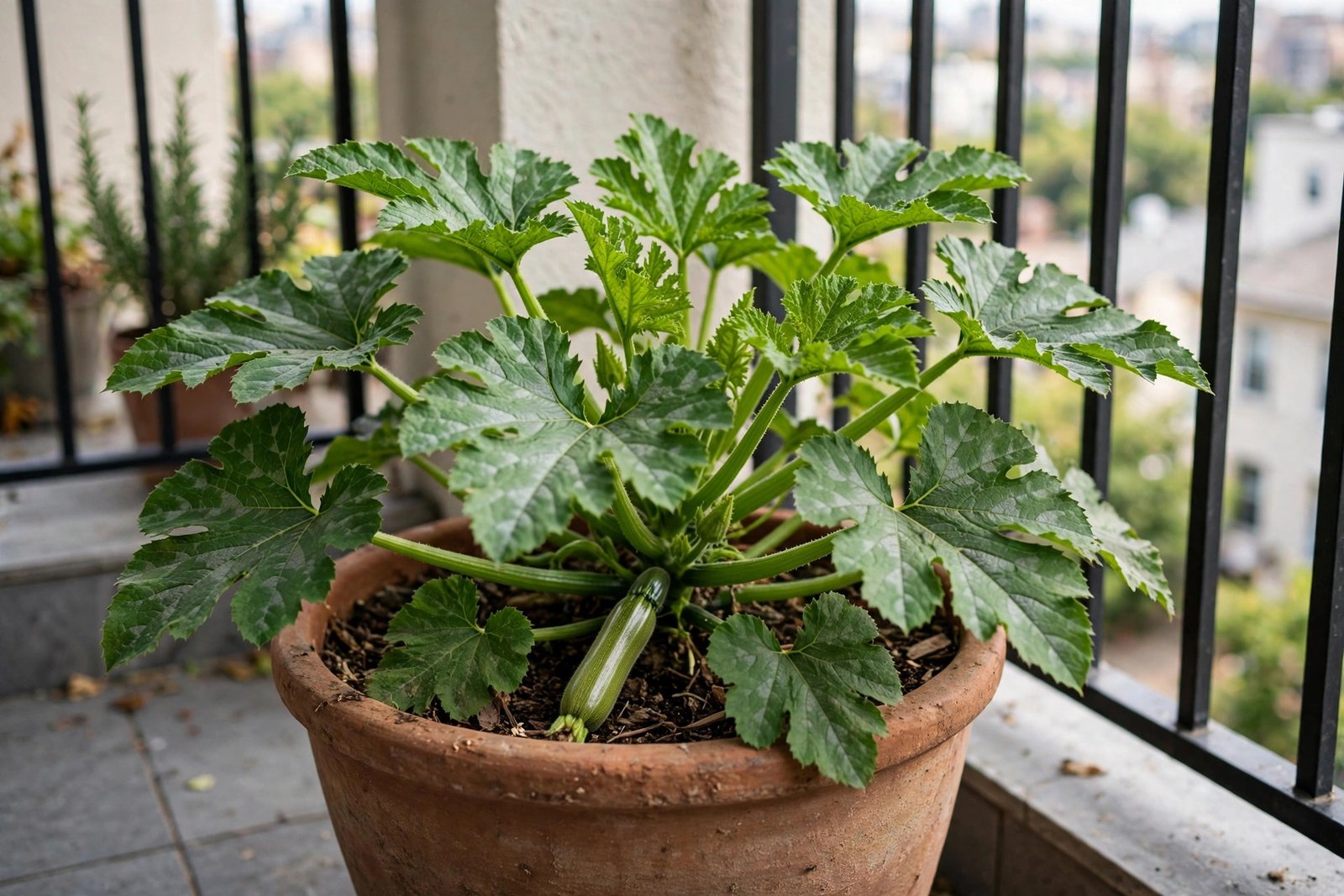
The Pot Size, With the Disagreement Shown
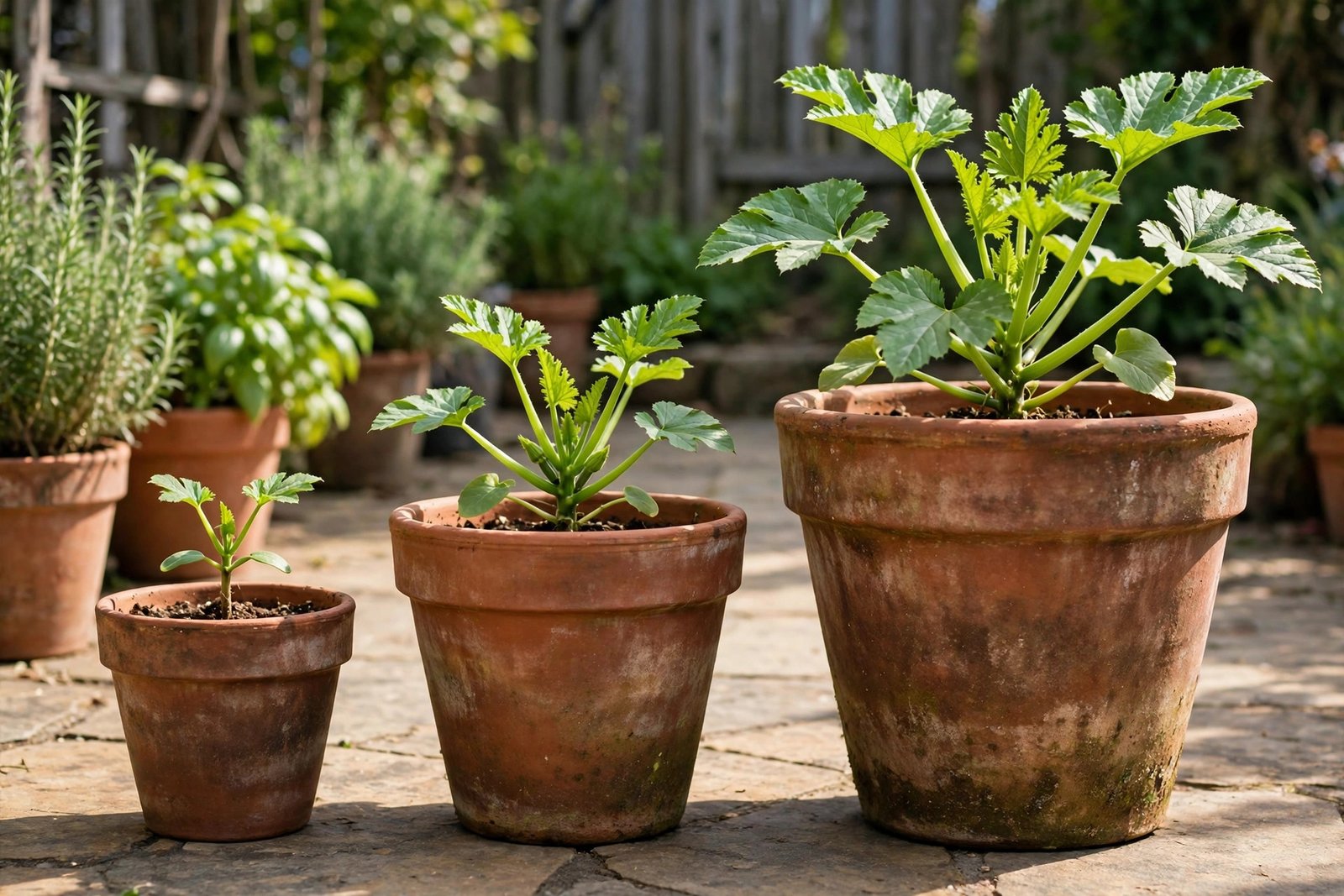
Ask five guides how big a pot zucchini needs and you get five answers. Here is what the extension pages actually say, side by side. No one has smoothed them into a single number, because there is no single number.
| Source | Minimum volume | Depth | Note |
|---|---|---|---|
| UW-Madison | 5 gallons | 12 to 18 in | Larger plants like squash need at least this |
| Colorado State | 5 gallons per plant | At least 8 in | 36 by 36 in of space; compact varieties suit pots best |
| UMD, container size table | 10 gallons | Not listed | Minimum listed for summer squash |
| UMD, size classes | 4 to 6 gallons | 8 to 12 in | Summer squash sits in the medium class |
| West Virginia University | 2 gallons | 12 to 24 in | Outlier: a table minimum, not a recommendation |
Our guidance, built on the minimums above. Five gallons is the floor, 7 to 10 gallons is better, and 12 to 18 in deep is the safer depth. A 7 to 10 gallon pot holds water longer, so the plant does not wilt by mid-afternoon on a hot day. The 2-gallon figure is an outlier from one table, not a recommendation, and no plant will thrive in it.
The University of Wisconsin-Madison container guide is the source for the 5-gallon minimum and the 12 to 18 in depth in the table above, and it lists squash among the larger plants that need a pot of at least that size.
Every pot needs drainage holes in the bottom, and the saucer underneath needs emptying after you water. Standing water rots roots. Dark pots heat the roots in full sun, and porous pots like unglazed clay dry out faster, so check them more often. A fabric grow bag works well at this size, and it is easier to move empty and store in winter. Our grow bags versus pots guide compares the two, so pick the one that fits your patio and your back.
Pick the spot before you fill the pot. A 7 to 10 gallon pot of wet potting mix is heavy, and you will not want to drag it across the deck once the plant is up. Set it where it will drain, where you can reach it with a hose or a full watering can, and where the leaves will not block a walkway. A bush zucchini spreads wider than most people expect, so leave it room.
Sow Direct, in Warm Soil
Zucchini grows fast from seed, so sow direct in the final pot. There is no need to start it indoors unless your season is short, and the plant dislikes root disturbance. If you do start indoors, sow 3 weeks before the last frost in 3-inch pots, handle the seedling gently, and move it with the whole root ball intact.
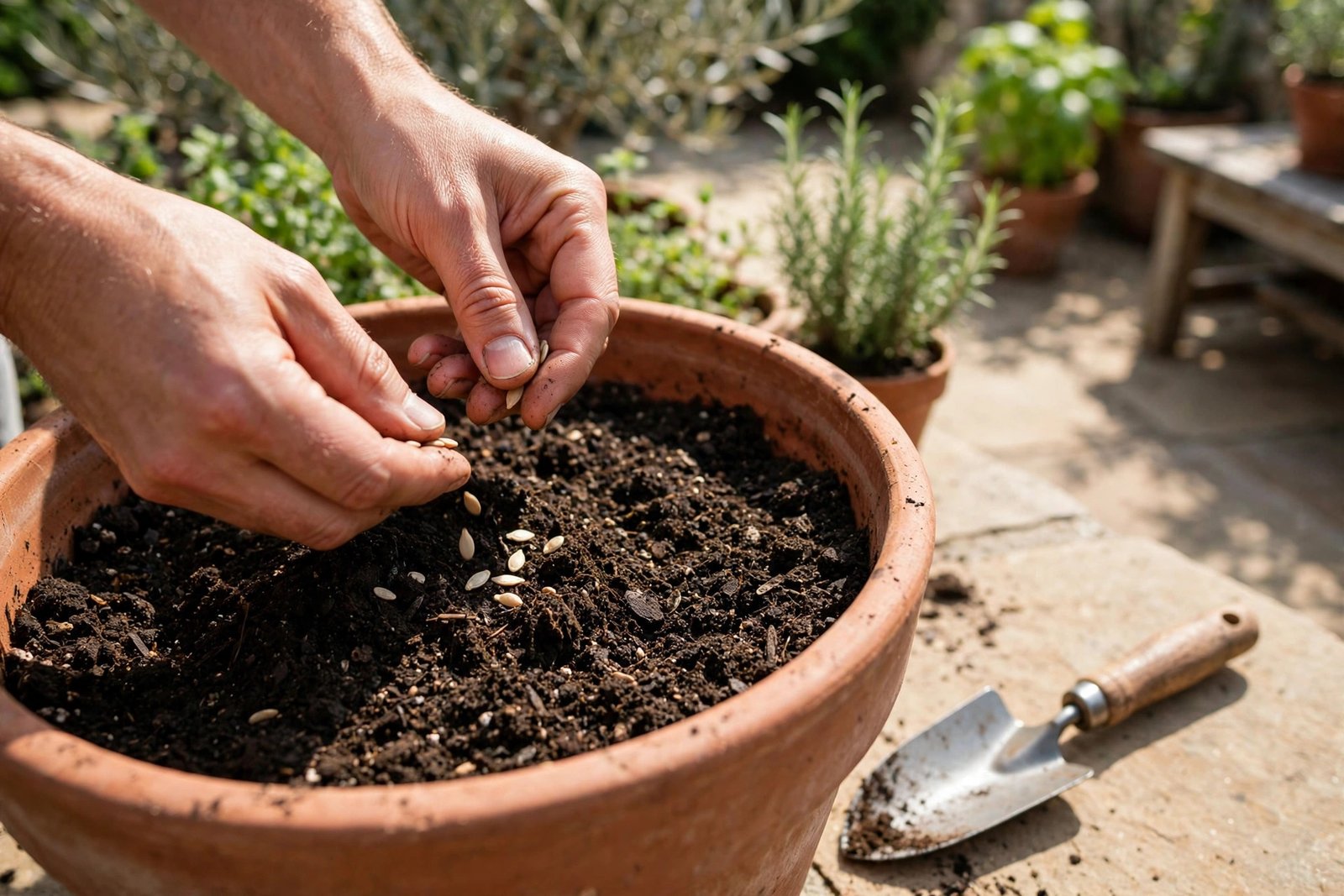
Sow two or three seeds about 1/2 in deep, then thin to the strongest one seedling. The seed needs warm soil, and soil warmth matters more than the calendar. The sources do not agree on one number, so here is the range, with each figure tied to its source:
- 60 degrees F at 4 in deep. Clemson Extension says do not plant until the soil reaches this.
- 65 to 75 degrees F. Clemson Extension says zucchini grows best at average temperatures in this range.
- 70 degrees F at 2 in deep. The University of Minnesota Extension says sow once the soil reaches at least this.
Some garden blogs quote 75 to 85 degrees F as the optimum for germination. That number comes from a blog, not an extension page, and no extension source puts the sowing minimum that high. The safe rule is simple: wait for warm soil, and if the soil still feels cold to the touch, wait a few more days.
Do not sow while frost is still possible. Zucchini is very tender, and frost injures the top growth. Your last frost date sets the sowing window. Our guide to starting seeds indoors owns the frost-date method and the full timing chart, so this guide does not rebuild it. Use that chart for timing only, because zucchini is direct-sown.
Fill the pot with a loose, rich potting mix, not garden soil, which packs down and drowns roots in a pot. The full mix recipe, with the ratios, lives in our soil mix guide for vegetables in pots. Zucchini likes soil close to neutral, at pH 6.0 to 6.5.
Sun, Water, Feed
Give the plant as much sun as you have. The University of Maryland Extension says at least 6 hours a day, and 8 to 10 hours is better. A spot that gets morning sun and afternoon shade will fruit, but it will fruit less than a plant in full sun.
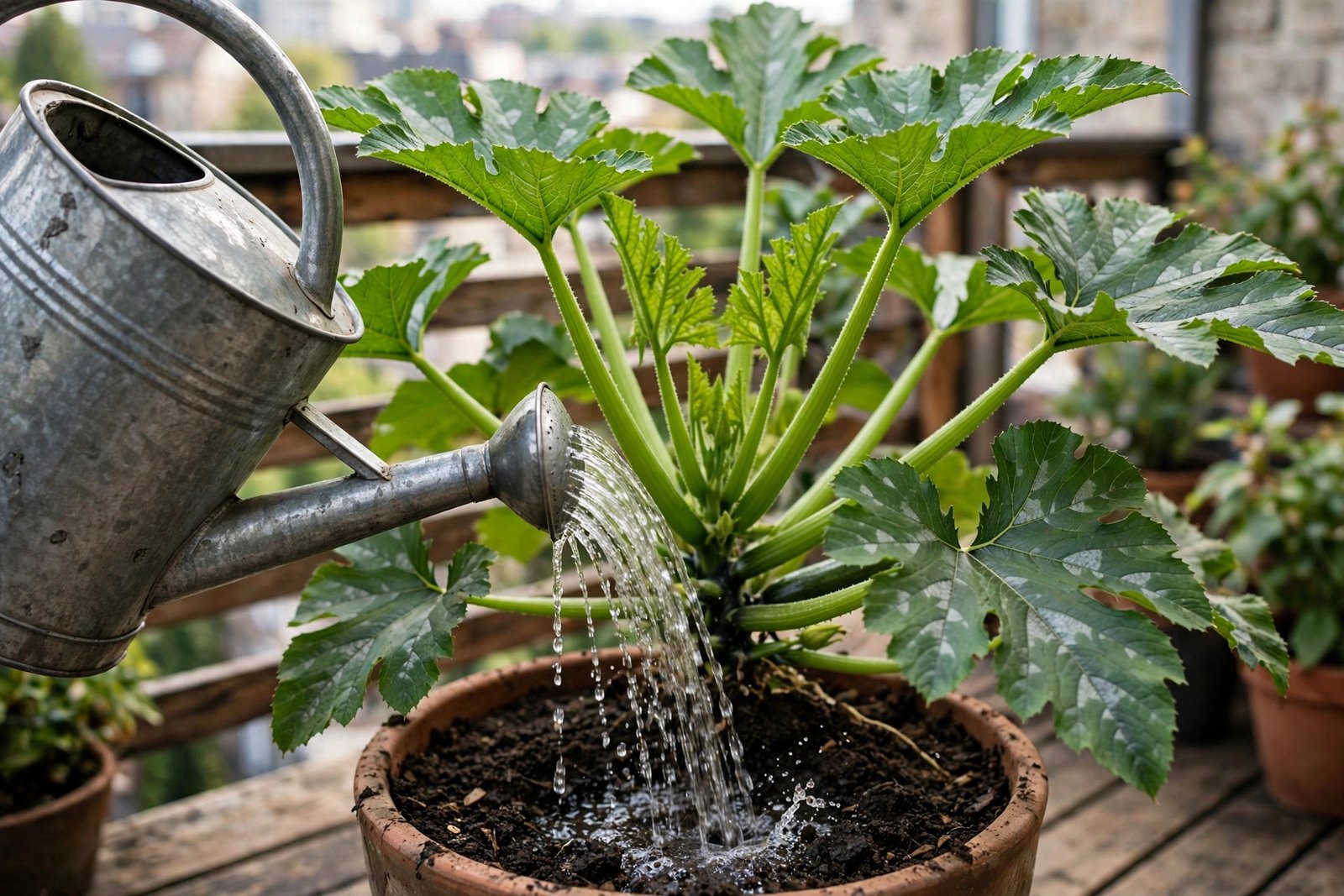
Water deeply at the base, and let the soil dry a little between waterings. In the ground, about 1 in of water a week keeps zucchini happy. In a pot, the mix dries faster, so check daily in hot weather, and water daily once the plant starts fruiting. Soak the soil thoroughly until water runs from the drainage holes, and do not sprinkle the leaves. Wet leaves invite powdery mildew, and a sprinkler wastes water on foliage that does not need it.
Zucchini is a heavy feeder, but it is easy to overdo the nitrogen. Too much nitrogen grows a big leafy plant with little fruit. Feed lightly and regularly instead of one heavy dose, and side-dress when the female flowers appear. Our fertilizer guide for container vegetables covers the rates and the schedule, so this guide does not re-teach them.
Peppers and beans share the same warm-season spot, and they make good neighbours in separate pots. Our pepper container guide and bean container guide cover their pots and their spacing.
Flowers, Pollination, and the Bee-Poor Balcony
Zucchini makes two kinds of flower. Male flowers grow on thin stems and open first, often a week or two before the females. Female flowers sit on a tiny swelling that becomes the fruit. The first blossoms are often all male, and they drop off. That is normal, not a problem.
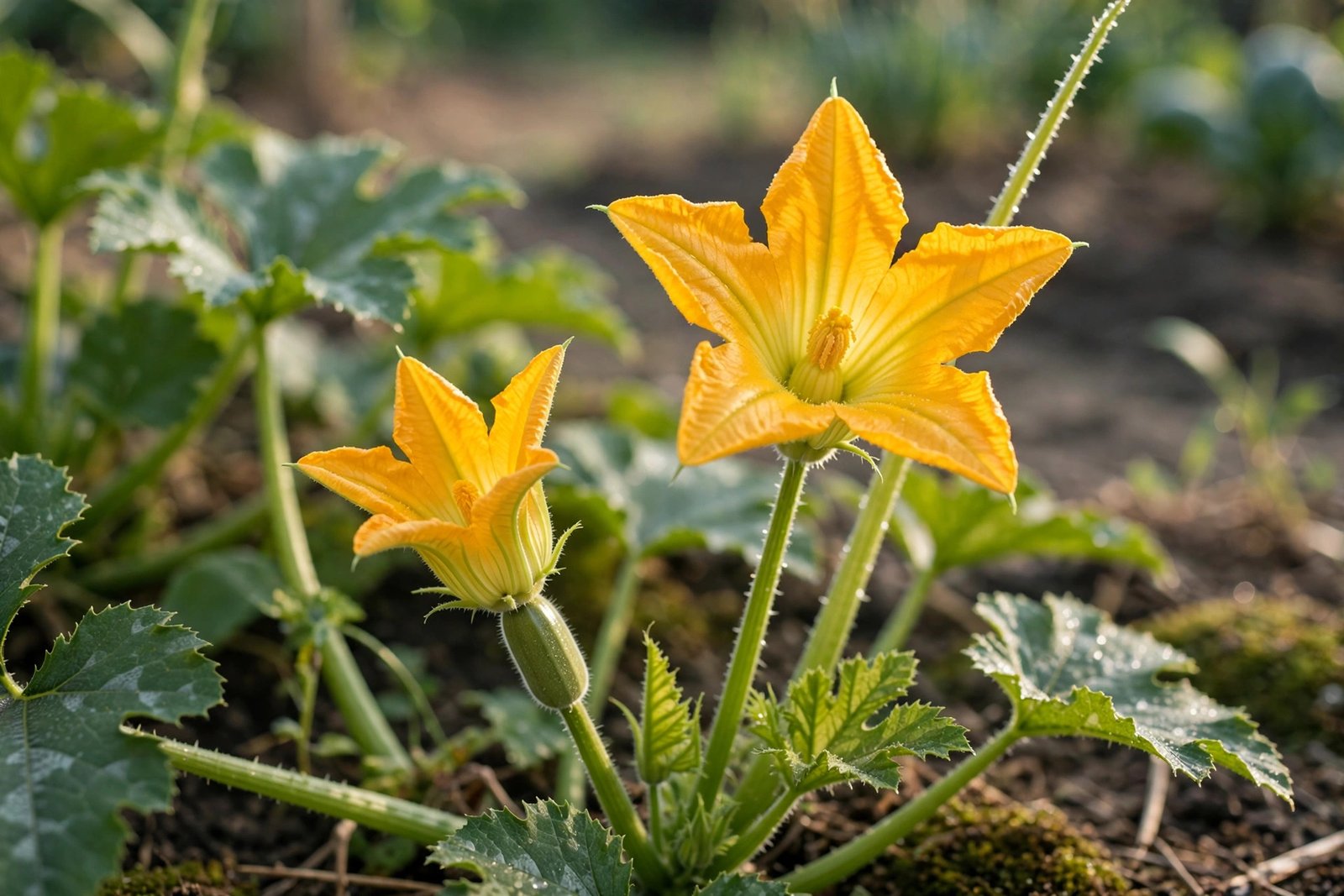
Bees move the pollen from male to female flowers. On a high balcony, bees may be scarce, and the female flowers then yellow and fall without setting fruit. That is the most common reason a healthy plant makes no zucchini.
If bees are scarce, do it yourself. In the morning, while the flowers are open, pick a male flower, peel back its petals, and touch the pollen-covered center to the center of a female flower. One male flower can pollinate several females. Skip it in the rain, when the pollen is wet and the bees are not flying.
If your balcony gets almost no bees at all, choose a variety that does not need them. Parthenocarpic types set fruit without pollination. Burpee’s ‘Sure Thing’ is one: it bears fruit even in cool, cloudy weather with no bees or male flowers around. The University of Maryland Extension lists parthenocarpic cultivars as the fix for poor pollination, and links to Cornell research on them.
What Goes Wrong
Most zucchini problems in pots trace back to water, pollination, or picking too late. Here is the short list, with the cause first.
Powdery mildew. White powdery spots on the leaves, usually late in the season. Give the plant airflow, keep the leaves dry, and water at the base in the morning so the foliage is dry before dark. Pick off the worst leaves, and do not crowd the pot.
Squash vine borer. The worst pest on zucchini. The borer tunnels into the stem at the base, and the whole plant wilts suddenly, even when the soil is wet. Plant early, because borers are worse later in the season. A second sowing in early July also works if the first plant fails. Never spray while bees are working the flowers, and any spray you use must follow its label.
Blossom-end rot. The blossom end of a small fruit turns dark and soft. It is a calcium problem, and it usually comes from uneven watering, not from a lack of calcium in the mix. Keep the watering steady, mulch the surface, and test the soil before adding lime.
Oversized fruit slows the plant. A zucchini left to grow huge tells the plant to stop making new fruit. Pick small and often, and the plant keeps producing.
Pick Small and Often
Start picking about 55 days after sowing, or 50 to 65 days from transplant. Check the plant every day or two once it starts bearing. Pick when the fruit is 6 to 8 in long and 1.5 to 2 in across, and leave 1 to 2 in of stem on the fruit. A small zucchini tastes better than a giant one, and picking it keeps the plant making more.
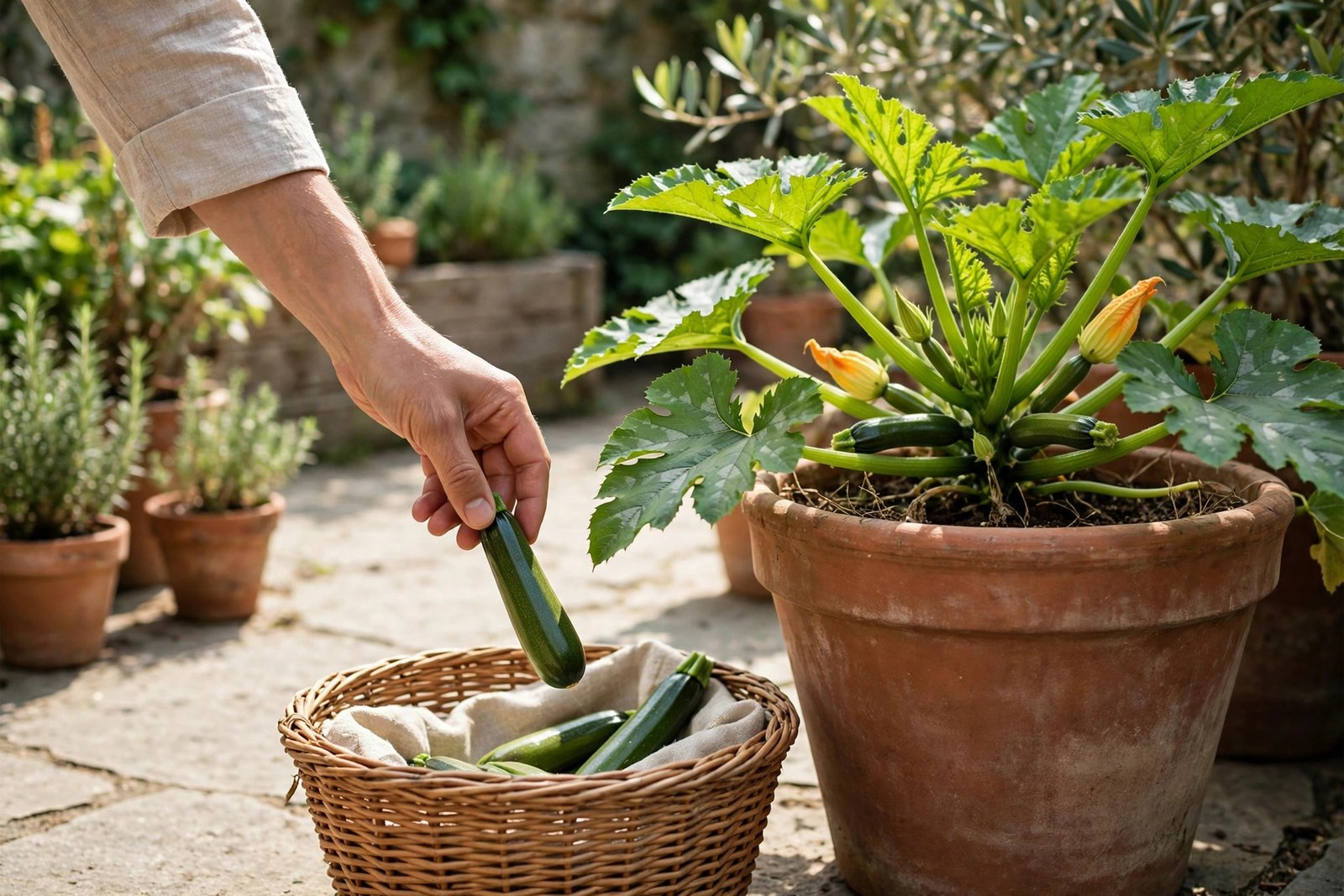
Do not pick when the leaves are wet. Wet leaves spread disease from plant to plant, and a wet stem wound rots faster. Keep picked zucchini in a plastic bag in the refrigerator for up to a week.
That is the whole method. One bush plant, one big pot, warm soil, steady water, and a daily look at the plant once it starts bearing. Plan it now, and the pot will be ready when the frost is past.
Frequently Asked Questions
How big a pot does zucchini need?
At least 5 gallons, and 7 to 10 gallons is better. Extension guides disagree on the exact number: UW-Madison says 5 gallons minimum, Colorado State says 5 gallons per plant, one UMD table says 10 gallons, another UMD page puts summer squash in a 4 to 6 gallon class, and West Virginia lists 2 gallons as a table minimum. The 2-gallon figure is an outlier, not a recommendation. Choose 7 to 10 gallons, at least 12 in deep, with drainage holes.
Can I grow zucchini on a balcony with few bees?
Yes, with two fixes. Hand-pollinate in the morning, while the flowers are open, by moving pollen from a male flower to a female flower. Or grow a parthenocarpic variety like ‘Sure Thing’, which sets fruit with no bees or male flowers around. Give the plant as much sun as the balcony gets, at least 6 hours a day.
Why are my zucchini flowers falling off without fruit?
The first flowers are usually male, and they always drop. If female flowers fall too, the plant is not getting pollinated. Bees may be scarce, or rain may be keeping them away. Hand-pollinate in the morning, and check that the plant gets at least 6 hours of sun and steady water.
When do I pick zucchini?
Pick when the fruit is 6 to 8 in long and 1.5 to 2 in across, about 55 days after sowing or 50 to 65 days from transplant. Check every day or two, leave 1 to 2 in of stem on the fruit, and do not pick when the leaves are wet.
Sources and Further Reading
University of Minnesota Extension, Growing Summer Squash and Zucchini in Home Gardens
University of Maryland Extension, Growing Summer Squash (Zucchini) in a Home Garden
University of Maryland Extension, Types of Containers for Growing Vegetables
University of Maryland Extension, Growing Vegetables in Containers and Salad Tables
University of Wisconsin-Madison Division of Extension, Growing Vegetables in Containers (XHT1278)
University of Wisconsin-Madison Division of Extension, Vegetable Varieties for Containers (XHT1273)
Colorado State University Extension, Vegetable Gardening in Containers (CMG GardenNotes #724)
Clemson Cooperative Extension, Summer Squash
West Virginia University Extension, Container Gardening
Burpee, Squash, Summer, Sure Thing Hybrid