
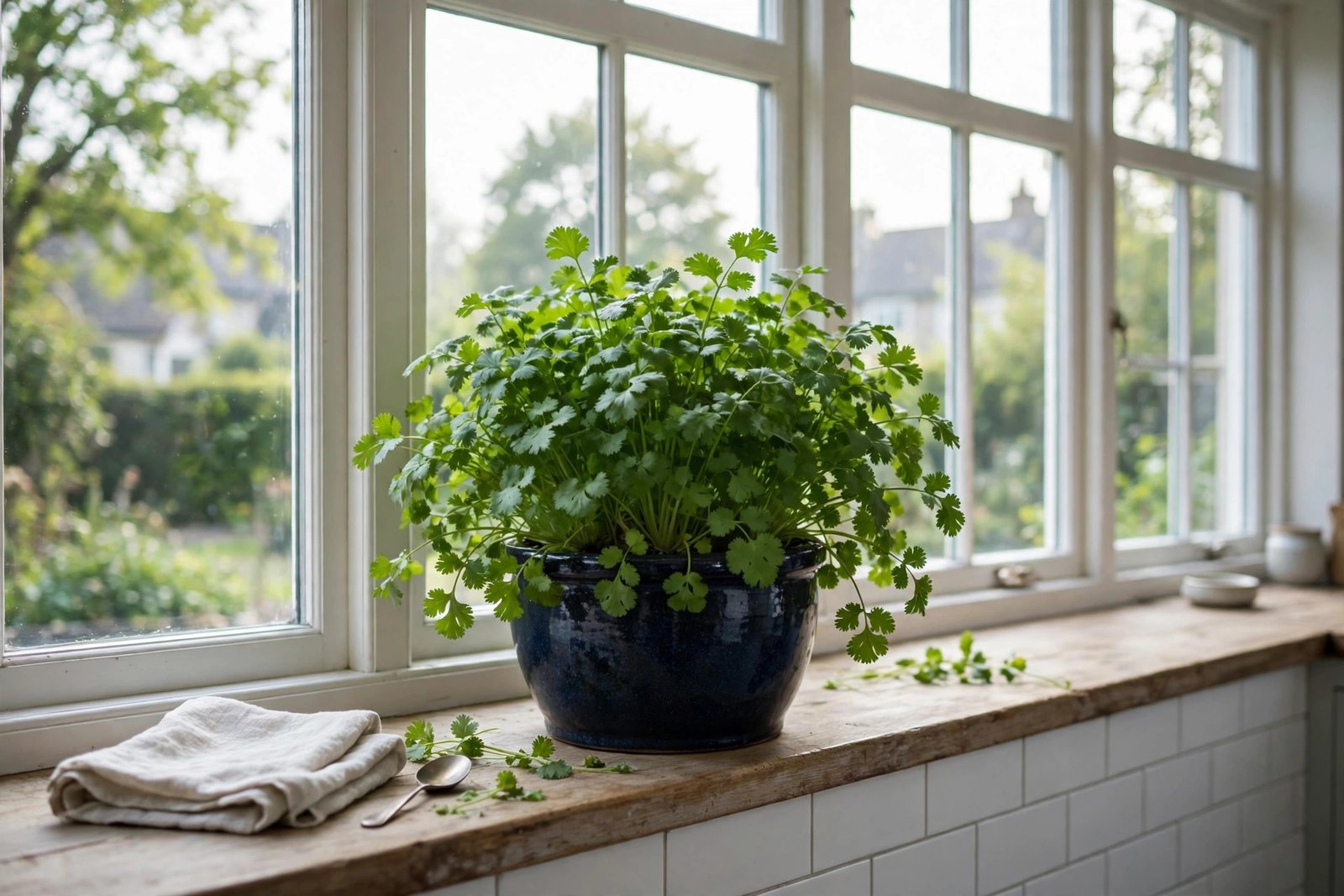
How to Grow Cilantro Indoors
Cilantro indoors is a sprint, not a houseplant. You sow a pot, pick leaves for a few good weeks, and then the plant bolts and the pot is done. That is not failure. It is the plant doing exactly what a cool-season annual does. The skill is not stopping the bolt. Nothing stops it. The skill is slowing it down with a cool room and a slow-bolt variety, and always having the next pot already growing.
Two different jobs share this plant’s name. Tray-grown cilantro microgreens are cut young, days after sprouting, and live by a different set of rules. This guide is about the other job: a full-size potted herb picked over weeks. If you want the tray crop, our guide to growing cilantro microgreens covers it. Everything below is the potted plant.
The Bolting Clock: Three Triggers You Cannot Switch Off
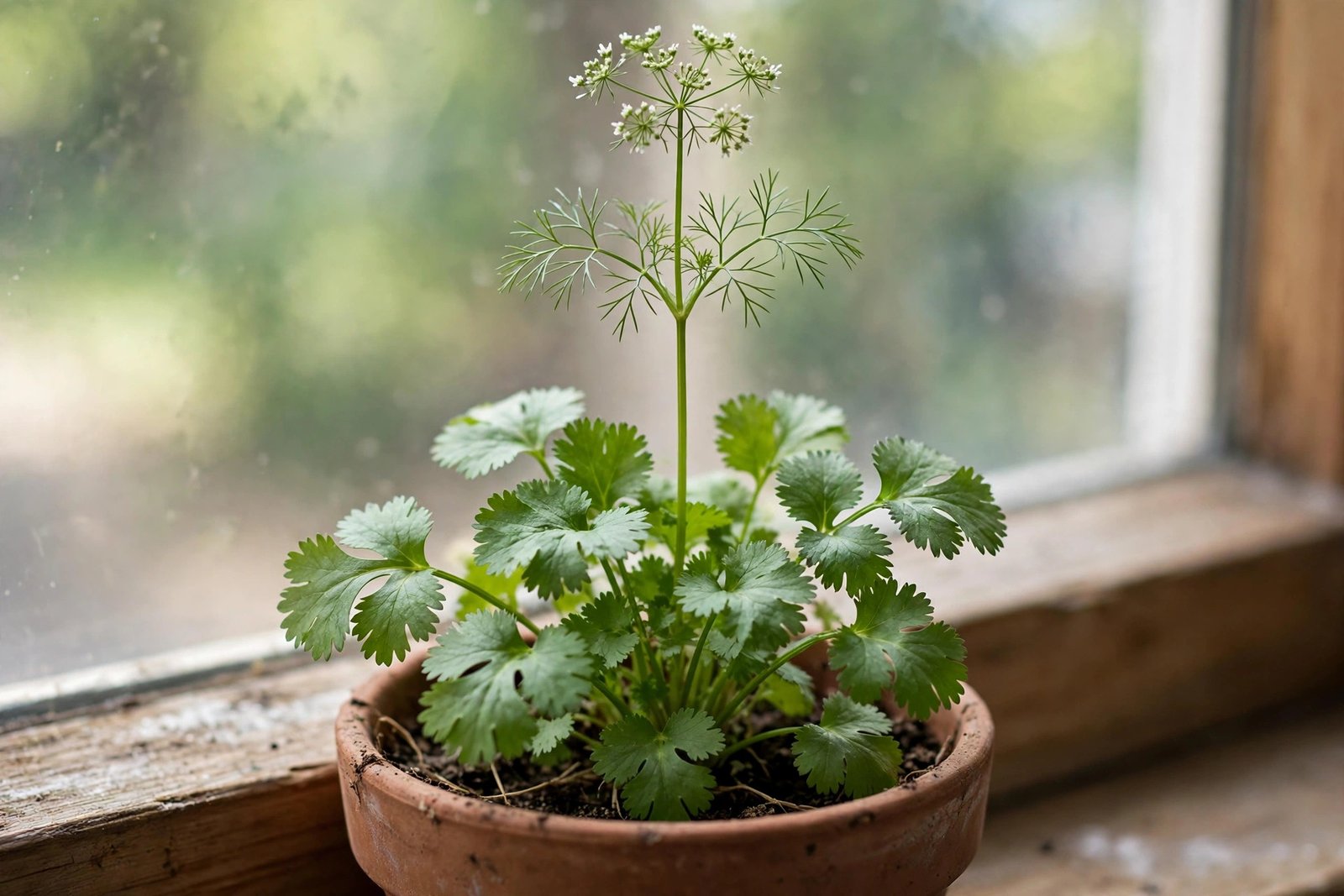
Bolting means the plant stops making the flat leaves you cook with and sends up a tall stem with lacy, fern-like leaves, then flowers and seed. Wisconsin Extension describes the change plainly: young plants make wide flat leaves, and a bolting plant makes lacy leaves along the flower stalk. Once the stalk is up, the leaves turn harsh and picking is over. The Royal Horticultural Society is just as blunt. Flowering happens sooner in hot, dry weather, and plants then stop producing leaves to concentrate on setting seed.
Three triggers run the clock, and they stack. Heat is the first. Day length is the second. Age is the third. Drought and root disturbance do not start the clock, but they speed it up. The table shows what each trigger does and what you actually control.
| Trigger | What it does | What you control |
|---|---|---|
| Heat | Warm soil and warm air push the plant to flower. Utah State Extension tells indoor growers to keep the soil below 75°F, especially near a heat source or a window that gets very warm. | The coolest bright room. Keep the pot off hot sills and away from radiators and heating vents. |
| Day length | Cilantro is a long-day plant, so lengthening days signal flowering. Wisconsin Extension warns that no slow-bolt variety holds well under high temperatures and long days. | An east window and afternoon shade. Under lamps, favor the shorter end of the herb schedule (see below). |
| Age | The plant is an annual with a short life. Wisconsin puts leaf harvest at 45 to 80 days from sowing, and the RHS notes the plant dies after setting seed. | Nothing. This is why the relay exists: a new pot every 2 to 3 weeks. |
| Drought | Dry soil in warm weather hastens flowering. The RHS names hot, dry weather as the combination that ends leaf production soonest. | Even moisture. Never let a pot swing between soaked and parched. |
| Root disturbance | The long taproot hates moving. Wisconsin says cilantro does not transplant well because of it. | Sow in the final pot. Never pot on. |
Light hours deserve one honest paragraph, because the advice conflicts. Penn State Extension’s general herb guidance runs lamps 14 to 16 hours a day. Two indoor cilantro guides argue for the bottom of that range, 12 to 14 hours, on the grounds that stretching the day is itself a flowering signal for a long-day plant. That shorter cap is grower advice, not extension fact, and this guide labels it as such. What extension sources do confirm is the sensitivity itself: Wisconsin’s warning about long days stands. If you grow under lights, start at 12 to 14 hours and watch the plant. If it stays leafy and compact, the schedule suits it.
The honest line: cool conditions delay bolting. Nothing cancels it. A slow-bolt variety, a cool room and steady water buy you weeks. They do not buy you forever.
Pick a Slow-Bolt Variety, Then Trust the Room More Than the Packet
Variety choice matters, but it matters less than the room. Wisconsin Extension’s cultivar notes end with a warning worth reading twice: some cultivars are less susceptible to early bolting, but none hold well under high temperatures and long days. Buy a slow-bolt variety and give it a cool room. Either one alone disappoints.
| Variety | What the sources say |
|---|---|
| Calypso | Slowest to bolt in the breeder’s own trials, consistently about three weeks slower than Santo (Tozer Seeds). Wisconsin agrees it is slower to flower than Santo. The RHS gives it an Award of Garden Merit for a long cropping period. First pick if you can find it. |
| Santo | The widely available standard. Wisconsin calls it a slow-bolting type grown for its leaves, and Johnny’s Selected Seeds lists it as the standard cilantro. Good and easy to find, but Calypso outlasts it. |
| Leisure | A uniform, slow-bolting variety (Wisconsin). Utah State names it one of the two best leaf picks, alongside Slow Bolting. |
| Cruiser | Slow to bolt with an upright habit, a good bunching variety (Wisconsin). RHS Award of Garden Merit, compact with large tasty leaves. Johnny’s calls it bolt-resistant. |
| Slo Bolt / Slow Bolt | Wisconsin: harvestable in about 45 days from sowing and slower to flower than many varieties. Utah State lists Slow Bolting among its excellent varieties. |
One contradiction in online advice is worth settling. Some web pages claim Santo bolts fast. The extension and seed-producer record says the opposite: Santo is a slow-bolting standard, and Calypso is slower still. If a page ranks Santo as fast to bolt, that page is guessing.
Sow Where It Will Live
Cilantro grows a taproot, one long main root that runs straight down, and it resents being moved. Wisconsin Extension says it does not transplant well because of that root, and the RHS agrees that the plant dislikes being moved. So the rule is simple: sow the seed in the pot the plant will live and die in. There is no cell tray stage and no potting on. Spinach follows the same rule for the same reason, and our guide to growing spinach indoors explains the shared logic if you grow both.
Pot depth is the one place indoor guides disagree loudly, so here is the spread instead of a single picked number.
| Source | Depth recommended |
|---|---|
| Indoor growing guide (Herbs at Home) | 8 inches for one plant, 12 inches for three plants in one pot. |
| Other indoor guides | 6 to 8 inches is the common recommendation. |
| Extension sources | Utah State says only that the container must be deep enough. Penn State says taproot herbs belong in deep pots. Neither names a number for cilantro. |
The working rule from that spread: at least 8 inches deep, and deeper if three plants share one pot. Depth matters more than width here, because the taproot wants somewhere to go. A wide shallow bowl is the wrong pot for this plant, however pretty it looks on the sill.
Sow 1/4 to 1/2 inch deep and cover the seed fully with mix. Both Utah State and Wisconsin give that depth, and the RHS says to cover with a little soil or compost. Space seed about 2 inches apart. Thinning advice splits: the RHS thins to 2 inches, Wisconsin to 3 to 6 inches. In a pot, 2 to 3 inches is the practical middle: room to pick, with enough leaf cover to shade the mix. Snip the extras at the base instead of pulling, so the roots of the keepers stay put.
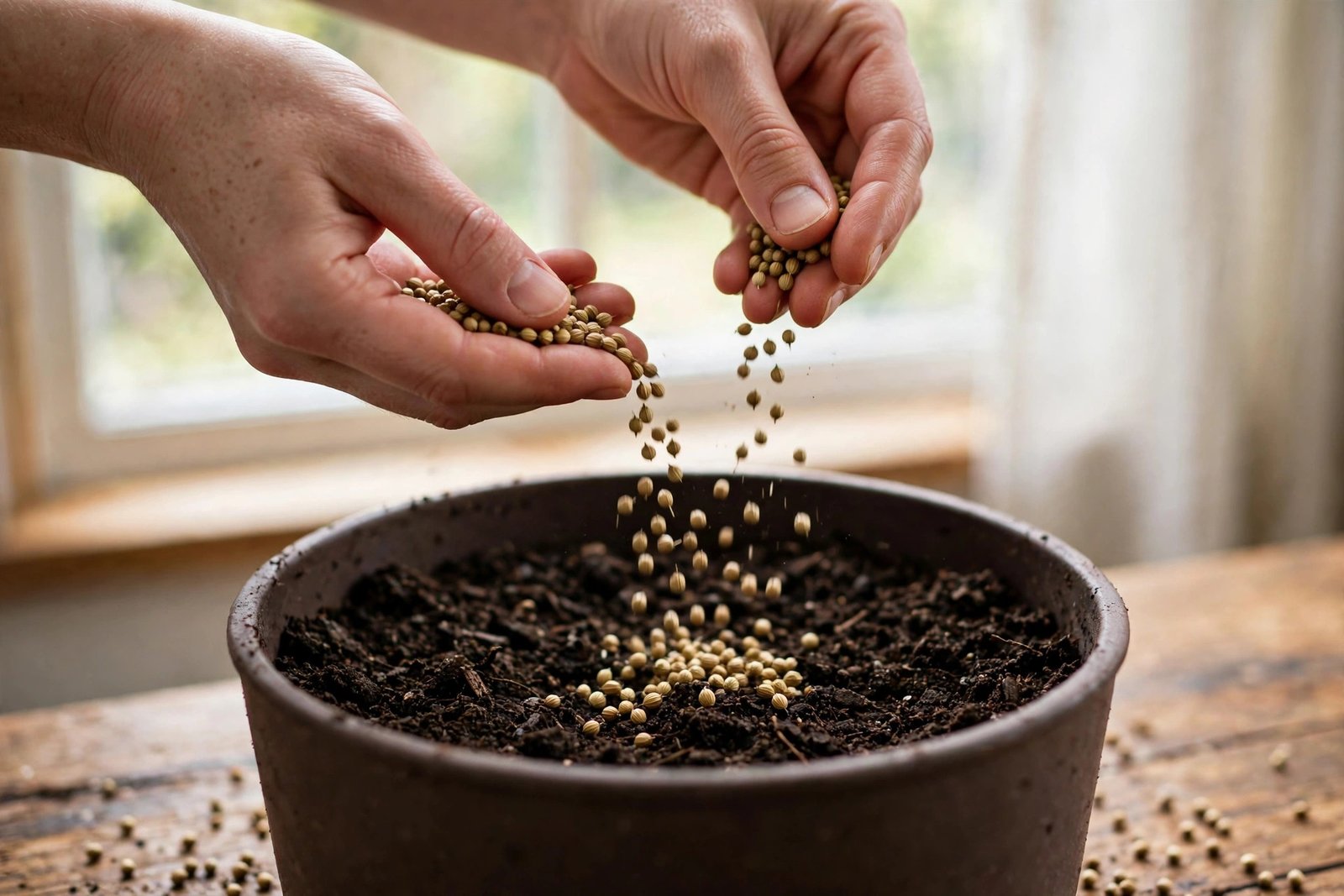
Germination is the slow part, and patience is the skill. The RHS puts indoor germination at two to three weeks, and Utah State says seeds germinate in about 21 days. One indoor guide reports sprouts in 7 to 10 days at 65 to 70°F from split seed, so treat the first week as early, not as the promise. Keep the mix moist and the pot at 65 to 70°F while you wait, and do not resow in panic at day 10. Cool soil is slow, not dead.
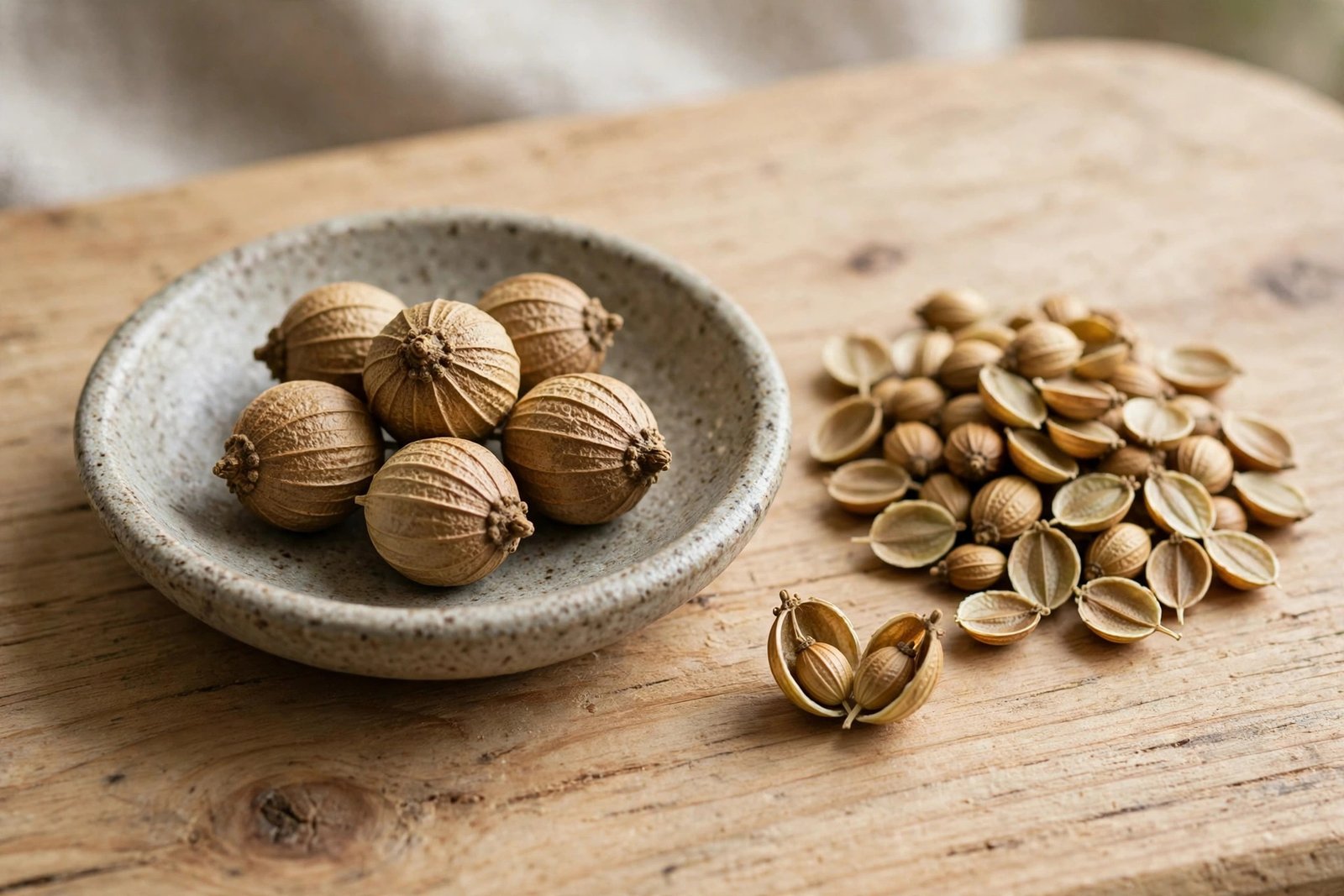
One seed fact changes how evenly the pot comes up. What you buy as cilantro seed is a round coriander husk, and one husk holds two seeds inside it. Sown whole, the pair sprout on different schedules and the stand comes up patchy. Split seed, the husk cracked into its two halves, sows and sprouts evenly. Buy seed sold as split, or crack whole seed gently yourself with a rolling pin. The full split-seed method, with the rolling-pin technique and the soak question settled, lives in our cilantro microgreens guide, because the same husk fact rules the tray crop too.
Cool and Bright, Not Warm and Sunny
Cilantro wants the coolest bright spot in the house, and that combination is the whole indoor game. Penn State Extension puts indoor herbs at 65 to 70°F in the day and 55 to 60°F at night, and files cilantro with the herbs that manage on 2 to 6 hours of direct sun. Treat 6 hours as the target and the lower end as headroom, not as the plan: Penn State warns that herbs starved of their preferred light grow thin and spindly, with smaller leaves and less aroma. The RHS adds the windowsill warning from the other side. Cilantro does not last long as a windowsill herb, going pale in low light and quitting fast if it gets too hot or dry.
Placement follows from the clock. An east window gives bright morning light without the cooking afternoon sun, and a bright spot with afternoon shade suits this plant better than a south sill that bakes all afternoon. Utah State Extension warns indoor growers to keep the soil below 75°F, especially near a heat source or a window that gets very warm. A pot on a sill above a radiator fails that test all winter. Our guide to how much sunlight indoor herbs need covers window directions and lamp setups in full, so this guide will not repeat them.
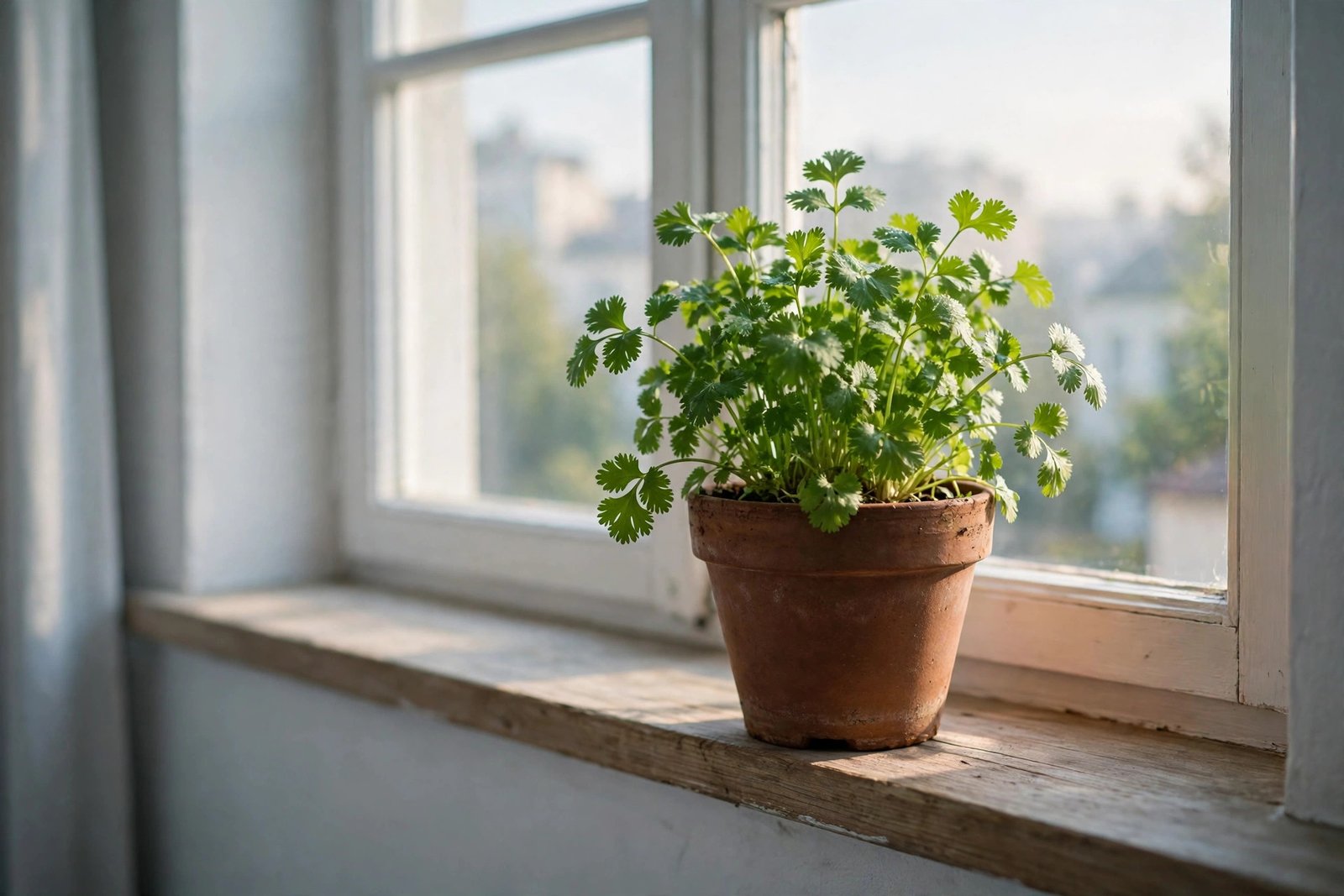
One shelf note: cilantro is the cool-season opposite of basil, which wants warmth and cannot survive below 50°F. Do not park the two pots in the same warm spot and expect both to thrive. If you are choosing which herbs earn sill space, our windowsill herb guide ranks the options, and the indoor herb garden hub sets out the whole shelf. Cilantro earns its place on cool sills. On a hot one, grow something else.
Water and Feed: Evenly Moist, Lightly Fed
Watering advice for cilantro looks contradictory until you separate garden soil from pot mix. Utah State, writing for gardens, says to water sparingly, because the plant does not do well in damp or humid conditions. Wisconsin, writing for the same plant, says to keep plants evenly moist all season. The RHS resolves it for containers: pots dry out far faster than ground soil, so check daily, keep the mix just moist, and never let it go soggy. In a pot, that is the rule. Water when the top inch of mix feels dry, water at the base, and empty the saucer so the pot never stands in water. Drought is a bolting trigger, so the dry end of the swing costs you leaves. Soggy is the other failure, so the wet end costs you roots.
Feeding is a light touch, and overdoing it costs flavor. Utah State warns that over-fertilization decreases flavor and that too much nitrogen makes the plant less flavorful. Penn State’s general herb rule is a low dose of water-soluble fertilizer every two weeks, and feeding more often can hurt aroma and taste. For a short sprint crop, one light feed after the true leaves are in is plenty. If leaves look pale, check the light before the bottle. Pale cilantro in a dim spot is usually a light problem, and extra feed on a light-starved plant makes soft weak growth.
Mix gets one line, because the recipe lives elsewhere: ordinary free-draining potting mix, never garden soil, with the detail in our guide to the best soil mix for vegetables in pots.
Harvest: Two Cuts, Then Spent
Start picking when the plants reach 4 to 6 inches tall. Utah State, Wisconsin and the RHS all land on about 6 inches as the picking height, with the RHS starting at 4 to 6 inches, so the signal is height, not a date on the calendar. Take the older outer stems at the base, a few from each plant, and leave the center alone. Wisconsin notes that removing the older outside leaves encourages the plant to make new ones, and the younger leaves carry the stronger flavor. The RHS version of the same routine is cut-and-come-again: take a few leaves, let the plant recover for a couple of weeks, then pick again.
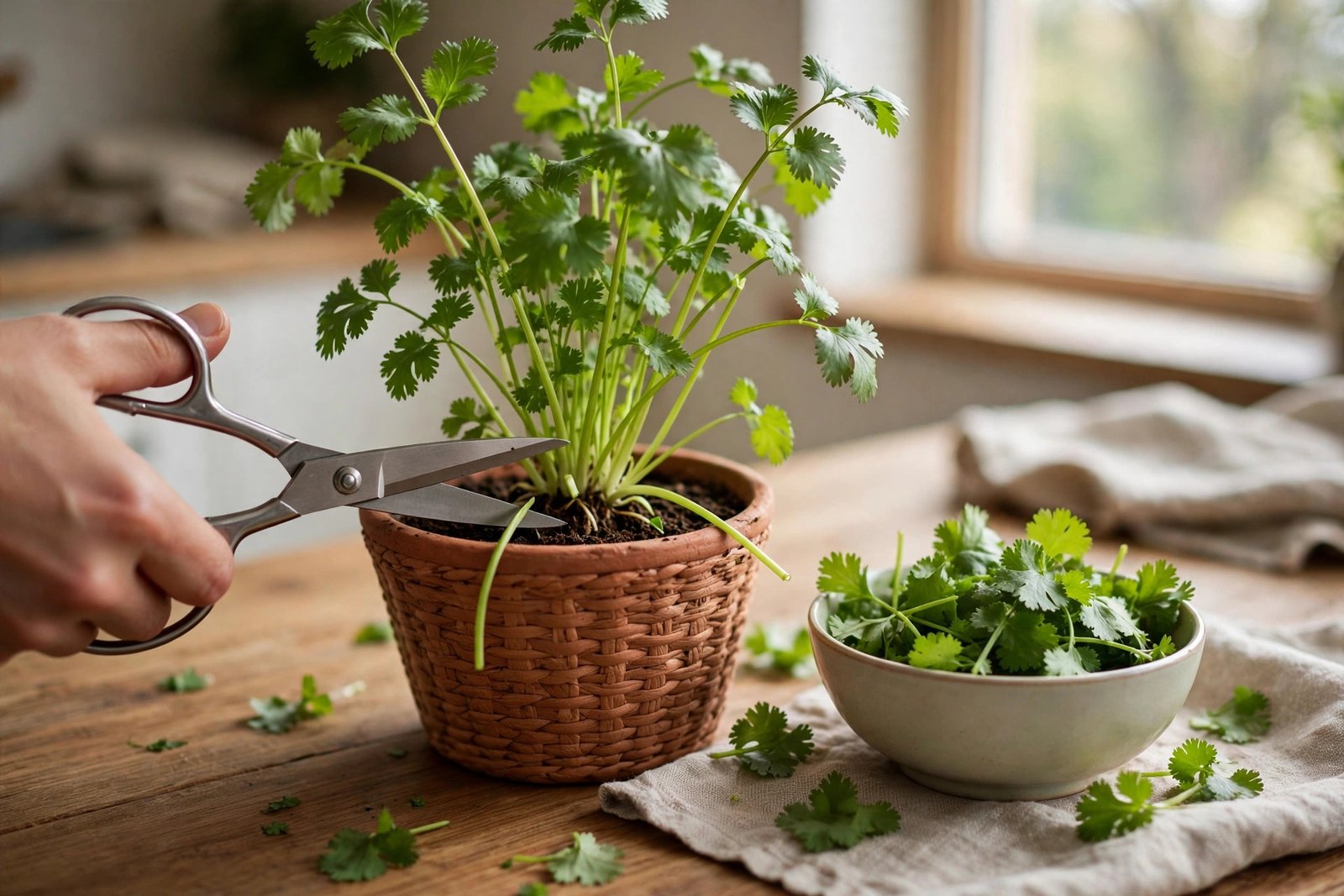
Expect a couple of good pickings per pot, then the plant is spent. That is the honest shape, and it is why this guide never promises a plant that picks forever. There is a second method for a second cutting: Wisconsin says a whole plant cut off about an inch above the ground can regrow for another cutting. It works, and the regrowth is real, but it is a bonus cut, not a new plant. Plan the relay, not the rescue.
When a flower stem appears, remove it the same day. The RHS says removing flower stems as soon as they start to develop is key to continued harvests, because the plant otherwise puts its energy into seed. Pinching the stem buys days, not weeks. Once the tall stem is up and the leaves have gone lacy and harsh, pick what is still mild that day and let the relay take over.
One flavor note that is not a growing failure: some people taste soap in cilantro leaves, and Wisconsin Extension notes that a genetic factor appears to be involved in whether a person likes or dislikes the flavor. If the leaves taste soapy to you and fine to everyone else, that is the explanation. No growing change fixes it.
The Relay: A New Pot Every 2 to 3 Weeks
The relay is the system that makes a short-lived plant feel like a constant supply. Wisconsin Extension’s instruction is direct: make successive sowings at 2 to 3 week intervals for an extended harvest. Run three pots in rotation and the gaps disappear.
| Pot | Sown | Job right now |
|---|---|---|
| Pot A | Week 0 | Being picked. |
| Pot B | Week 2 | Growing on, first pick coming. |
| Pot C | Week 4 | Just sown, germinating. |
When Pot A bolts, pull it and sow its replacement the same day. The rotation never stops, and no single bolt ever leaves you without leaves. A packet holds plenty of seed for repeated sowings, so the habit costs almost nothing.
Two relay habits save the most disappointment. First, sow the replacement before the picking pot bolts, not after, because germination alone takes one to three weeks. A gap sown after the bolt is a gap of a month. Second, keep the young pots in the same cool bright conditions as the picking pot. A replacement raised in a warm dim corner bolts before it ever picks.
Let the Last Pot Bolt: The Coriander Fork
Cilantro and coriander are the same plant, Coriandrum sativum. The fresh leaves are sold as cilantro. The dried seeds are the spice coriander. Wisconsin Extension states the naming split plainly, and it turns a bolted pot from a failure into a second harvest, if you choose it on purpose.
The fork is a choice, not an accident. Pull a bolted pot and lean on the relay when you want leaves. Or let the last pot of a run finish the job: leave it to flower, let the seed heads form, and harvest coriander. Do not let every pot bolt for seed, or the leaf supply stops. One pot for seed, the rest for leaves, is the balance.
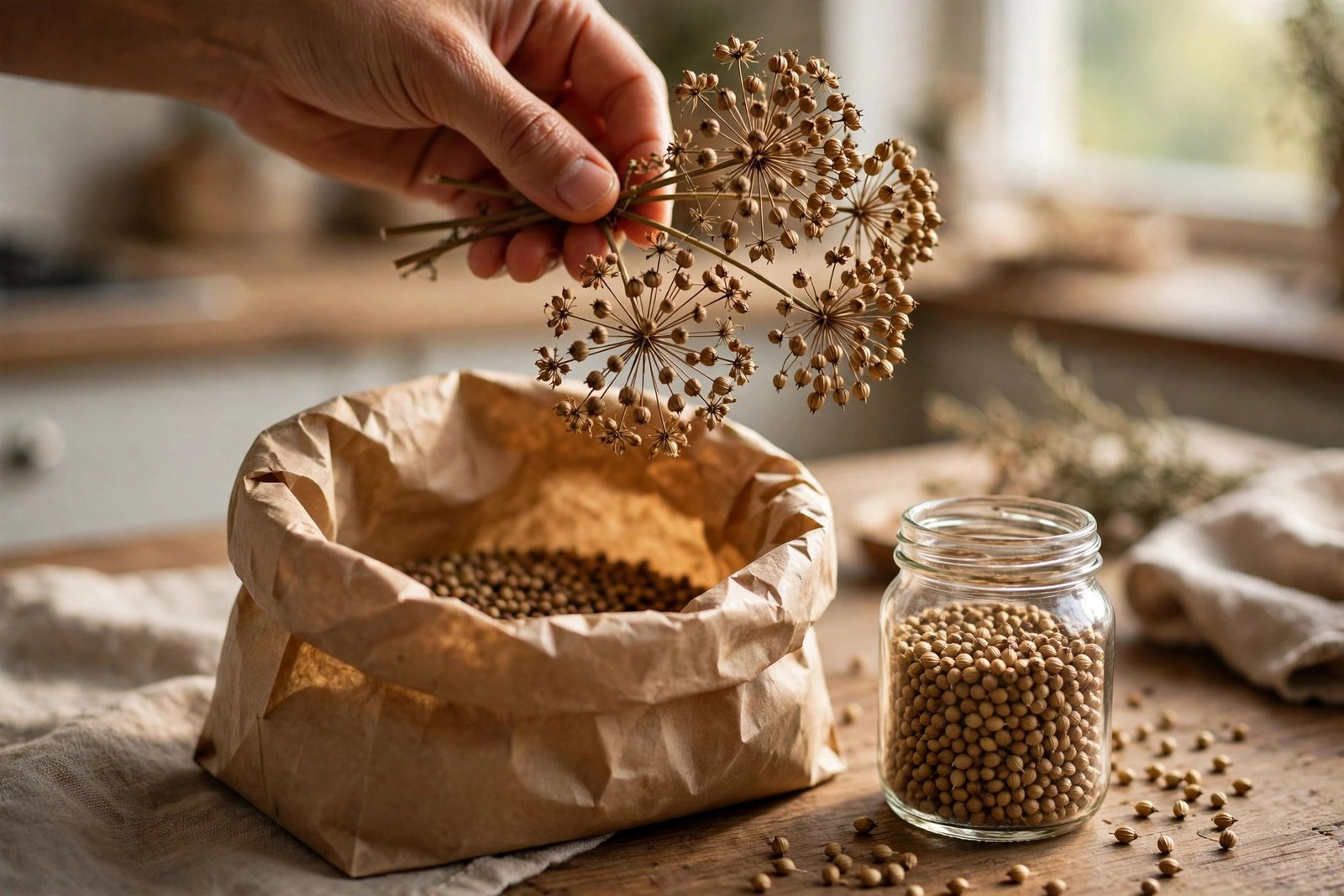
Harvest the seed when it turns light brown and the whole plant has dried, usually 2 to 3 weeks after flowering, per Wisconsin. Cut the stems before much seed shatters, and hang them in a warm airy place over a cloth or inside a paper bag to catch what falls. The RHS version is simpler and agrees: cut whole stems into a paper bag, then lay the seed on paper in a warm room for a week or so until fully dry. Dry seed stores for months in an airtight container in a cool dark place. Save some in a labeled envelope for the next sowing, and grind the rest for cooking.
What Goes Wrong
| Problem | Likely cause | Fix |
|---|---|---|
| Bolted in two weeks | Heat, long days, or an old plant. A warm room speeds the clock hard. | Irreversible. Pick what is mild today, pull the pot, and sow the replacement in a cooler spot. |
| Leggy and pale | Light too weak or too far away. The RHS warns cilantro goes pale in low light, and Penn State links weak light to thin spindly growth. | Move to the brightest cool spot or under a lamp 6 to 12 inches above the leaves. Sow the next pot where the light is better. |
| Seed never sprouted | Sown too deep, dry mix, or a cold pot. Or impatience: germination takes one to three weeks. | Check depth (1/4 to 1/2 inch), keep the mix moist, hold 65 to 70°F, and wait the full three weeks before resowing. |
| Bitter leaves before any stalk | Early bolting warning. Wisconsin notes leaves can develop a disagreeable flavor as bolting approaches. | Pick the same day, move the pot somewhere cooler, and water back to even moisture. |
The short version: sow a slow-bolt variety in a deep final pot in your coolest bright spot, keep the mix evenly moist, pick the outer stems young, and sow the next pot every 2 to 3 weeks. When the last pot bolts, let it finish and harvest coriander. The clock always wins in the end. The relay means you never notice.
Growing Cilantro Indoors FAQs
Is this the same as cilantro microgreens?
No, and the difference matters. Cilantro microgreens are a tray crop, cut young at the seed leaf or first true leaf stage. A potted cilantro plant is a full-size herb picked over weeks, with its own habit of bolting. If you want leaves from a plant over weeks, you want the potted herb. If you want a tray of young greens, you want the microgreens guide.
Why did my cilantro bolt in two weeks?
Heat is the usual reason, with long days and plant age behind it. Cilantro is a cool-season annual, and Utah State Extension tells indoor growers to keep the soil below 75°F. A pot in a warm room, on a hot sill, or above a radiator bolts fast. Once the tall stalk rises, the change cannot be reversed. Pick what is still mild the same day, pull the pot, and sow the replacement somewhere cooler.
Will cilantro grow back after cutting?
Partly, and only for a short while. Picking the outer stems at the base encourages new leaves, and Wisconsin Extension says a whole plant cut about an inch above the ground can regrow for a second cutting. But no pot picks forever. Cilantro is an annual with a short life, and the reliable system is the relay: a new pot every 2 to 3 weeks, so a replacement is always growing.
Can I transplant a store-bought cilantro plant?
You can try, but expect a short run. Cilantro grows a long taproot and does not transplant well, and the RHS notes that supermarket pots are usually overcrowded plants that soon start flowering. If you try it, divide the pot gently, disturb the roots as little as possible, and move the plant into a deep final pot at once. Sowing seed directly in the final pot is the more reliable route.
Sources and Further Reading
- Penn State Extension, Growing Herbs Indoors (read directly for this guide): cilantro sits in the group of herbs that manage on 2 to 6 hours of direct sun; rooms at 65 to 70°F by day and 55 to 60°F at night; lamps 6 to 12 inches above the plants for 14 to 16 hours; a low dose of water-soluble fertilizer every 2 weeks; taproot herbs belong in deep pots; basil cannot survive below 50°F.
- Utah State University Extension, Cilantro/Coriander in the Garden (read directly for this guide): keep soil below 75°F indoors, especially near a heat source or a warm window; sow 1/4 to 1/2 inch deep; seeds germinate in about 21 days; harvest leaves at about 6 inches; water sparingly in garden soil, as the plant does not do well in damp or humid conditions; fertilize 1 to 2 times per season, since over-fertilization decreases flavor; Leisure and Slow Bolting are the leaf picks; plant early, mulch, keep well watered, and grow plants close together to delay bolting.
- University of Wisconsin-Madison Extension, Cilantro/Coriander (read directly for this guide): a cool-season crop that bolts in hot weather; leaves harvested in 45 to 80 days, a seed crop needs at least 100 days; Calypso is slower to flower than Santo, and Santo, Leisure, Cruiser, Marino and Slo Bolt are all slow-bolting types, but none hold well under high temperatures and long days; does not transplant well because of its long taproot; thin to 3 to 6 inches; successive sowings at 2 to 3 week intervals; keep evenly moist; pick after 6 inches tall, before bolting, since leaves may develop a disagreeable flavor at that stage; a whole plant cut an inch above the ground can regrow for a second cutting; harvest seed when light brown, 2 to 3 weeks after flowering, and dry thoroughly; a genetic factor appears to be involved in whether a person likes or dislikes the flavor.
- Royal Horticultural Society, How to Grow Coriander (read directly for this guide): harvests in as little as 10 weeks from sowing; treat the leaf crop as a short-term salad crop with small repeated sowings; flowering happens sooner in hot, dry weather; remove flower stems as soon as they appear to prolong leaf harvests; Calypso, Cruiser and Confetti hold the Award of Garden Merit; the plant dislikes being moved and goes leggy and pale indoors in low light, heat, or drought; indoor germination takes two to three weeks and outdoor germination one to three weeks; thin to 2 inches; containers need daily checks, kept just moist, never soggy; cut-and-come-again picking from 4 to 6 inches tall, with a couple of weeks to recover between pickings; dry seed on paper in a warm room for a week or so and store airtight; supermarket pots are overcrowded and soon flower.
- Tozer Seeds, Calypso variety sheet (breeder trial data, labeled as such in the article): Calypso was consistently about 3 weeks slower to bolt than Santo in the breeder’s trials, and at least 3 to 4 weeks slower than other slow-bolting varieties.
- Johnny’s Selected Seeds variety listings (seed-producer listings, read via search results): Calypso listed as slowest to bolt, Cruiser as slow-bolting and bolt-resistant, Santo as the standard cilantro.
- Grower-guide advice, labeled as grower advice in the article rather than extension fact: the 12 to 14 hour lamp cap and the 8 inch single-plant / 12 inch three-plant pot depths (Herbs at Home, How to Grow Cilantro Indoors); sprouts in 7 to 10 days at 65 to 70°F from split seed (same guide); 6 to 8 inch pot depths as the common recommendation across indoor guides.


One Comment